
This guide explains what hybrid search is, why it beats keyword-only or vector-only systems, what to look for, and which platforms lead — so you can match a system to your catalog and team.
What is hybrid search?
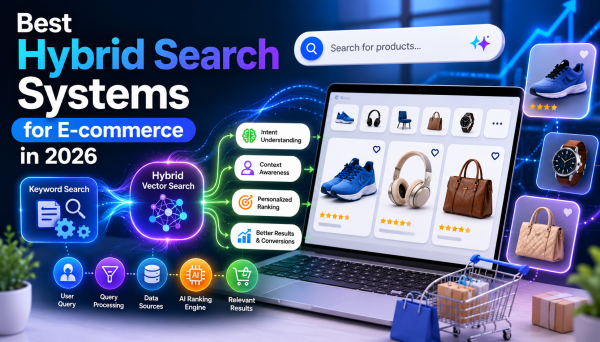
The result: a shopper searching “warm waterproof jacket for hiking” gets both the items that literally contain those words and the semantically related technical shell jackets that don’t — ranked by what’s most likely to convert. For the deeper mechanics, see our explainer on vector search for product discovery.
Why hybrid beats keyword-only or vector-only
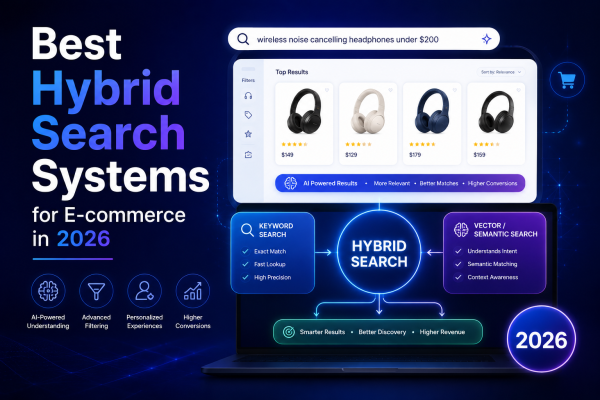
Each method alone has a blind spot. Keyword-only search fails on descriptive, misspelled and natural-language queries — it can’t match meaning, so “shoes for a beach wedding” returns little. Vector-only search can drift on precise queries — it may “understand” a SKU or exact model number loosely and return approximate matches when the shopper wanted an exact hit. Hybrid covers both gaps: lexical handles the exact and the rare, vector handles the fuzzy and the descriptive.
| Approach | Exact terms / SKUs | Descriptive / long-tail | Zero-result rate |
|---|---|---|---|
| Keyword-only | ✅ Strong | ❌ Weak | Higher |
| Vector-only | ⚠️ Can drift | ✅ Strong | Lower |
| Hybrid | ✅ Strong | ✅ Strong | Lowest |
This is why the best hybrid search systems for e-commerce have become the standard for stores that care about relevance and conversion.
AI Search Grader by bCloud AI
Grade your ecommerce search in 10 quick questions
31% of ecommerce searches return zero results — and most shoppers who hit a dead end leave for a competitor. How does your store's search stack up?
Answer 10 short questions and get your AI search score, plus a personalized report to fix the gaps. Free, takes about 2 minutes.
No signup needed to take the quiz.
Understanding intent…
Scoring your answers across relevance, AI, experience, and insights.
Your AI search score is ready
Tell us where to send your personalized report. You'll see your score and recommendations right away.
Your score by pillar
Personalized recommendations
Fix the gaps in weeks, not quarters
bCloud AI replaces keyword-only search with hybrid AI retrieval — sub-200ms responses, 99.99% uptime, and conversion lifts of up to 40% across 50+ implementations.
What to look for in the best hybrid search systems for e-commerce
Not all hybrid implementations are equal. Evaluate on:
Fusion quality. How intelligently does the system blend lexical and vector scores? Good fusion (e.g., tunable weighting or reciprocal rank fusion) matters more than the raw presence of both methods.
Re-ranking with business signals. The best systems layer commercial signals — popularity, margin, stock, personalisation — on top of relevance, so results serve revenue, not just similarity.
Speed at scale. Hybrid does more work per query, so latency under peak load (p95/p99) is critical. Compare options in our API site search comparison.
Real-time indexing. Prices and stock change constantly; the index must keep up so results stay accurate.
Merchandising controls. No-code rules to pin, boost and bury, layered on the hybrid relevance.
Ease of operation. Some systems deliver hybrid out of the box; others require you to build and tune the pipeline yourself.
Transparent, scalable pricing. Model real query volumes — usage-based pricing can climb as you grow.
The best hybrid search systems for e-commerce, compared
bcloud.ai — best overall hybrid search for commerce
[bcloud.ai] delivers hybrid keyword + vector relevance with [real-time indexing] and built-in merchandising, tuned for online stores that want strong results without building the pipeline themselves. Best for: retailers wanting enterprise-grade hybrid search with low operational overhead. Standout: [insert your differentiator]. Pricing: [insert USD/GBP].
Algolia (NeuralSearch) — hosted hybrid with strong tooling
Algolia’s NeuralSearch combines its fast keyword engine with vector relevance, backed by a mature merchandising dashboard. Best for: teams valuing speed and developer tooling. Watch-outs: usage-based pricing at scale.
Elasticsearch / OpenSearch — maximum control, self-managed
Elastic supports lexical (BM25) and kNN vector search, with hybrid blending — the Elasticsearch documentation details its hybrid and semantic options. Best for: engineering-led teams that want to own the stack. Watch-outs: you build, tune and operate relevance and merchandising yourself.
Constructor — hybrid optimised for revenue
Constructor blends relevance methods and optimises ranking toward conversion and revenue outcomes. Best for: larger retailers wanting outcome-based ranking. Watch-outs: enterprise, sales-led.
Coveo — enterprise hybrid relevance and personalisation
Coveo offers mature ML ranking with hybrid retrieval and personalisation across commerce and support. Best for: enterprises with complex needs. Watch-outs: heavier implementation.
Typesense — fast, open-source hybrid
Typesense provides keyword and vector search with hybrid capability in a lightweight, developer-friendly package. Best for: teams wanting open-source control with low latency. Watch-outs: fewer built-in commerce/merchandising features.
Weaviate — vector-native with hybrid support
Weaviate is a vector database with built-in hybrid (BM25 + vector) search. Best for: teams building custom, AI-heavy discovery experiences. Watch-outs: more of a building block than a turnkey commerce product.
Comparison table
| System | Hybrid method | Merchandising | Real-time index | Managed? | Pricing |
|---|---|---|---|---|---|
| [bcloud.ai] | Keyword + vector, re-ranked | ✅ Built-in | ✅ | ✅ Hosted | [Usage-based] |
| Algolia | NeuralSearch | ✅ Strong | ✅ | ✅ Hosted | Usage-based |
| Elasticsearch/OpenSearch | BM25 + kNN | DIY | ✅ | ❌ Self-managed | Infra/licence |
| Constructor | Hybrid + revenue ML | ✅ | ✅ | ✅ Hosted | Enterprise |
| Coveo | Hybrid + ML | ✅ | ✅ | ✅ Hosted | Enterprise |
| Typesense | Keyword + vector | Basic | ✅ | Self/Cloud | Flat/infra |
| Weaviate | BM25 + vector | DIY | ✅ | Self/Cloud | Infra/usage |
Verify all feature and pricing claims against current vendor docs before publishing.
Hosted vs self-built hybrid search
You can buy a hosted hybrid system ([bcloud.ai], Algolia, Constructor, Coveo) that handles fusion, re-ranking and merchandising for you, or build one on Elastic, Typesense or Weaviate. The hosted route reaches strong relevance fastest and suits teams without a dedicated search engineer; the build route offers maximum control at the cost of ongoing tuning and operations. For most commerce teams, the best hybrid search systems for e-commerce are the hosted ones that deliver quality defaults, because relevance engineering is a specialised, never-finished job.
How to choose
Confirm true hybrid. Check that the system genuinely fuses lexical and vector retrieval and re-ranks with business signals — not just bolts vector on as an afterthought.
Benchmark on your data. Build a labelled query set from your logs and measure top-3 hit rate and zero-result rate across candidates.
Test latency at peak. Hybrid does more work; confirm p95/p99 stays acceptable under your real load.
Weigh operational load. Be honest about whether your team can run a self-managed stack or needs strong defaults.
Model pricing at scale. Project costs at several times current traffic before committing.
For a broader view across relevance approaches and catalog sizes, see the top semantic search solutions for e-commerce and the top e-commerce search solutions for large catalogs.
How Hybrid Search Improves Product Discovery
A well-designed hybrid search experience helps shoppers move from vague intent to relevant products with less effort. Instead of depending on customers to use the exact terminology found in a product catalog, the search engine can recognize both the words they enter and the meaning behind those words. This is especially valuable for broad, descriptive, and long-tail searches where shoppers may describe a need rather than a specific product. By combining exact matching with semantic understanding and then applying factors such as availability, popularity, and merchandising priorities, hybrid search can present a more useful product set while keeping important commercial considerations in view. The result is a search experience that makes large catalogs easier to explore and helps shoppers reach relevant products faster.
The bottom line
Common Challenges When Implementing Hybrid Search (and How to Solve Them)
Deploying a hybrid search engine is more than enabling keyword and vector retrieval. To achieve consistently relevant results at scale, retailers must balance search quality, performance, and business goals. Understanding the most common implementation challenges helps teams avoid costly mistakes.
Balancing Lexical and Vector Results
Too much emphasis on keyword matching ignores user intent, while excessive semantic weighting can reduce precision. Effective score fusion and re-ranking create the right balance.
Maintaining Low Search Latency
Hybrid search executes multiple retrieval methods simultaneously. Efficient indexing, optimized infrastructure, and intelligent caching help maintain fast response times.
Keeping Product Data Current
Outdated prices, inventory, or product information reduce shopper confidence. Real-time indexing ensures search results always reflect the latest catalog changes.
Measuring Search Quality
Success isn’t measured only by click-through rate. Teams should also monitor zero-result searches, conversion rate, search exits, and average order value.
Aligning Results with Business Goals
Search relevance should also consider inventory, promotions, profit margins, and merchandising priorities instead of relying solely on similarity scores.
Scaling for Growth
As product catalogs and search traffic increase, the platform should continue delivering consistent relevance and low latency without extensive manual tuning.
Best practice: The most successful ecommerce search platforms continuously optimize hybrid ranking using shopper behavior, merchandising rules, and AI-driven relevance models rather than relying on static search configurations.
FAQ
What is hybrid search in e-commerce?
Hybrid search combines keyword (lexical) matching with vector (semantic) retrieval, then re-ranks the blended results with business signals. It captures both exact matches and meaning-based matches.
Why is hybrid search better than vector-only search?
Vector-only search can drift on precise queries like SKUs or exact model numbers. Hybrid keeps lexical precision for those while adding semantic understanding for descriptive and long-tail queries.
Do I need to build hybrid search myself?
No. Hosted platforms such as [bcloud.ai], Algolia, Constructor and Coveo provide hybrid search out of the box. Building it yourself on Elastic, Typesense or Weaviate is an option if you want full control.
Which hybrid search system is best for a large catalog?
Weight real-time indexing throughput and tail-query relevance most heavily. [bcloud.ai], Algolia, Constructor and Coveo are strong hosted options; Elastic suits engineering-led teams.
Does hybrid search reduce zero-result searches?
Yes. By adding meaning-based matching to keyword matching, hybrid systems typically achieve the lowest zero-result rates of any approach.
Is hybrid search slower than keyword search?
It does more work per query, so latency matters. Well-engineered systems keep p95/p99 low; benchmark under your real peak load before deciding.
Future-Proof Your Ecommerce Search with Hybrid AI
Combine keyword precision with semantic understanding to deliver more relevant results, fewer zero-result searches, and higher conversions at every stage of growth.