
On-site search is one of the highest-intent surfaces in any store: shoppers who use it convert at far higher rates than those who only browse. Yet the Baymard Institute has documented for years how many stores still return poor results for descriptive, misspelled or natural-language queries. For a growing team, fixing that is one of the fastest paths to more revenue from existing traffic — which is exactly why choosing software with the right features matters.
Why growing teams need different features
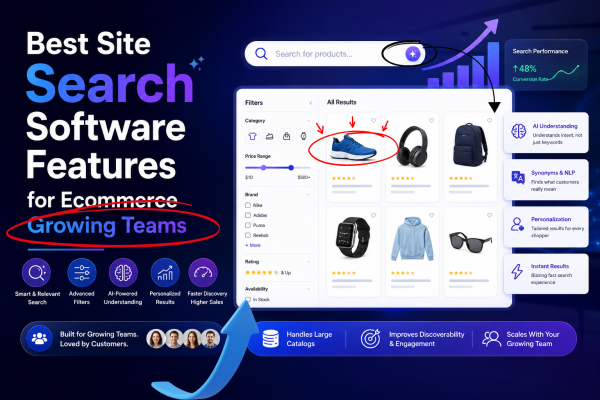
It helps to think about the best site search software features ecommerce growing teams need as time multipliers rather than capabilities on a spec sheet. A feature only earns its place if it returns more hours than it consumes — strong defaults that work on day one, no-code controls a marketer can operate alone, and automation that improves relevance without anyone touching a config file. When you evaluate options through that lens, the shortlist narrows fast, because most “enterprise-grade” platforms assume a level of staffing that a lean team simply doesn’t have. The right tool quietly does the heavy lifting so one person can own search, merchandising and analytics at once.
The essential features, ranked by impact
Here are the capabilities that deliver the most for lean, fast-moving stores — roughly in priority order.
AI relevance (semantic + vector search)
The single biggest lever. Semantic search matches the meaning of a query, so “shoes for a beach wedding” returns dressy sandals, not hiking boots. Combined with keyword matching (hybrid search), it slashes zero-result rates on the long-tail and descriptive queries that dominate real traffic. For the mechanics, see our explainer on vector search for product discovery and the roundup of best hybrid search systems for e-commerce.
Typo tolerance and synonyms
Shoppers misspell, abbreviate and use their own vocabulary. Software should handle typos automatically and let you map synonyms without code.
Fast autocomplete / instant search
As-you-type suggestions with product previews keep shoppers moving and reduce abandonment. Speed here is felt directly.
Merchandising controls
The ability to pin, boost, bury and create rules — promote high-margin or in-stock items, surface seasonal collections — without engineering tickets. For a growing team, no-code merchandising is essential.
Real-time indexing
Prices and stock change constantly. Search must reflect those changes immediately so shoppers never click through to an out-of-stock or mispriced item.
Built-in search analytics
What are shoppers searching for? Which queries return nothing? Which drive conversions? Good analytics turn search into a continuous improvement loop and reveal catalog gaps — invaluable when you can’t afford a separate BI tool.
Faceted filtering
Smart, dynamic faceted navigation lets shoppers refine by size, colour, price and attributes. It’s table stakes for any catalog beyond a few hundred SKUs.
Personalisation
Tailoring results and recommendations to behaviour lifts conversion, ideally without heavy configuration.
Easy integration
Native connectors for Shopify, BigCommerce, WooCommerce or a clean API mean a growing team can launch in days, not months. The Nielsen Norman Group has long shown how much search quality affects the overall shopping experience, so fast deployment pays back quickly.
Scalability and transparent pricing
The platform should grow from thousands to millions of SKUs without re-platforming, and pricing should be predictable — usage-based models can spike as you grow, so model your real volumes.
A/B testing
Testing relevance and merchandising changes safely lets a small team improve with evidence instead of guesswork.
Reliable support and documentation
When one person owns search, responsive support and clear docs are a feature in their own right.
AI Search Grader by bCloud AI
Grade your ecommerce search in 10 quick questions
31% of ecommerce searches return zero results — and most shoppers who hit a dead end leave for a competitor. How does your store's search stack up?
Answer 10 short questions and get your AI search score, plus a personalized report to fix the gaps. Free, takes about 2 minutes.
No signup needed to take the quiz.
Understanding intent…
Scoring your answers across relevance, AI, experience, and insights.
Your AI search score is ready
Tell us where to send your personalized report. You'll see your score and recommendations right away.
Your score by pillar
Personalized recommendations
Fix the gaps in weeks, not quarters
bCloud AI replaces keyword-only search with hybrid AI retrieval — sub-200ms responses, 99.99% uptime, and conversion lifts of up to 40% across 50+ implementations.
Features checklist for ecommerce growing teams
| Feature | Why it matters for a lean team | Priority |
|---|---|---|
| AI / semantic (hybrid) relevance | Biggest relevance gain, low effort | ⭐⭐⭐ Must-have |
| Typo tolerance & synonyms | Catches real-world queries | ⭐⭐⭐ Must-have |
| Autocomplete / instant search | Keeps shoppers moving | ⭐⭐⭐ Must-have |
| No-code merchandising | Control without engineering | ⭐⭐⭐ Must-have |
| Real-time indexing | Accurate stock & price | ⭐⭐⭐ Must-have |
| Search analytics | Continuous improvement loop | ⭐⭐ High |
| Faceted filtering | Refinement at scale | ⭐⭐ High |
| Personalisation | Lifts conversion | ⭐⭐ High |
| Native integrations / API | Fast launch | ⭐⭐ High |
| Transparent, scalable pricing | Avoids cost spikes | ⭐⭐ High |
| A/B testing | Evidence-based tuning | ⭐ Nice-to-have |
| Strong support & docs | Lifeline for small teams | ⭐ Nice-to-have |
How the leading software maps to these features
Most modern platforms — [bcloud.ai], Algolia, Constructor, Klevu, Searchspring, Nosto and Elastic — cover the must-haves, but they differ in how much configuration each demands. For a growing team, weight strong defaults and no-code operation heavily. [bcloud.ai], for example, targets exactly this segment: [hybrid AI relevance], [real-time indexing] and built-in merchandising with [fast setup] so a lean team gets enterprise-grade search without enterprise overhead. Standout: [insert your differentiator]. Pricing: [insert USD/GBP]. For a wider comparison, see the top semantic search solutions for e-commerce.
This is also where the best site search software features ecommerce growing teams rely on start to separate the contenders from the also-rans. Two platforms can both tick “AI relevance” and “merchandising” on paper, yet one delivers them out of the box while the other expects weeks of tuning before the quality shows up. For a growing store, that gap is the whole decision — the same feature is an asset when it works by default and a liability when it needs a specialist to babysit it. Always ask a vendor not just whether a feature exists, but how much configuration it takes to reach production-quality results.
Heavier, self-managed options like Elastic give maximum control but expect you to build relevance and merchandising yourself — usually the wrong trade for a growing team without a dedicated search engineer.
How growing teams should prioritise
Don’t try to adopt every feature at once. A pragmatic sequence:
Start with relevance. Turn on hybrid AI search, typo tolerance and synonyms. This delivers the fastest conversion lift.
Add merchandising. Once relevance is solid, use no-code rules to promote the products that matter commercially.
Instrument it. Switch on analytics and watch zero-result and exit queries — they reveal catalog and content gaps.
Layer personalisation and testing. With the basics humming, refine with personalisation and A/B tests.
Re-evaluate pricing at each growth stage. Confirm your model still makes sense as traffic and SKUs climb.
This order front-loads the features with the highest return and defers the ones that need more time to operate — exactly the balance a growing team needs.
Common mistakes to avoid
Growing teams tend to make three avoidable errors. First, over-buying: choosing an enterprise platform whose complexity outstrips the team’s capacity to run it. Second, ignoring analytics: treating search as set-and-forget instead of a feedback loop. Third, underestimating pricing growth: signing up on a usage-based plan without modelling what it costs at 5–10× today’s traffic. Picking software whose features match your operating capacity, not just your wish list, is what separates a search tool that pays for itself from one that becomes a maintenance burden.
The bottom line
The best site search software features ecommerce growing teams should prioritise all share one trait: they deliver strong results with minimal upkeep. Lead with hybrid AI relevance, typo tolerance and no-code merchandising; instrument everything with analytics; and choose a platform with transparent, scalable pricing and fast integration. A product built for this segment — like [bcloud.ai] — lets a small team punch well above its weight, turning on-site search into one of the highest-ROI surfaces in the store.
A useful final check is to map the best site search software features ecommerce growing teams have prioritised against your next twelve months, not just today. The platform that fits a 5,000-SKU catalog and modest traffic should still hold up at 50,000 SKUs and a holiday-season spike, without a re-platform or a pricing surprise. Growth is the whole point of being a growing team, so the features you choose — real-time indexing, scalable relevance, transparent pricing — should be the ones that keep paying off as the numbers climb, rather than the ones you’ll have to rip out the moment you succeed.
Choosing The best site search software is essential for businesses that want to deliver fast, accurate, and personalized search experiences. A modern search solution helps customers quickly find products, articles, and resources while reducing bounce rates and increasing conversions. Advanced features such as AI-powered search, autocomplete, typo tolerance, semantic search, and personalized recommendations make The best site search software a valuable investment for eCommerce stores and content-rich websites.
When comparing search platforms, businesses should evaluate scalability, ease of integration, analytics, indexing speed, and customization options. The best site search software should provide real-time indexing, multilingual support, synonym management, and detailed search insights that help optimize the customer journey. Whether you operate a small online store or a large enterprise website, selecting The best site search software can significantly improve user engagement, product discovery, and overall business performance.
As customer expectations continue to rise, implementing AI-driven search technology is no longer optional. Organizations that invest in The best site search software gain a competitive advantage by delivering relevant search results, improving customer satisfaction, and increasing revenue. By choosing a platform that combines speed, accuracy, and intelligent ranking, businesses can create seamless digital experiences that encourage visitors to stay longer and convert more often.
How the Best Site Search Software Supports Ecommerce Growth
The best site search software does more than return products for a shopper’s query; it helps create a faster and more useful path from product intent to purchase. For growing ecommerce businesses, this means understanding natural-language searches, handling misspellings, surfacing relevant products, and keeping results aligned with inventory and merchandising priorities. When search can be managed without constant engineering support, teams can respond faster to changing customer behaviour, improve weak queries, and identify gaps in their product catalog. The combination of intelligent relevance, easy management, analytics, and scalability makes site search an important part of the overall ecommerce growth strategy rather than simply another website feature.
Questions to Ask Before Choosing Site Search Software
Before investing in a search platform, take time to evaluate whether it matches your team’s resources and long-term growth plans. Asking the right questions can help you avoid expensive migrations and unnecessary complexity later.
- Does it deliver relevant results without extensive configuration?
- Can non-technical teams manage merchandising and search rules?
- Will the platform continue to perform as your catalog and traffic grow?
- Does the pricing remain predictable as your business scales?
The right site search software should save your team time while improving the customer experience. Prioritize solutions that combine AI-powered relevance, simple management, transparent pricing, and the flexibility to grow with your ecommerce business.
FAQ
What site search features matter most for a small ecommerce team?
Hybrid AI relevance (semantic + keyword), typo tolerance and synonyms, fast autocomplete, no-code merchandising and real-time indexing. These deliver the biggest conversion lift with the least ongoing effort.
Do growing teams need AI or semantic search?
Yes. It’s the single biggest relevance improvement and it reduces zero-result searches on descriptive and long-tail queries — and modern platforms make it work out of the box.
Is enterprise search software overkill for a growing store?
Often. Enterprise platforms reward heavy configuration that lean teams can’t staff. Prioritise strong defaults and no-code operation instead.
How important is search analytics?
Very. It turns search into a continuous improvement loop and surfaces catalog gaps, which is especially valuable when you can’t afford a separate analytics tool.
What’s the biggest hidden cost in site search software?
Usage-based pricing. Model your costs at several times today’s traffic before committing, so growth doesn’t trigger a bill shock.
Which platforms fit growing teams best?
Look at bCloud AI, Algolia, Klevu, Searchspring and Constructor, weighting ease of operation and transparent pricing. Compare them against the feature checklist above.
Stop Losing Revenue to Outdated Search
Upgrade to AI-powered search that understands shopper intent, boosts conversions, and scales with your growth—without the complexity of enterprise platforms.