
What is natural language search?
Natural language vs. keyword search
Keyword search breaks the moment a shopper phrases things their own way. Natural language search interprets the need behind the words. Here’s how they compare:
| Keyword search | Natural language search | |
|---|---|---|
| How it matches | Literal words in the query against the words in your catalog | The meaning, constraints, and intent behind the query |
| Real-world phrasing | Breaks on full sentences, synonyms, and descriptions of a need | Handles the messy reality of how people actually type and speak |
| Outcome | A vague request returns little or nothing | A vague request becomes the right product |
One treats the shopper’s words as a literal string to match; the other treats them as a meaning to understand. That single difference is the whole point.
AI Search Grader by bCloud AI
Grade your ecommerce search in 10 quick questions
31% of ecommerce searches return zero results — and most shoppers who hit a dead end leave for a competitor. How does your store's search stack up?
Answer 10 short questions and get your AI search score, plus a personalized report to fix the gaps. Free, takes about 2 minutes.
No signup needed to take the quiz.
Understanding intent…
Scoring your answers across relevance, AI, experience, and insights.
Your AI search score is ready
Tell us where to send your personalized report. You'll see your score and recommendations right away.
Your score by pillar
Personalized recommendations
Fix the gaps in weeks, not quarters
bCloud AI replaces keyword-only search with hybrid AI retrieval — sub-200ms responses, 99.99% uptime, and conversion lifts of up to 40% across 50+ implementations.
How natural language search works
Behind the scenes, several capabilities work together to turn a plain-language request into the right result:
LLM query understanding
Large language models interpret and rewrite the query, pulling intent and constraints out of natural phrasing.
Vector embeddings
Meaning is mapped to the closest products, so “summer footwear” surfaces sandals it was never explicitly tagged for.
Multi-turn context
The system carries context from one question to the next, refining results as the shopper narrows in.
Sub-second speed
Results return in well under a second, so the experience feels instant — not like waiting on a chatbot.
Conversational commerce: the AI shopping assistant
The business case
Natural language and conversational search move the numbers because they meet shoppers where they already are:
↓ Bounce
Lower bounce rate
Would-be zero-result searches become relevant matches.
↑ Conversion
Higher conversion
Shopper intent is understood on the first try.
↑ Long-tail
More long-tail capture
The specific queries that signal a ready-to-buy shopper.
↑ Access
Wider access
Voice and plain-language queries open your store to more people.
The shoppers who describe exactly what they want are often the closest to purchase — natural language search is how you avoid losing them at the search box.
Natural language search and AI visibility
What to look for
Separating genuine conversational intelligence from a chat skin comes down to a few essentials:
| What to look for | Why it matters |
|---|---|
| True intent understanding | Not keyword matching with a chat skin — test it with a full, messy sentence |
| Multi-turn context | Follow-up questions actually work, instead of resetting the search |
| Speed under a second | The conversation feels natural rather than like waiting on a bot |
| Grounding in your real catalog | The assistant never invents products it can’t sell |
| Personalization | The conversation adapts to each individual shopper |
Natural language search makes product discovery more flexible by allowing shoppers to express their needs with the details that matter to them. A customer can describe a product by combining preferences, use cases, budget, style, size, or other constraints without worrying about the exact words used in the catalog. The search engine interprets these signals together and connects them with relevant products, making complex searches easier to complete. When this understanding is combined with conversational context, personalization, and real-time catalog data, shoppers can move from an initial idea to a confident product choice with fewer searches and less friction.
Common mistakes to avoid
Real-World Natural Language Search Examples
The easiest way to understand natural language search is to compare how shoppers actually search today. Instead of typing a few keywords, they describe exactly what they need, expecting the search engine to understand context and intent.
| Traditional Keyword | Natural Language Query | Expected Result |
|---|---|---|
| running shoes | I need lightweight running shoes for marathon training under $150. | Running shoes matching price, purpose, and performance. |
| office chair | Show me an ergonomic office chair for long working hours. | Ergonomic chairs with lumbar support and comfort features. |
| gift | What’s a good birthday gift for someone who enjoys photography? | Photography accessories, gadgets, and personalized gift ideas. |
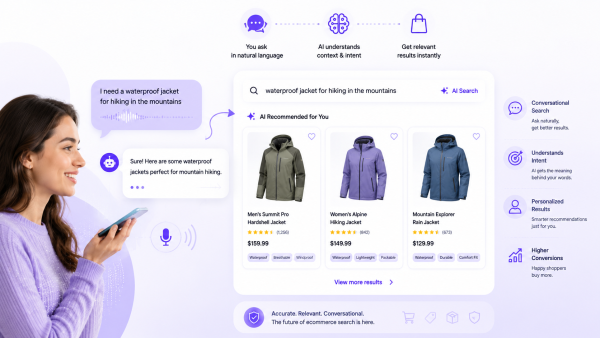
| winter jacket | I need a waterproof jacket for hiking in cold weather. | Insulated outdoor jackets suitable for hiking conditions. |
These examples show why natural language search delivers a better shopping experience. Instead of forcing customers to think like a search engine, the search engine adapts to how customers naturally communicate.
Frequently asked questions
What is natural language search?
Natural language search lets shoppers search in full, conversational sentences and still get relevant results. It understands the meaning, constraints, and intent behind a query rather than matching exact keywords, so “a warm waterproof jacket for hiking in fall” returns products that fit even if those words aren’t in the titles.
What’s the difference between natural language search and conversational search?
Natural language search understands a single plain-language query. Conversational search adds memory across a multi-turn exchange, so a shopper can ask follow-up questions or change direction and the system understands it as one continuous conversation.
How is natural language search different from keyword search?
Keyword search matches the literal words in a query against your catalog and fails when shoppers phrase things their own way. Natural language search interprets intent and meaning, handling synonyms, full sentences, and descriptions of a need.
What is an AI shopping assistant?
An AI shopping assistant is a conversational search experience that behaves like a knowledgeable salesperson — a shopper describes what they want in plain language, and the assistant asks clarifying questions, surfaces options, and refines results across the conversation, grounded in your real catalog.
Does natural language search help with AI visibility?
Yes, in a connected way. The same natural-language understanding that powers on-site conversational search is what external AI engines use to interpret shopper questions, and a catalog they can clearly understand is more likely to be recommended.
Let shoppers search by talking.
bCloud AI brings natural language and conversational search to your store — a ChatGPT-like shopping assistant grounded in your real catalog, returning relevant results in under 200ms. See it in action.
bcloud.ai