
Why vectors changed recommendations
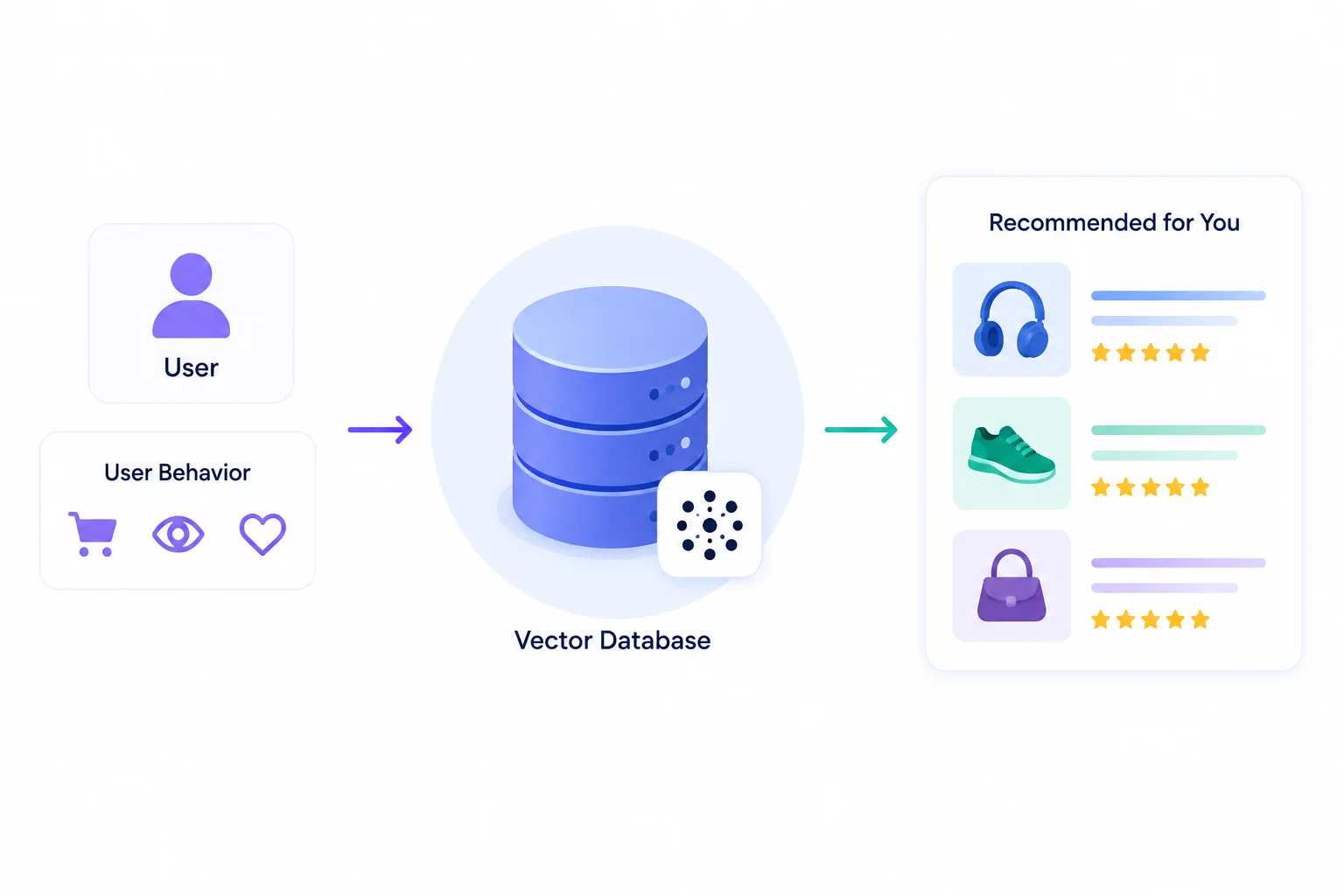
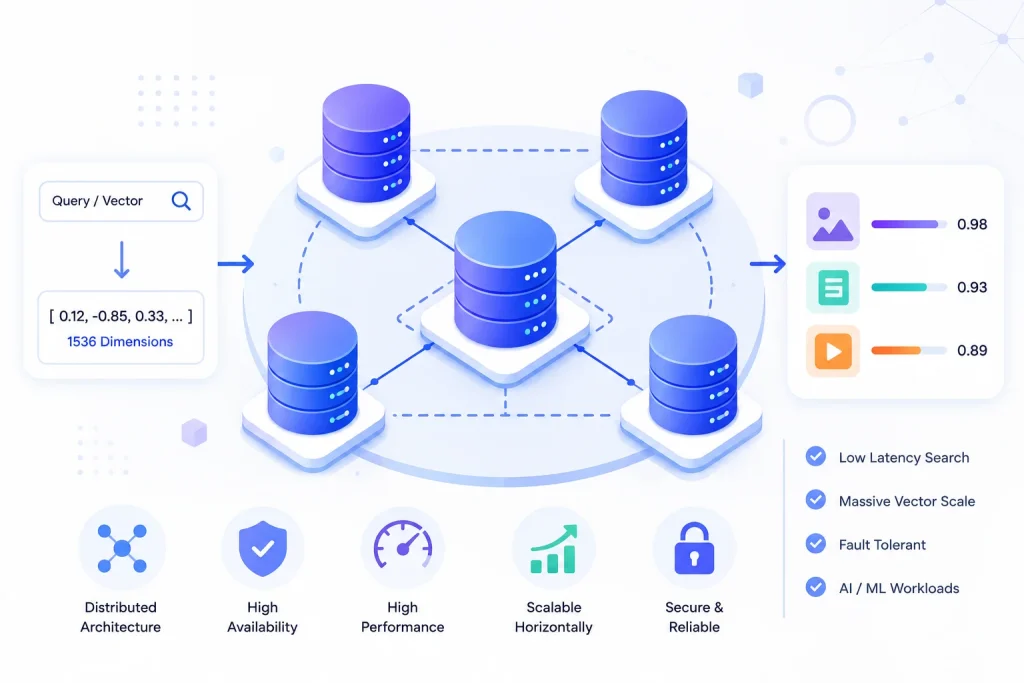
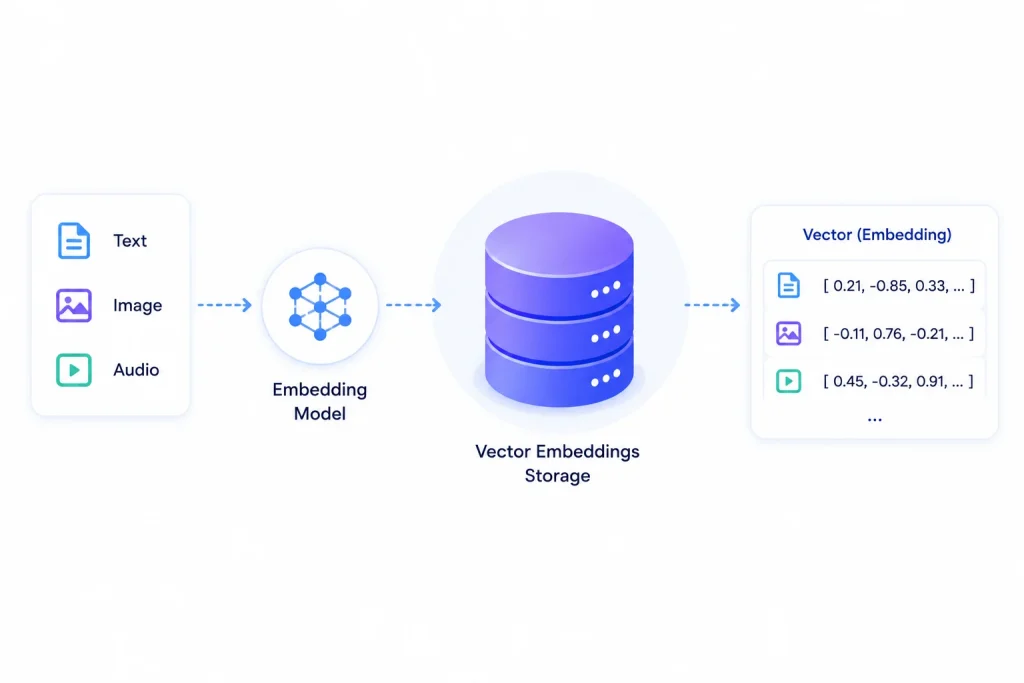
Embeddings collapsed the distinction. An item embedding captures what something is from its description, image, and attributes, so a product added an hour ago is immediately placeable. A user embedding captures taste from behavior. Both live in the same space, and a vector database makes retrieving neighbors from either fast enough for a page load.
The practical consequence: a recommendation engine that once needed nightly batch jobs now runs in real time, and cold-start items stop being invisible. If the storage layer is unfamiliar, our vector database hub covers the fundamentals.
The three recommendation architectures
Item-to-item.
The simplest and most robust recommendation engine pattern. Embed every product, and when someone views one, retrieve its nearest neighbors. This powers “similar products,” “you might also like,” and related-item modules. It requires no user history at all, which makes it the right starting point — most teams underestimate how far this alone gets them.
User-to-item.
This recommendation engine pattern represents the shopper as a vector — commonly a recency-weighted average of the items they’ve engaged with — then retrieve products near that point. This is personalization proper, and it’s how a homepage or a category page adapts per visitor. Our vector search personalization guide covers the mechanics in an ecommerce context.
Two-tower models.
The sophisticated recommendation engine option, built on the approximate-nearest-neighbor retrieval described in the HNSW paper: train two neural networks, one encoding users and one encoding items, so that users land near products they’ll engage with. This captures patterns simple averaging misses — brand affinity, price sensitivity, substitution behavior. It also requires training infrastructure and enough behavioral data to learn from, which is why most teams should earn their way to it rather than start there.
A mature recommendation engine usually runs all three, choosing per surface: item-to-item on product pages, user-to-item on the homepage, two-tower where the volume justifies it.
AI Search Grader by bCloud AI
Grade your ecommerce search in 10 quick questions
31% of ecommerce searches return zero results — and most shoppers who hit a dead end leave for a competitor. How does your store's search stack up?
Answer 10 short questions and get your AI search score, plus a personalized report to fix the gaps. Free, takes about 2 minutes.
No signup needed to take the quiz.
Understanding intent…
Scoring your answers across relevance, AI, experience, and insights.
Your AI search score is ready
Tell us where to send your personalized report. You'll see your score and recommendations right away.
Your score by pillar
Personalized recommendations
Fix the gaps in weeks, not quarters
bCloud AI replaces keyword-only search with hybrid AI retrieval — sub-200ms responses, 99.99% uptime, and conversion lifts of up to 40% across 50+ implementations.
What makes a vector database good for recommendations
A recommendation engine’s requirements differ from pure search, and this is where platform choice actually matters.
A recommendation engine needs filtered retrieval, always.
Every real recommendation carries constraints: in stock, ships to this region, not already purchased, not the item currently being viewed, within a price band. Combining filters with approximate nearest-neighbor search is the hard part of this workload, and implementations diverge sharply. Qdrant leads here with rich payload filtering that holds latency under complex constraints, where some systems slow 2–3×. Weaviate also performs well.
High write throughput matters more here than in search.
A recommendation engine generates constant writes. User vectors change constantly — every click and purchase shifts them. A recommendation engine updating profiles in real time generates far more writes than a search index does. Milvus handles the highest write throughput thanks to its distributed architecture; Qdrant and Pinecone follow, while lighter systems struggle under write-heavy loads. Our real-time indexing guide covers why this matters.
Multi-vector support.
Products often need several embeddings — text, image, behavioral — and recommendation quality improves when you can query across them or combine them. Not every platform supports this natively.
Low latency at the tail.
Recommendations render inline with a page, so p99 matters more than the average. A recommendation module that’s usually fast and occasionally slow degrades the whole page.
Metadata richness.
You’ll filter and boost on business attributes constantly. Payload flexibility saves a lot of workaround code.
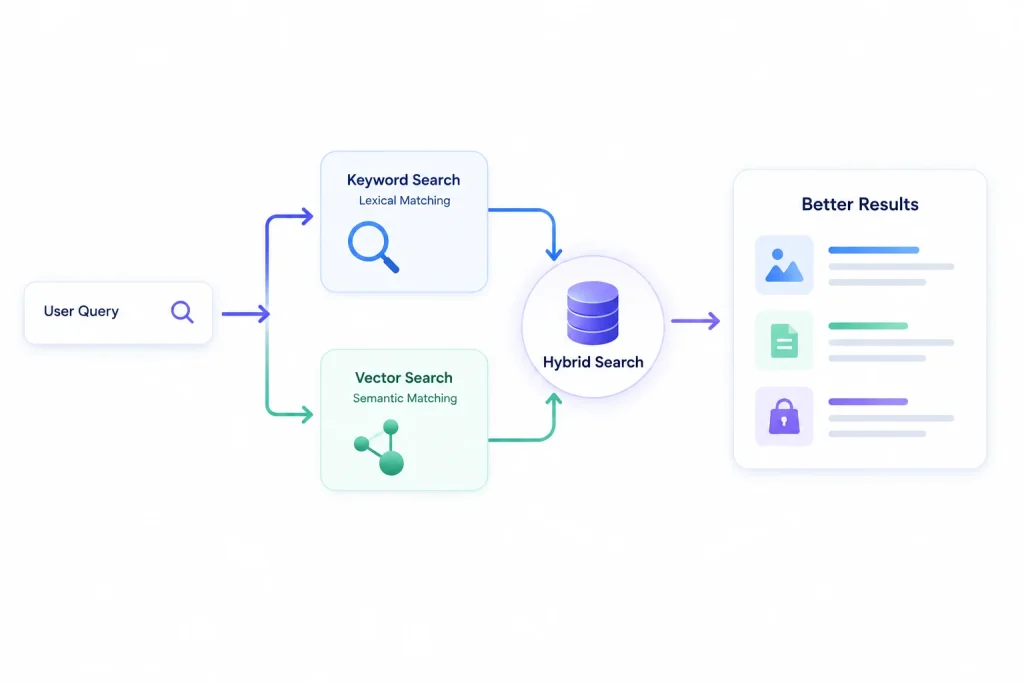
For platform-by-platform detail see our vector database comparison, and for the hybrid capability that lets you blend keyword signals into recommendations, vector database hybrid search.
The problems nobody warns you about
- Cold start breaks a recommendation engine for users, not items. Vectors solved cold-start for items — a new product has a description, so it has an embedding. Users are the remaining problem. A first-time anonymous visitor has no vector, and your recommendation engine has to degrade gracefully to popularity, category context, or session signals rather than showing nothing. On many stores most sessions are new or anonymous, so this path deserves more attention than it usually gets.
- The filter bubble. Recommend only what’s similar to past behavior and you narrow discovery over time, suppressing exactly the serendipity that grows basket size. Deliberate exploration — reserving a slice of recommendations for diverse or under-exposed items — is a design decision, not a default. Measure result diversity alongside click-through, because a recommendation engine optimizing purely for immediate clicks will happily collapse into a rut.
- Stale user vectors. A taste vector that still reflects December shopping in March is worse than none. Recency-weight aggressively and let session signals override long-term history when they conflict — someone who always buys menswear but is browsing children’s boots today is shopping for a child.
- A recommendation engine recommending the obvious. Nearest-neighbor retrieval will happily recommend the same product in a different color, or an item already in the cart. Business rules filtering these out are unglamorous and essential.
- Popularity collapse turns a recommendation engine into a bestseller list. Behavioral embeddings drift toward bestsellers, because that’s where the signal is. Without counterweights, your recommendation engine slowly becomes a bestseller list with extra steps.
Measuring a recommendation engine
A recommendation engine is unusually prone to looking successful while adding nothing, so measurement discipline matters.
Run a permanent holdout.
A slice of traffic that never sees recommendations, compared on conversion and revenue per session. Not a launch test — permanent, because quality drifts as catalogs and models change.
Measure incremental revenue, not attributed revenue.
Attribution counts every purchase that followed a recommendation click, including ones the shopper would have made anyway. The holdout tells you the difference, and it’s usually smaller than attribution suggests.
Track diversity.
Distinct items recommended across sessions, and how concentrated recommendations are on your top products. A falling number signals the filter bubble tightening.
Segment by new versus returning.
Expect little effect on first-time visitors and clear lift on repeat traffic. Any other pattern means your cold-start fallback or your weighting is miscalibrated.
Watch p99 latency.
Recommendation modules that slow a page cost more than they earn.
Our search relevance metrics and A/B testing ecommerce search guides cover the methodology in detail.
Where recommendations appear, and why placement changes everything
A recommendation engine isn’t one feature — it’s several surfaces with different requirements, and treating them identically is a common source of mediocre results.
Product detail pages
carry the highest-intent recommendation traffic. The shopper is already considering something specific, so item-to-item similarity works well, with the caveat that “similar” must not mean “the same product in another color.”
Cart and checkout
need complements rather than substitutes. Recommending another laptop to someone buying a laptop is worse than useless; recommending a sleeve or a dock is the point. This requires modeling complementarity, which pure similarity retrieval doesn’t capture — items bought together sit far apart in embedding space, since a laptop and a sleeve aren’t semantically similar at all.
Homepage and category pages
are where user-to-item personalization earns its keep, because there’s no item context to anchor on. This is also where cold-start handling shows most visibly.
Post-purchase and email
operate on a different timescale, where long-term taste vectors matter more than session signals.
Empty search results
are an underused recommendation surface. A shopper who hit a dead end has declared intent and has nowhere to go — retrieving semantically near items turns an exit into a second chance.
The practical implication for your recommendation engine: one embedding space, several retrieval strategies, and business rules per surface. Systems that apply identical logic everywhere produce the uncanny experience of being shown the thing you just bought.
Complementarity: the hard problem
Worth expanding on, because it’s where most vector-based recommendation work underdelivers.
Similarity retrieval answers “what resembles this?” Complementarity answers “what goes with this?” — a genuinely different question that nearest-neighbor search on content embeddings doesn’t solve. Three approaches work.
Co-purchase embeddings.
Train embeddings from basket data rather than content, so items frequently bought together end up close. This captures complementarity directly but needs transaction volume and suffers cold start for new items.
Dual-space retrieval.
Maintain both a content embedding and a behavioral embedding per item, and query the appropriate one per surface — content similarity on product pages, co-purchase on the cart.
Category-aware rules on top of retrieval.
Retrieve semantically, then filter or boost by category relationship rules. Less elegant, works immediately, and requires no additional training data — which makes it the sensible starting point for most teams.
Worth being direct about, because the build is larger than it looks.
Building a recommendation engine on a vector database means owning all of this: an embedding pipeline for items and users, storage and indexing, filtering and business rules, exploration logic, a serving layer fast enough for page render, retraining infrastructure, and a permanent experimentation harness. The vector database is maybe 20% of that. Our vector embeddings storage and vector database management systems guides cover two of the pieces.
That’s the right investment when recommendations genuinely differentiate your business — marketplaces, content platforms, anywhere discovery is the product.
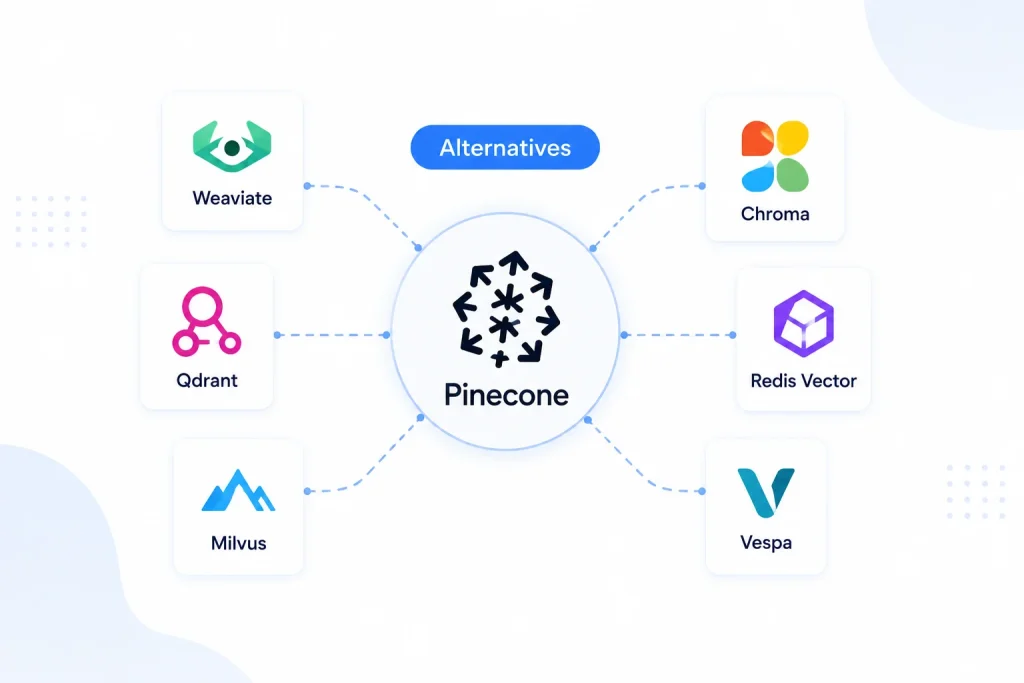
For most retailers, a managed platform that includes recommendations alongside search is faster and cheaper. bCloud AI runs search, browse ranking, and recommendations from one vector foundation, so the same understanding of your catalog and your shoppers powers every surface rather than being rebuilt three times. Our top semantic search solutions for e-commerce roundup compares that category, and Pinecone alternatives covers the build route.
Getting a recommendation engine live in 30 days
A realistic sequence, ordered by return rather than sophistication.
Week 1 — ship the simplest recommendation engine: item-to-item only.
Embed your catalog and ship “similar products” on product detail pages. No user data required, no cold-start problem, and it typically delivers the largest single increment. Teams routinely skip straight to personalization and leave this easier win untouched.
Week 2 — business rules and filtering.
Exclude out-of-stock items, the currently viewed product, near-duplicate variants, and anything already in the cart. Unglamorous, and it’s the difference between a recommendation engine that looks intelligent and one that looks broken.
Week 3 — session signals.
Build a lightweight session vector from the last few interactions and use it on the homepage and category pages. Works for anonymous visitors, which is most of your traffic.
Week 4 — measurement.
Stand up a permanent holdout and start reporting incremental conversion and revenue per session. Do this before adding sophistication, because without it you can’t tell whether the next thing you build helps.
Beyond:
long-term taste vectors, complementarity modeling, and two-tower models — each earned by data showing the simpler layer has plateaued.
Frequently asked questions
Can you build a recommendation engine on a vector database?
Yes, and it’s now a common architecture. Items and users are represented as embeddings in the same space, so retrieving recommendations becomes a nearest-neighbor query. This handles cold-start items well and runs in real time, unlike the batch pipelines classical collaborative filtering required.
Which vector database is best for recommendations?
Prioritize filtered-search performance, write throughput, and tail latency rather than raw benchmarks. Qdrant leads on filtered retrieval under complex constraints, Milvus on write throughput at scale, and Weaviate offers strong hybrid capability. pgvector works well below a few million vectors if you already run Postgres.
How do vector recommendations handle new users?
Poorly, unless designed for it — a first-time visitor has no vector. Good implementations fall back to popularity, category context, and session signals that build within two or three interactions. Since many sessions are new or anonymous, this fallback path deserves real attention.
What’s the difference between item-to-item and user-to-item recommendations?
Item-to-item retrieves products similar to one being viewed, requiring no user history — this powers “similar products” modules and is the most robust starting point. User-to-item represents the shopper as a vector and retrieves products near it, which is personalization proper and requires behavioral data.
Do vector recommendations create filter bubbles?
They can. Recommending only what resembles past behavior narrows discovery over time and suppresses serendipity. Counter it with deliberate exploration — reserving a slice of recommendations for diverse items — and measure result diversity alongside click-through.
How do I measure whether recommendations are working?
Run a permanent holdout group that never sees recommendations and compare conversion and revenue per session. Measure incremental rather than attributed revenue, since attribution counts purchases shoppers would have made anyway. Track diversity and p99 latency as guardrails.
One understanding of your catalog, every surface.
bCloud AI powers search, browse, and recommendations from a single vector foundation — measured against a live control.
bcloud.ai