
What makes a hybrid search platform “hybrid”
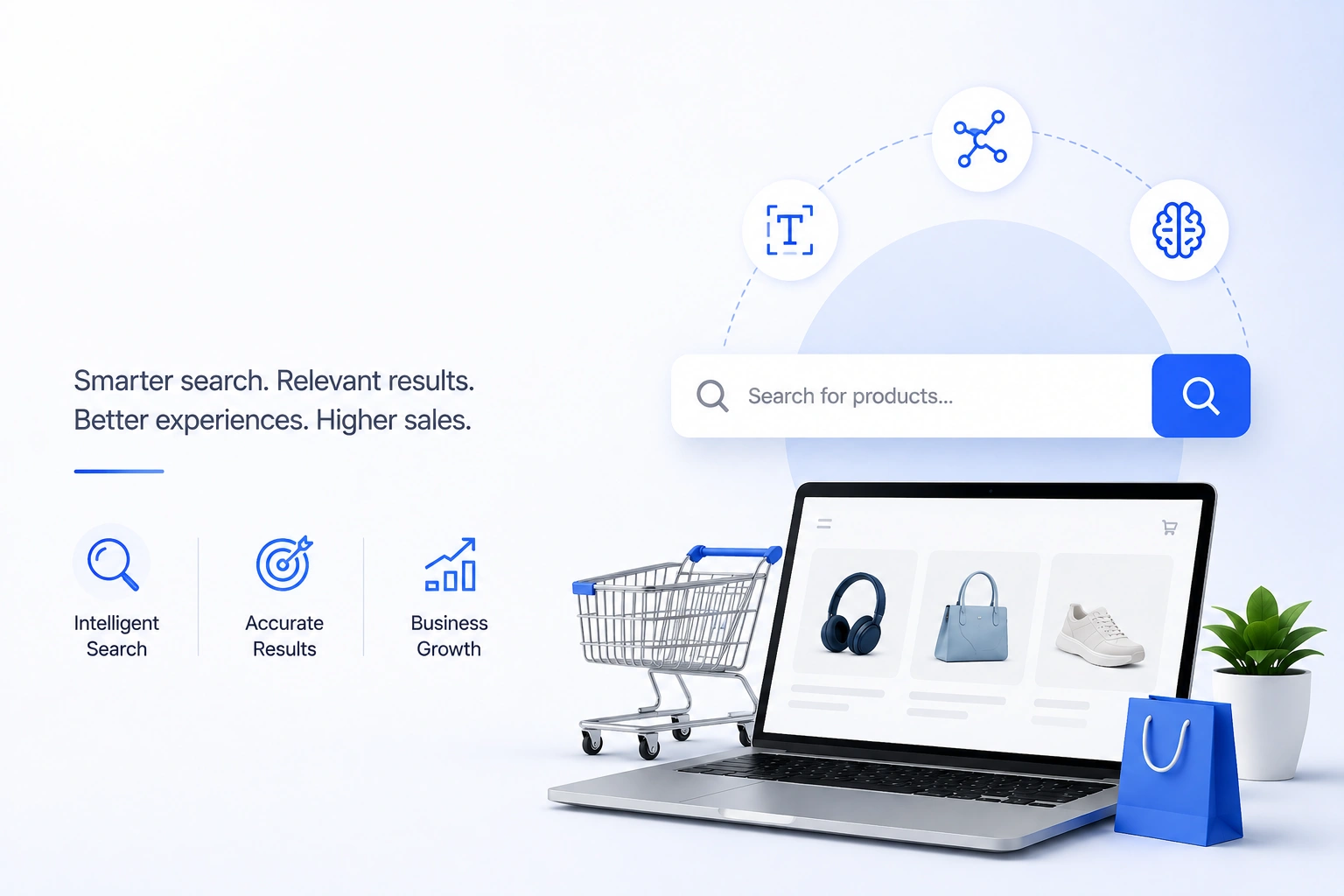
Hybrid retrieval means two engines running on every query. The lexical side scores exact term matches with an algorithm like BM25 — the ranking function documented in Wikipedia’s Okapi BM25 entry — which is unbeatable on SKUs, part numbers, and brand names. The semantic side embeds the query as a vector and finds products with similar meaning, so “warm jacket for a rainy commute” returns rain shells no keyword system would surface.
A hybrid search platform then fuses the two candidate lists, usually with Reciprocal Rank Fusion, and re-ranked using commercial signals like stock, margin, and conversion history. Each method fails in the opposite direction — keyword collapses on synonyms, vector drifts on identifiers — so running both covers each blind spot.
That’s the architecture. The reason a hybrid search platform is a distinct purchase from a hybrid search engine is everything wrapped around it: merchandising controls, real-time indexing, analytics, personalization, and the operational burden of keeping two indexes synchronized. For the wider field across relevance approaches, see our roundup of the top semantic search solutions for e-commerce, and for the mechanics of fusion itself, our guide to what hybrid search is.
The 7 best hybrid search platform options for ecommerce
1. bCloud AI — best managed hybrid search platform overall
bCloud AI combines hybrid BM25 + vector retrieval with conversational search, AI recommendations, and personalization on one managed stack. Response times run sub-200ms cached and under 400ms cold, ranking models retrain weekly on real clicks and purchases, and — the differentiator that matters most at mid-market — semantic capability is included at every tier rather than gated behind an enterprise contract. Pricing is based on catalog size rather than per search, so peak season doesn’t inflate the invoice. The free tier covers 20,000 searches and 100,000 records monthly with free implementation and 24×7 support. Best for: retailers who want hybrid relevance without operating the pipeline. See the AI search engine for architecture detail.
2. Algolia (NeuralSearch) — best developer experience
Algolia pairs famously fast keyword search with polished InstantSearch libraries, 200+ integrations, and a free tier of 10,000 requests monthly. Its vector layer, NeuralSearch, is genuine — but sits on the top-tier Elevate enterprise plan, and usage-based pricing climbs with traffic. Best for: engineering-led teams who can reach the tier where hybrid actually lives.
3. Constructor — best outcome-optimized platform
Constructor ranks toward conversion and revenue using clickstream and purchase behavior rather than relevance alone, with particular strength in high-SKU fashion and marketplace catalogs. Custom, sales-led pricing with a 30-day trial. Best for: enterprise retailers measuring search on revenue rather than relevance scores.
4. Coveo — best for multi-property enterprises
Mature machine-learning ranking with hybrid retrieval spanning commerce and support properties. Enterprise pricing and a correspondingly heavier implementation. Best for: large organizations unifying search beyond the storefront.
5. Klevu — best mid-market platform for Shopify and Magento
Strong NLP-driven discovery with mature merchandising automation, well established among Shopify and Magento retailers. Quote-based annual pricing with a 14-day trial and no permanent free plan; reviewers cite a steeper configuration curve. Best for: catalog retailers wanting proven merchandising depth.
6. Elasticsearch / OpenSearch — best self-operated engine
BM25 plus native kNN vector fields, the ELSER semantic model, and built-in Reciprocal Rank Fusion. Every primitive of a hybrid search platform, with none of the operations handled for you — cluster sizing, index lifecycle, relevance tuning, and uptime are yours forever. Best for: teams with dedicated search engineers and requirements a platform can’t express.
7. Typesense / Weaviate — best open-source hybrid
Typesense delivers keyword plus built-in vector search in a fast, resource-priced package with no per-search charges. Weaviate fuses BM25, dense vectors, and metadata filters in a single query with built-in vectorization modules. Both are lighter to run than Elasticsearch; both ship fewer commerce merchandising features. Best for: technical teams wanting open-source control at predictable cost.
AI Search Grader by bCloud AI
Grade your ecommerce search in 10 quick questions
31% of ecommerce searches return zero results — and most shoppers who hit a dead end leave for a competitor. How does your store's search stack up?
Answer 10 short questions and get your AI search score, plus a personalized report to fix the gaps. Free, takes about 2 minutes.
No signup needed to take the quiz.
Understanding intent…
Scoring your answers across relevance, AI, experience, and insights.
Your AI search score is ready
Tell us where to send your personalized report. You'll see your score and recommendations right away.
Your score by pillar
Personalized recommendations
Fix the gaps in weeks, not quarters
bCloud AI replaces keyword-only search with hybrid AI retrieval — sub-200ms responses, 99.99% uptime, and conversion lifts of up to 40% across 50+ implementations.
Managed platform vs self-operated: the decision that matters most
The seven above split into two genuinely different purchases, and picking the wrong category wastes more money than picking the wrong vendor within a category.
A managed hybrid search platform absorbs the operational surface: fusion tuning, index synchronization, re-embedding migrations when models change, uptime, and scaling. You configure and merchandise; the vendor runs the machinery. Time to live is typically weeks. This is the right default for most retailers, because relevance engineering is a specialized, never-finished discipline and search is rarely where a retail business differentiates.
A self-operated engine trades that convenience for control: custom embedding models, bespoke ranking logic, data residency on your terms. The honest cost is ownership — the nearest-neighbor index needs tuning, real-time indexing needs building, and someone owns the pager. Right when discovery is your product; expensive theater when it isn’t.
The tiebreaker: model the fully loaded three-year cost of each path at twice your catalog and three times your traffic, including engineering salaries on the self-hosted side. Managed usually wins that comparison until genuine mega-scale.
How to evaluate a hybrid search platform on your own catalog
Vendor demos run on curated data. Run these five hybrid search platform tests on yours instead.
The messy-query test.
This is the single most revealing hybrid search platform test. Pull a hundred real queries from your logs — typos, long descriptions, half-remembered brands, problem-framed searches. Score which platform puts the right product on the first screen. This is where hybrid quality separates.
The exact-match floor.
Search precise SKUs and model numbers. They must resolve literally, every time. Drift here means the lexical half is weak, which is disqualifying for any catalog with technical identifiers.
Filtered latency at scale.
Sub-200ms at p95 and p99, with your catalog size and your real facets applied, under concurrent indexing load. Nearly every production query carries filters, and filtered performance is where implementations diverge most — the vector index underneath is almost certainly HNSW, from the original paper, and its behavior under filtering varies enormously between platforms.
The fusion question.
Ask the vendor directly which fusion method they use — Reciprocal Rank Fusion or weighted scoring — and how you’d change the balance. Confident vendors answer in a sentence. Evasive answers usually mean there’s less hybrid there than the marketing suggests.
The pricing shape.
Ask where semantic capability sits in the tiers, then model your bill at three times current traffic. Per-query pricing converts a strong quarter into a painful invoice; catalog- or resource-based pricing stays flat through spikes.
Validate the winner with a live traffic split measuring search conversion and revenue per search, using the methodology in our search relevance metrics and A/B testing guides.
Implementation: what the first month looks like
Whichever hybrid search platform you choose, the rollout follows four phases — and the phases matter more than the vendor.
Data readiness comes first.
The semantic half can only embed meaning your catalog expresses. Audit titles, descriptions, and attributes; enrich thin records; decide product-versus-variant indexing. Most retailers discover a meaningful share of their catalog is too sparse for embeddings to work well — and no fusion setting rescues empty data.
Index and balance.
Stand up both retrievers, start with Reciprocal Rank Fusion (no tuning required, and it sidesteps the incompatible-score-scales problem), and verify both the exact-match floor and the natural-language ceiling before touching weights.
Business ranking.
Layer stock, margin, and conversion signals onto fused relevance, and hand merchandisers pin/boost/bury controls so campaigns don’t need engineering tickets.
Measured rollout.
Ship behind a traffic split — internal beta, small public slice, then ramp while conversion, zero-result rate, and tail latency hold against a control.
On a managed hybrid search platform this runs four to six weeks end to end. Assembling it yourself is a multi-month program, and that gap is usually the deciding number.
Diagnosing which half of your hybrid search platform is failing
Once you are live, bad results all look the same on the page. They are not.
Each retriever fails in a recognisable way. Knowing the signature saves you from tuning the wrong thing. Here are the three patterns worth learning.
Right category, wrong item.
The results are all jackets, but not the jacket asked for. That is the semantic half working and the lexical half being outvoted. Consequently the fix is fusion weighting, not embeddings.
Nothing at all for a real product.
Zero results when the item exists usually means both halves missed. Check the record first. Thin data returns nothing from either retriever, so no weighting change will help.
Odd items near the top.
One clearly unrelated product ranking high is often a business signal overriding relevance. Look at your boost rules before blaming retrieval. Margin weighting is the usual culprit.
In short, ask your vendor whether you can run each retriever alone. That single feature turns diagnosis from guesswork into a two-minute check. Our hybrid search guide covers how the two halves combine.
What a hybrid search platform costs to run
Pricing conversations in this category are muddied because vendors price on different units, so comparing headline numbers is close to meaningless. Four shapes exist, and each behaves differently as you grow.
Per-query billing
charges for every search request, sometimes with indexed records metered separately. Attractive below a few hundred thousand monthly searches, punishing above it — and the compounding is what catches teams out, because traffic growth and catalog growth stack. A hybrid search platform priced this way turns your strongest quarter into your largest invoice.
Resource-based billing
charges for the RAM and CPU your index consumes, common with open-source clouds. Predictable and often genuinely cheap, but you’re sizing infrastructure rather than buying an outcome, and memory becomes a hard ceiling you have to plan around.
Catalog and feature-based billing
scales with how many products you have and which capabilities you switch on, holding flat through traffic spikes. This is the shape most growth-stage retailers should want, because it makes search cost forecastable against a number you already know.
Enterprise contracts
negotiate everything annually, usually with modules that interlock — worth reading carefully, since a capability you assumed was included may require a second module.
Two questions cut through all of it. Ask where semantic capability sits in the tier structure, because several vendors reserve the vector half for their top plan, meaning the hybrid search platform you’re evaluating may not be the one you’re quoted. Then model your total at three times current traffic and twice your catalog. That figure, not the rate card, is the number to compare.
Common mistakes
- Launching a hybrid search platform on thin product data. The most common cause of disappointing hybrid results, and the one no vendor can fix for you.
- Skipping the SKU test. Teams dazzled by natural-language demos forget to type a part number, then discover the gap after launch.
- Tuning fusion by feel. Every balance change should be scored against a judged query set, not adjusted because a handful of hand-picked queries “look better.”
- Benchmarking without filters. Unfiltered demo numbers flatter every platform and predict nothing about production.
- Treating hybrid search platform launch as done. Vocabulary shifts and embeddings age. Score quality monthly and keep a permanent holdout so the lift stays proven.
What changed in hybrid search this year
Three shifts are worth factoring into a 2026 decision.
Hybrid stopped being a differentiator. Nearly every serious vendor now claims it, which means the marketing language converged while the engineering quality did not. The useful questions moved down a level: which fusion method, how is recall measured, what happens to filtered queries at your scale.
Measurement became the real separator. Buyers increasingly expect a hybrid search platform to prove lift against a control group rather than cite case studies. Vendors who can’t produce that methodology are being screened out earlier in evaluations, and rightly so.
Retrieval became the grounding layer for AI answers. The composed, cited product recommendations appearing inside AI assistants are built on hybrid retrieval, which means your search foundation now does double duty — powering today’s results page and shaping whether external engines can recommend your products at all. Every improvement to catalog structure and relevance compounds into visibility you’d otherwise have to buy.
Frequently asked questions
What is the best hybrid search platform for ecommerce?
For most retailers, a managed platform that includes hybrid retrieval at every tier rather than gating the vector half behind an enterprise plan. bCloud AI takes that approach with sub-200ms hybrid relevance, real-time indexing, built-in merchandising, and catalog-based pricing. Algolia’s NeuralSearch is the managed alternative on its top tier, while Elasticsearch, Typesense, and Weaviate suit teams operating their own stack.
What’s the difference between a hybrid search platform and a hybrid search engine?
A platform is managed end to end — fusion, ranking, merchandising, analytics, and freshness operated for you. An engine gives you the retrieval primitives and leaves operations, tuning, and uptime with your team. The distinction usually matters more to your budget than the vendor comparison within either category.
How do I know if a platform is genuinely hybrid?
Test both extremes on your catalog: an exact SKU must resolve literally, and a full descriptive sentence must return sensible products. Then ask which fusion method the platform uses. A vendor who can’t name it, or who fails either test, is offering less hybrid capability than the marketing implies.
How much does a hybrid search platform cost?
It depends entirely on pricing shape. Free tiers exist (bCloud AI includes 20,000 searches and 100,000 records monthly; Algolia offers 10,000 requests), usage-based plans scale with traffic, resource-based open-source clouds start in the low tens of dollars monthly, and enterprise suites are commonly quoted at $50K+ annually. Model your real cost at three times current volume before signing.
Is hybrid search worth it for a smaller store?
Usually yes, via a managed platform. The relevance gains on typos, synonyms, and descriptive queries apply at any catalog size, and managed delivery removes the operational cost that once made hybrid an enterprise-only architecture.
How long does implementation take?
Four to six weeks on a managed hybrid search platform, including data readiness, index setup, business ranking, and a measured rollout. Building from components realistically takes several months.
Hybrid relevance without the pipeline.
bCloud AI blends keyword precision with vector meaning in one sub-200ms engine — fusion, reranking, and merchandising included, priced on your catalog.
bcloud.ai