
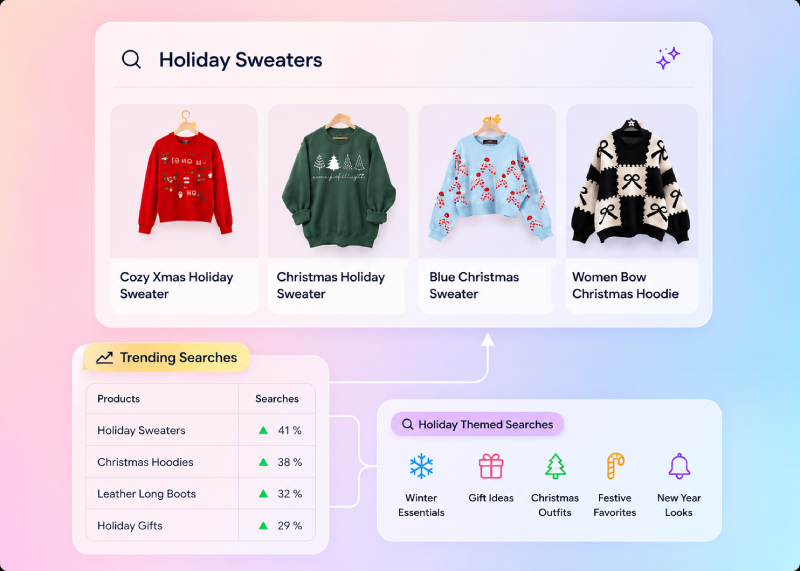
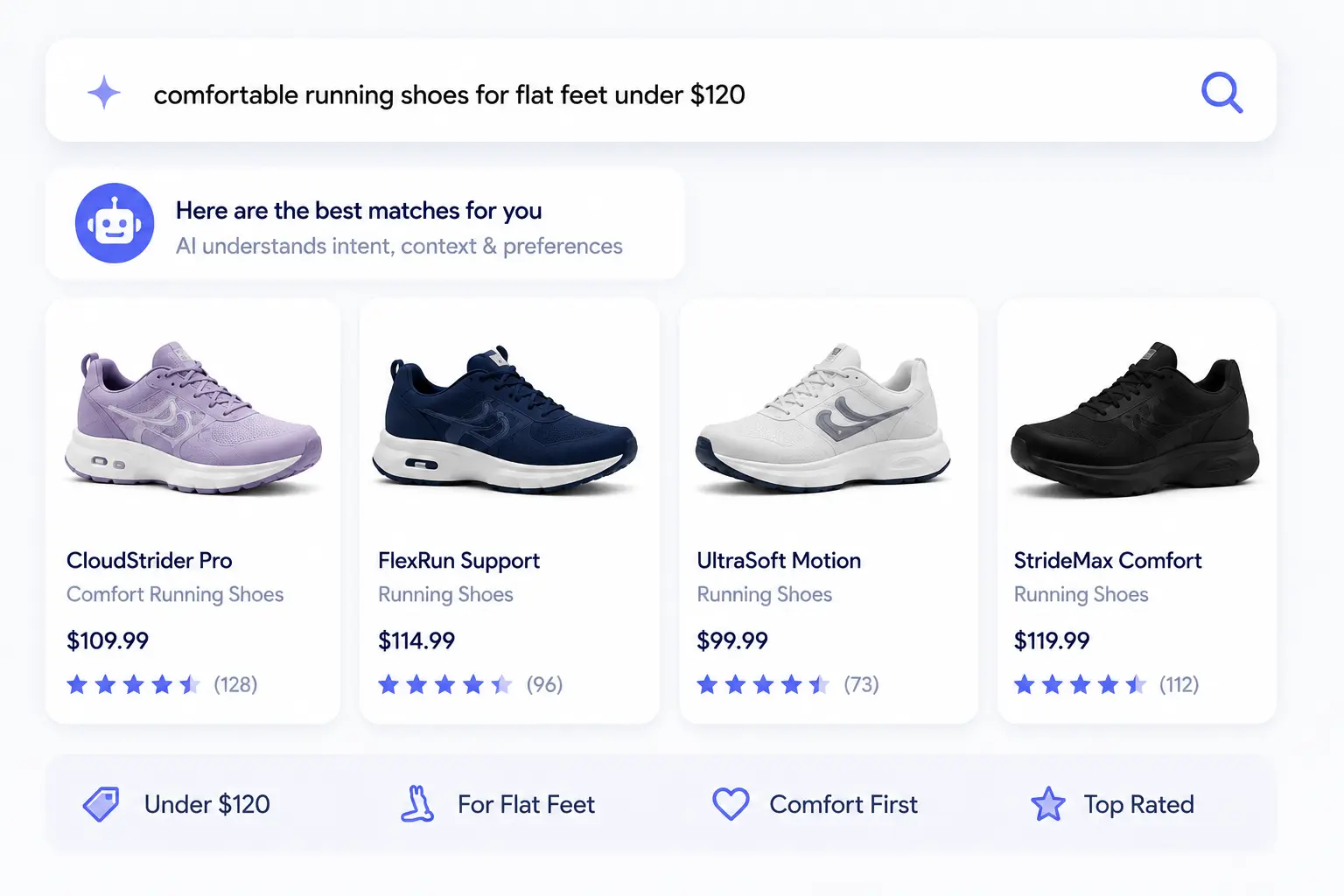

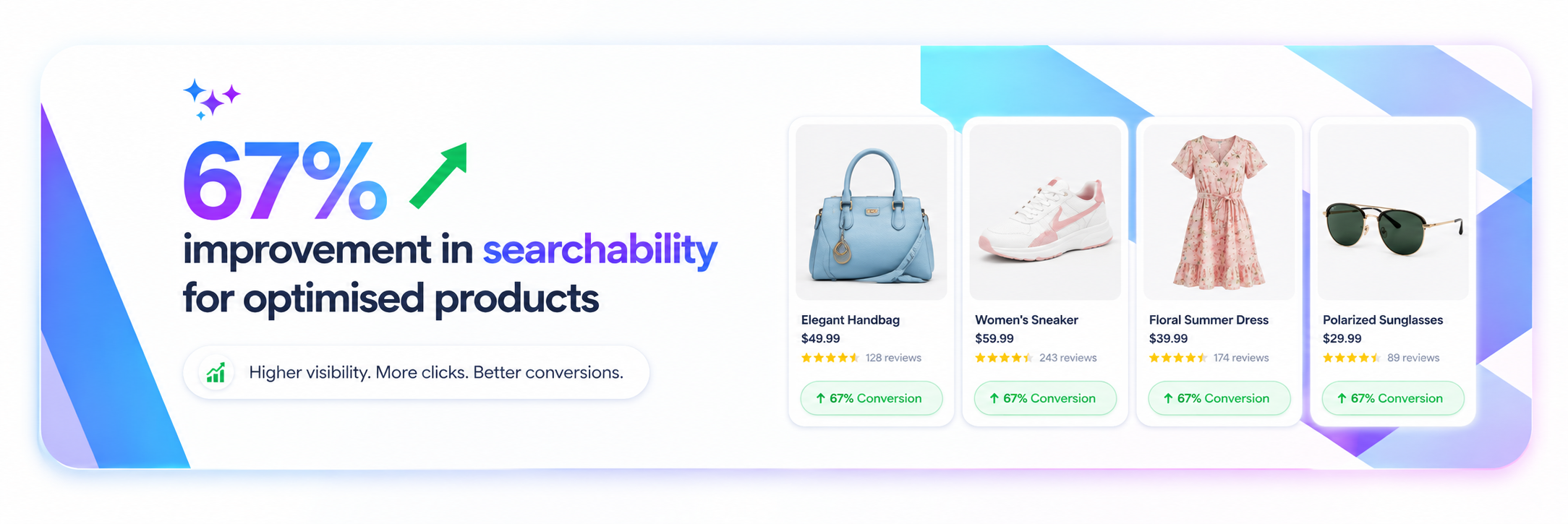

The Evolution of E-Commerce Search Technology
How Modern E-Commerce Search Actually Works
Step 1: Query Understanding
- Product category: Headphones (audio equipment)
- Connectivity requirement: Wireless (Bluetooth or RF)
- Use case: Work from home (implies long battery life, comfort for extended wear, noise cancellation)
- Implied priorities: Comfort > Bass response, Battery life > Portability
Step 2: Parallel Search
- Semantic vector search (38ms): Finds products with similar meaning embeddings in 1536-dimensional space
- Keyword search (67ms): Traditional BM25 algorithm finds exact and near-exact word matches
Step 3: Hybrid Ranking
- Reciprocal Rank Fusion (60% semantic, 40% keyword)
- Boost in-stock items (+15%)
- Boost high-margin products (+10%)
- Boost 4+ star ratings (+8%)
- Bury out-of-stock (-90%)
Step 4: ML Optimization
Step 5: Results Return
The Real Cost of Outdated E-Commerce Search
Scenario: Mid-sized retailer
- Monthly searches: 500,000
- Current zero-result rate: 31% (industry average)
- Current conversion rate: 2.1% (industry average)
- Average order value: $87
- Current monthly search revenue: $915,000
01
02
Zero-Result Failures
- 155,000 searches return nothing
- Estimated conversion if they found products: 2.1%
- Annual impact: $3.4 million
- Lost monthly revenue: $283,000
Poor Ranking (non-zero results that still fail)
- Remaining 345,000 searches show results
- But only 2.1% convert (vs. 4-5% with intelligent search)
- Opportunity gap: 2.1% → 4.0% achievable
- Additional monthly revenue potential: $655,000
- Annual opportunity: $7.9 million
03
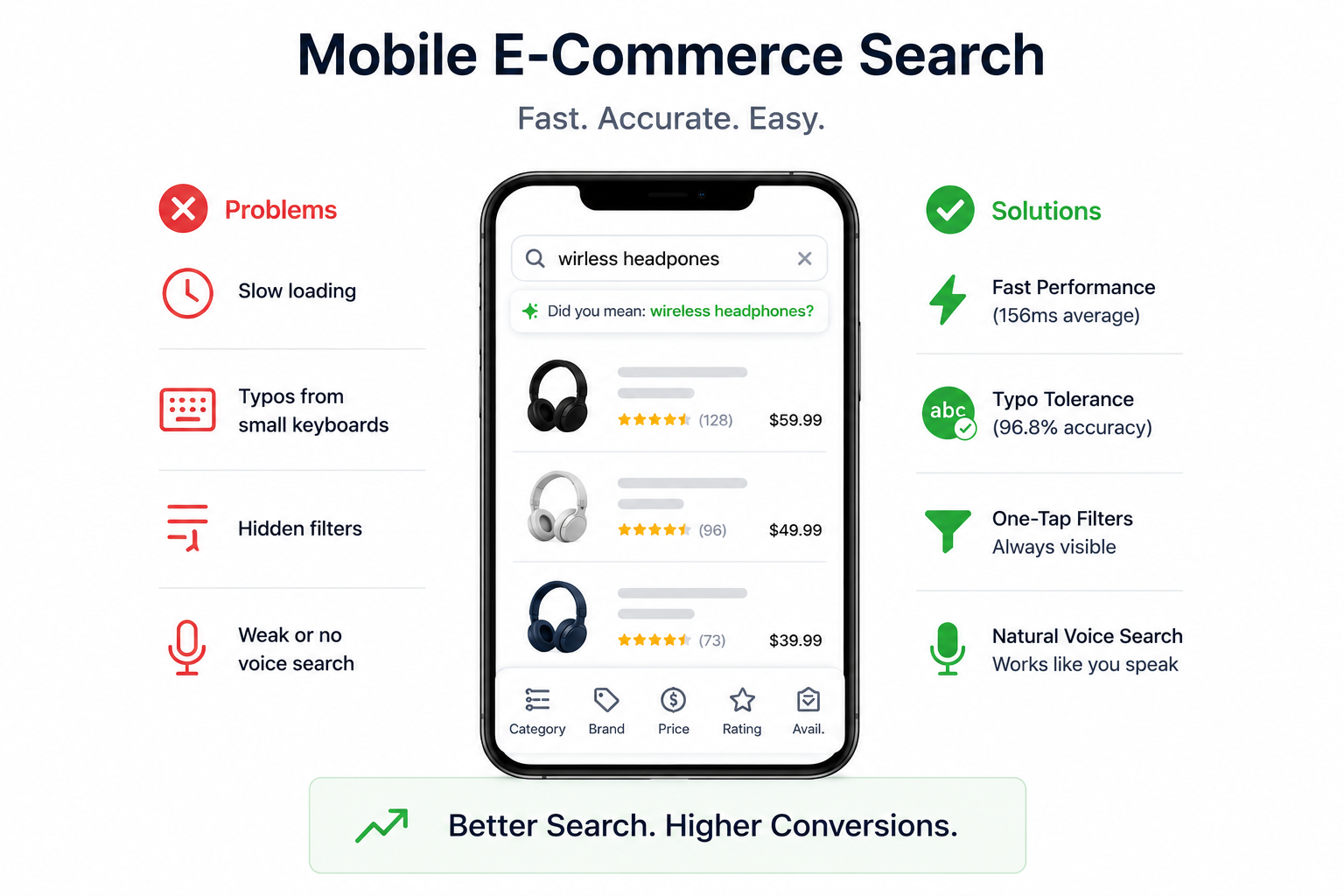
Mobile E-Commerce Search: The Majority Use Case
- Slow loading (1.2s average vs. 890ms desktop)
- Typos from small keyboards (28% of mobile searches vs. 8% desktop)
- Hidden filters requiring multiple taps to access
- Results that don't adapt to screen orientation
- No voice search or works poorly
- Touch targets too small for accurate tapping
- Performance (156ms average)
- Typo Tolerance (96.8% accuracy)
- One-Tap Filters
- Natural Voice Search
- Adaptive Layout
Analytics That Translate to Revenue
"What products should we add to our catalog?"
Top searches with zero results reveal exactly what customers want but can't find. If "standing desk converter" gets 2,000 monthly searches and you don't carry them, that's a $17,400 monthly opportunity at industry-average metrics.
"Where should we focus merchandising efforts?"
High-traffic, low-conversion searches show where better content, pricing, or product selection would have outsized impact. If "laptop" gets 50,000 searches monthly but only converts at 1.5% while category average is 3%, fixing that one search term doubles its revenue contribution.
"Which products have discoverability problems?"
Products with strong inventory but never appearing in search results likely have poor titles, missing attributes, or incorrect categorization. Our ecommerce search analytics flag these automatically so your team can fix them.
"How much revenue does search actually drive?"
Most retailers don't know because they've never measured it properly. Our multi-touch attribution shows that ecommerce search typically drives 40-60% of all revenue—making it your most important sales channel that wasn't being optimized.
Merchandising Without Manual Labor
Full Algorithmic Control
The system decides everything automatically. You can't promote seasonal items, clear inventory, or feature new products. Results are unpredictable and impossible to manage strategically.
Full Manual Control
You configure thousands of rules for thousands of queries. Requires dedicated teams, never scales, breaks constantly as catalog changes, and delivers inconsistent experiences across similar queries.
bCloud AI's ecommerce search offers a superior third option: intelligent defaults with strategic overrides.
Pin Products to Top Positions
Lock specific items to positions 1-3 for high-value searches. "Winter coats" during November-February shows your new collection first, automatically expires when the season ends. Configuration takes 30 seconds, updates propagate instantly.
Boost by Any Attribute
"Increase all 'Sale' tagged products by 15%" promotes your entire promotional catalog without manual product selection. "Boost items with >50 inventory units by 10%" automatically surfaces products you're well-stocked on.
Category-Specific Rules
Apply different logic to different departments: boost high-margin items in electronics, prioritize fast-moving inventory in fashion, surface bestsellers in home goods. Different categories need different strategies—our ecommerce search platform accommodates that reality.
Time-Based Promotions
"Boost products tagged 'back-to-school' by 25% from July 15 - September 15" runs automatically. No manual start, no manual stop. The system enables and disables promotions based on calendar dates you configure once.
A/B Testing Built In
Split traffic 50/50 between two ranking strategies and measure conversion difference. Our platform includes native testing tools that make optimization continuous and data-driven rather than opinion-based.
Search Across Every Channel
🔎
Website (Desktop + Mobile)
Full-featured search with autocomplete, filters, facets, and intelligent results that adapt to screen size automatically.
📱
Native Mobile Apps
iOS and Android SDKs bring identical search capabilities to your mobile applications. Same intelligence, same speed, same results—wrapped in native UI components.
🎙️
Voice Commerce
Alexa Skills, Google Actions, and other voice platforms query your ecommerce search directly. "Ask [Your Store] for wireless headphones under $100" works immediately without custom integration work.
🛍️
Social Commerce
Instagram Shopping, Facebook Shops, TikTok Shopping—all powered by the same search infrastructure. Customers get consistent experiences regardless of where they discover your products.
🏬
In-Store Kiosks
Physical retail locations use identical search for endless-aisle functionality. Out-of-stock in store? Search, order, ship to home. Same seamless experience customers get online.
🌐
Marketplace Integrations
Amazon, eBay, Walmart Marketplace—use bCloud AI's search to power your presence on third-party platforms. Customers searching "your-brand wireless headphones" on Amazon get bCloud-powered results.
Implementation That Doesn't Disrupt Business
Phase 1: Discovery & Planning (Week 1)
- Connect to your e-commerce platform
- Analyze current search performance
- Identify quick wins and long-term opportunities
- Build custom implementation roadmap
Phase 2: Data Optimization (Week 2)
Analyze data quality (titles, descriptions, attributes, categorization)
LLM-powered auto-generation of missing content
Attribute extraction from unstructured text
Phase 3: Configuration (Weeks 3-4)
Configure business rules (inventory-based, margin-based, rating-based)
Set up merchandising controls
Train your team on dashboard usage
Phase 4: Testing (Weeks 5-6)
Limited public beta (5% of traffic)
Expanded beta (25% of traffic)
Full rollout (100% of traffic)
Phase 5: Optimization (Ongoing)
Weekly performance reviews
Monthly strategic planning
Quarterly business reviews
Total time: 6 weeks. Typical ROI realization: 60-90 days. Payback period: 18-30 days on average.
Security, Compliance, and Enterprise-Grade Reliability
SOC 2 Type II certified
annual audits
GDPR compliant
(EU customers)
CCPA compliant
(California)
99.99% uptime SLA
(we've never missed it)
SOC 2 Type II certified
for data security
Related posts
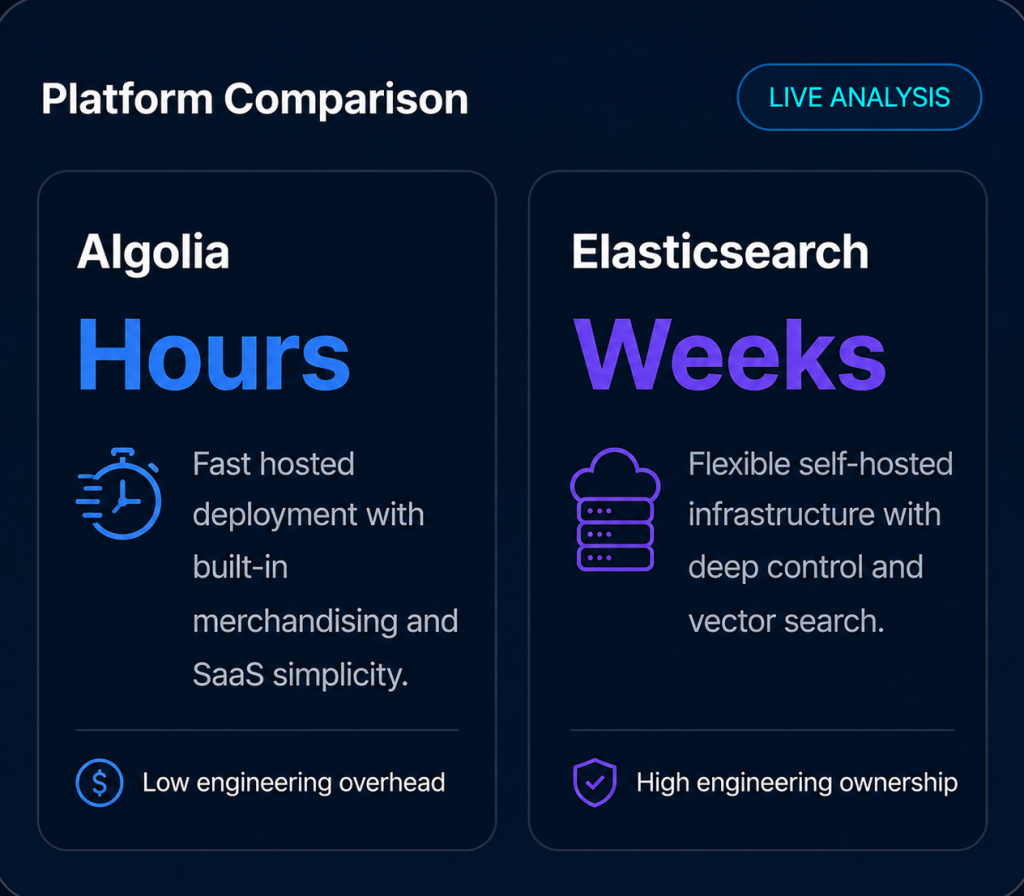
Algolia vs Elasticsearch
The Algolia vs Elasticsearch debate is one of the most common tech-stack decisions e-commerce and SaaS teams make.

Switch From Algolia
Algolia’s per-search pricing punishes you for scale. We charge one flat monthly fee that covers unlimited searches—plus our AI is 10x smarter.
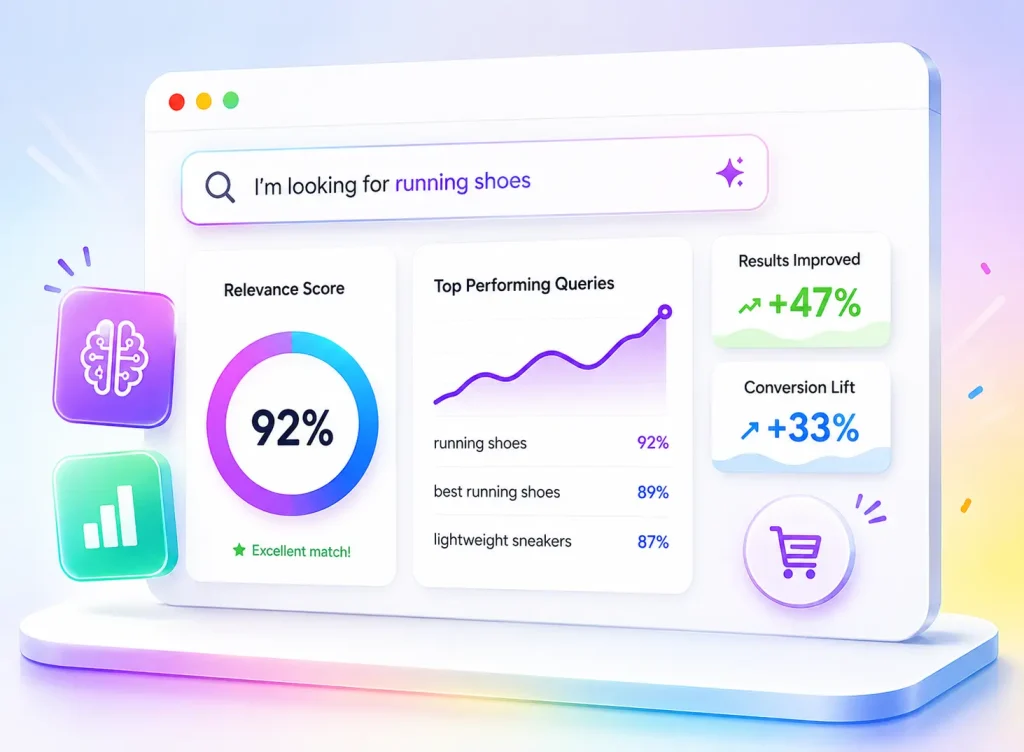
Algolia Alternative
If you’ve been searching for an Algolia alternative, you’re not alone. Algolia’s pricing has shifted toward AI-tier paywalls and per-request billing
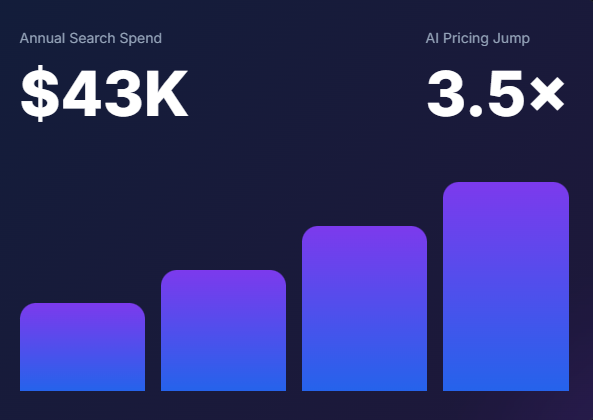
Algolia Too expensive
The real cost math behind search pricing at scale — and what fast-growing ecommerce teams switch to next.
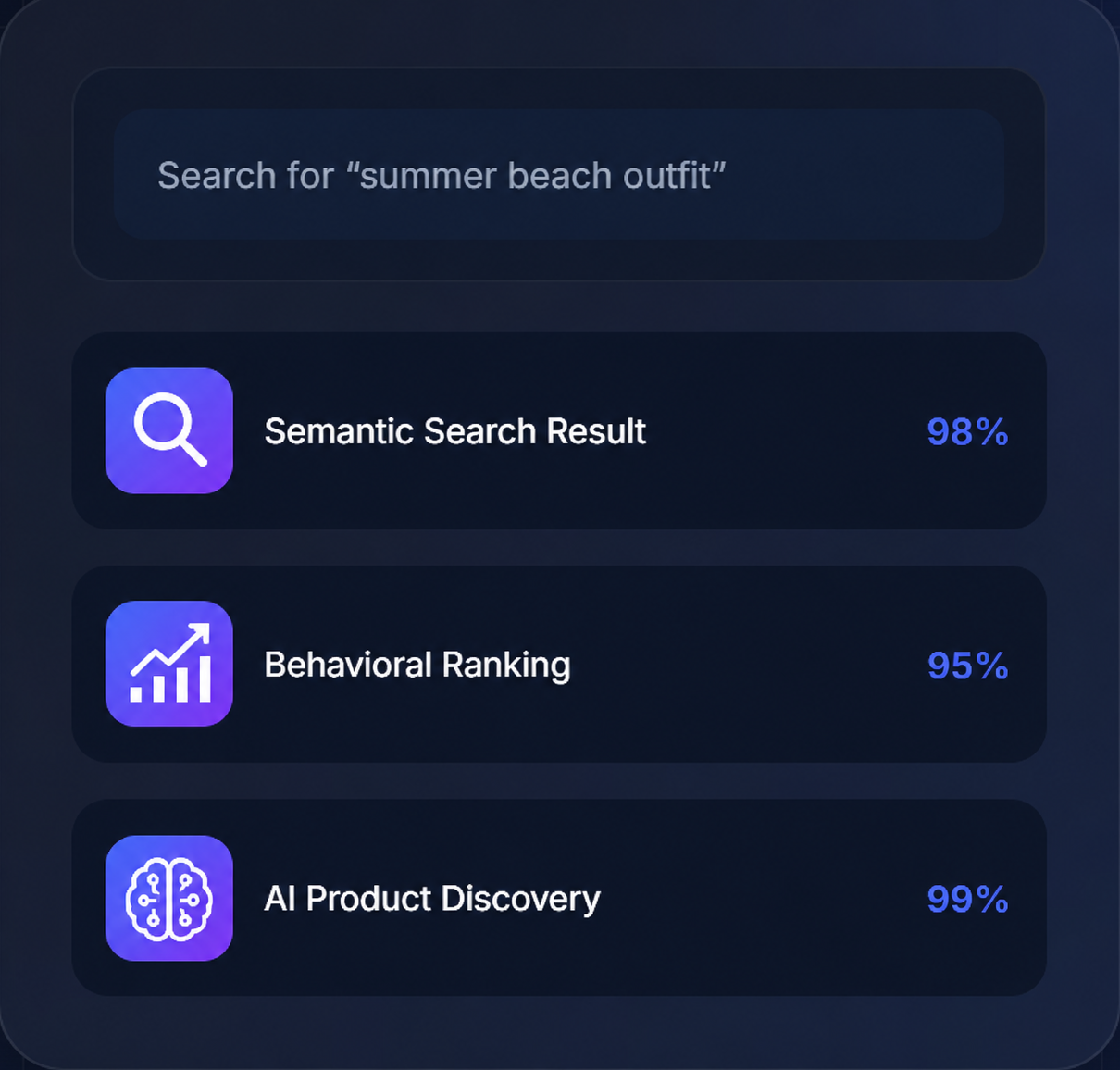
Ecommerce Site Search Software
Ecommerce site search software is the single biggest conversion lever most stores leave un-tuned.
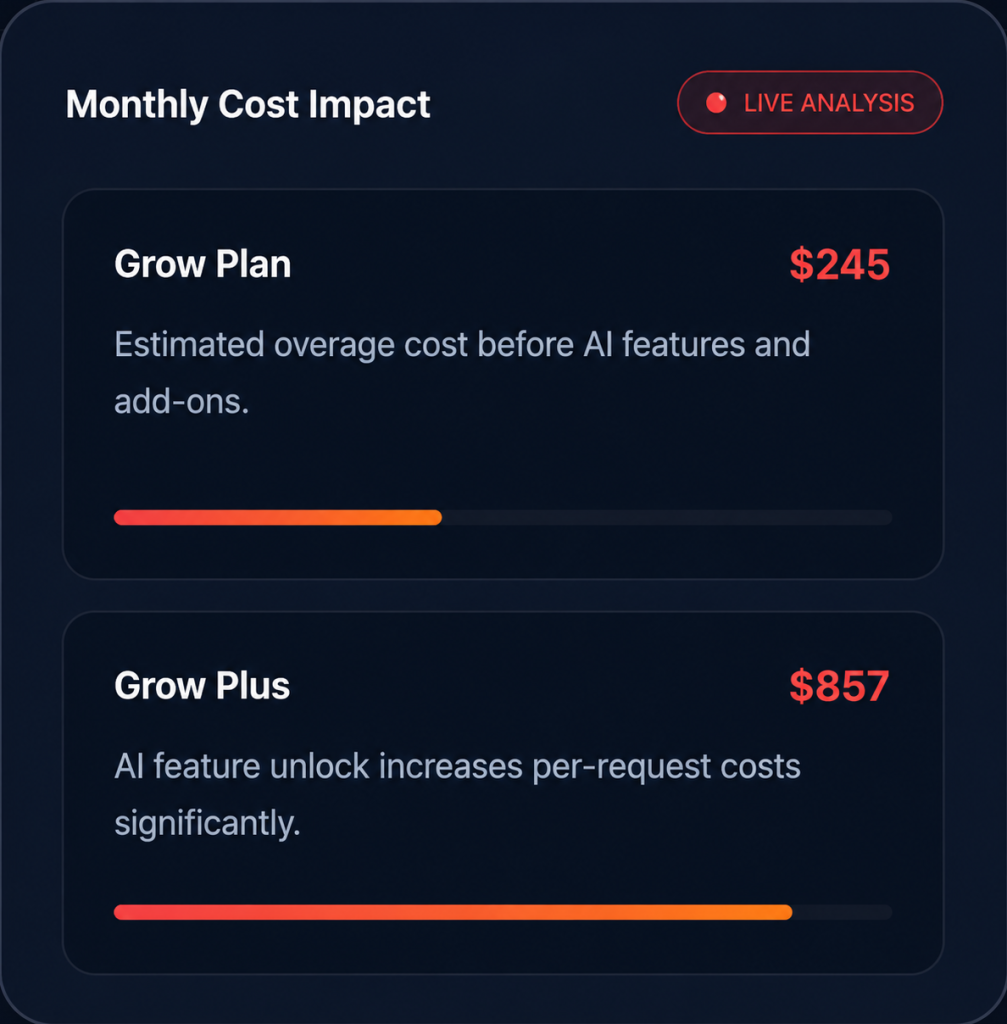
Algolia pricing
Understanding Algolia pricing matters because the published rates rarely reflect the real monthly invoice.
bCloud AI vs 50 Competitors
Fifty fully-written comparison articles totaling 75,000+ words.
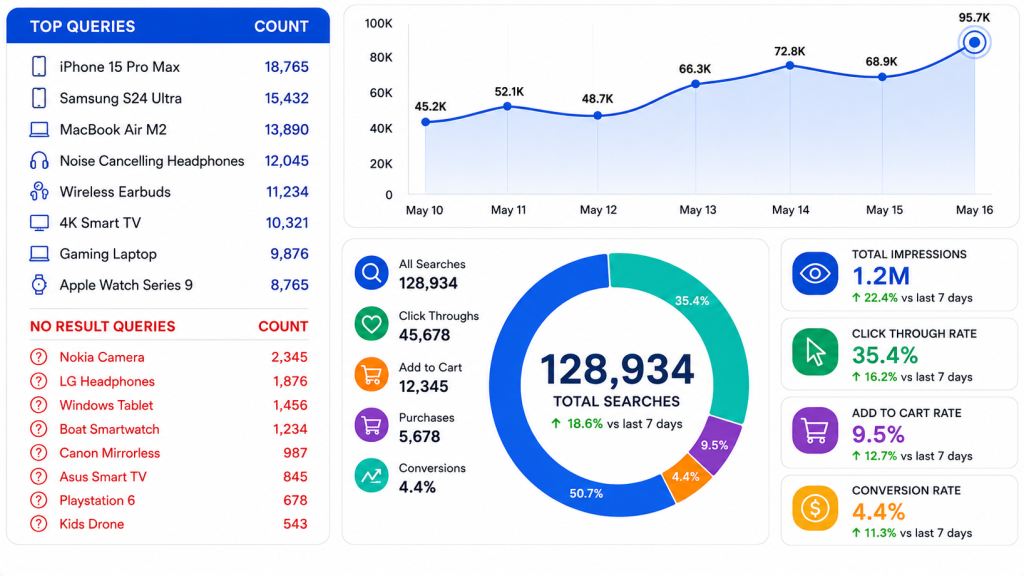
Analytics
Convert raw user behaviour into concrete next steps with a comprehensive analytics.

Hawksearch Alternative
Hawksearch has been a steady choice for B2B and B2C catalogs since the early 2010s.

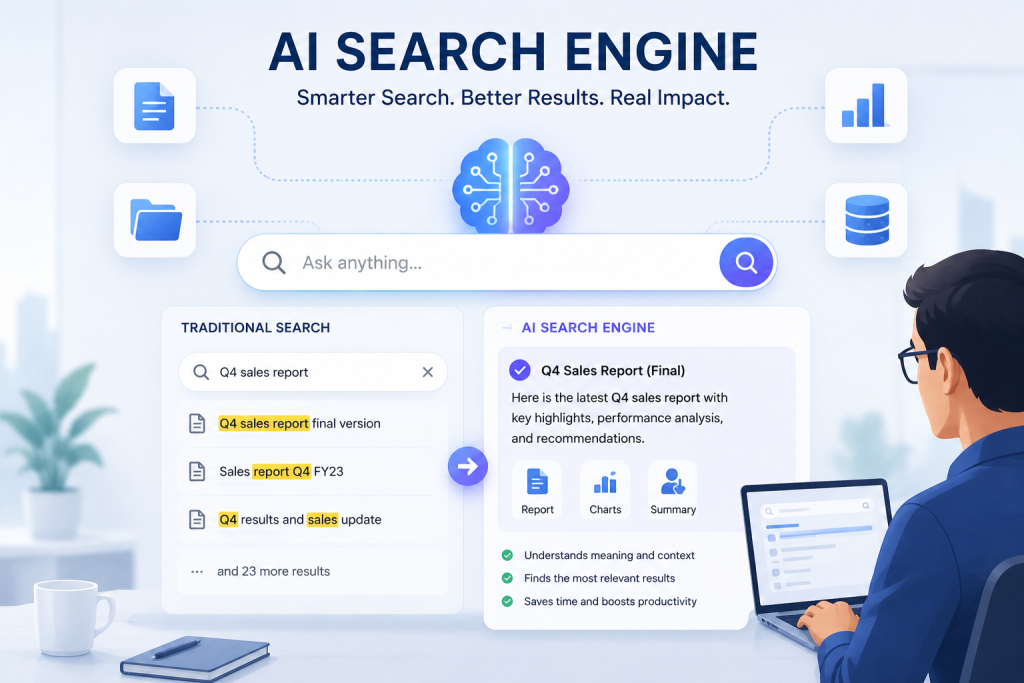
AI Search
E-commerce search engine makes all the difference between a sale and an abandoned cart.
Frequently asked questions
What is AI-powered ecommerce search?
Why is keyword matching no longer enough for ecommerce search?
How does modern AI ecommerce search actually work?
How much revenue does outdated site search cost?
Do merchandisers lose control with AI-powered search?
Can one search platform cover every sales channel?