
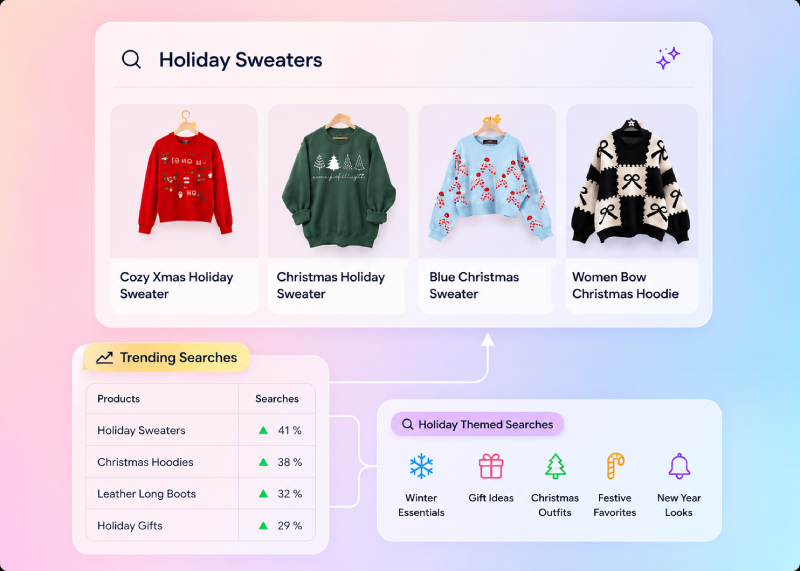
E-Commerce Search That Actually Converts

The Evolution of E-Commerce Search
When done right, ecommerce search is your best salesperson. It understands what customers need, surfaces exactly the right products, and guides them toward purchase faster than any human could. When done wrong, it’s a conversion killer that sends frustrated shoppers straight to competitors who actually understand them.
When a customer searches “laptop for video editing,” they’re not asking for every laptop in your catalog. They need high-performance machines with dedicated graphics cards, 32GB+ RAM, and fast processors. A basic e-commerce search engine returns hundreds of irrelevant results. An intelligent one surfaces exactly the three models that fit their needs.
- Ten years ago, ecommerce search meant Elasticsearch with basic keyword matching. Customers searched "red dress," you showed them everything with those words, and conversion rates hovered around 2-3%. That was acceptable because everyone's search worked that way.
- Then Amazon happened. Google Shopping happened. Customers learned that search could understand intent, not just match words. They expected "laptop for video editing" to return high-performance machines, not every laptop in stock. They assumed typos would be corrected automatically. They thought voice search should work as well as typing.
- Traditional ecommerce search couldn't keep up. It still can't. The technology hasn't fundamentally changed—it's the same keyword engines with slightly better autocomplete. Zero-result rates remain stuck at 25-35% industry-wide. Search abandonment hovers at 60-70%. Retailers are losing billions collectively to search technology built for a different era.
What Modern E-Commerce Search Actually Does
⚡
Intent Classification
Not every search is a product search. "Return policy" and "track my order" are navigation queries that should route to help pages, not product listings. "How to choose running shoes" is informational content that builds trust before purchase. Our ecommerce search recognizes the difference and responds appropriately.
🧠
Semantic Understanding
Our LLM-powered engine interprets queries the way customers think. "Something for my daughter's first apartment" triggers results for starter furniture sets, kitchen essentials, décor bundles—products that solve the real need behind the search, not just match keywords literally.
📈
Behavioral Learning
Every interaction teaches the system. If customers searching "laptop" consistently click on MacBooks first, we surface them higher. If "wireless headphones" searchers care more about battery life than price, results rerank to reflect that preference. This happens automatically, continuously, without manual tuning.
The Business Impact of Intelligent E-Commerce Search
Revenue Metrics:
- Monthly search-driven revenue: $892K → $1.74M (+95%)
- Revenue per search: $1.83 → $2.97 (+62%)
- Average order value: $87 → $93 (+7%)
- Average order value: $87 → $93 (+7%)
01
02
Customer Experience:
- Zero-result searches: 31% → 6.8% (-78%)
- Search abandonment: 67% → 27% (-59%)
- Searches per session: 4.2 → 1.6 (-62%)
- Net Promoter Score: +55 points
Operational Efficiency:
- Support tickets: -68%
- Merchandising time: -71%
- Infrastructure costs: -89%
03
Download the whitepaper for the venuemarketplace.com implementation of bCloud AI
Mobile E-Commerce Search: Where Most Retailers Fail
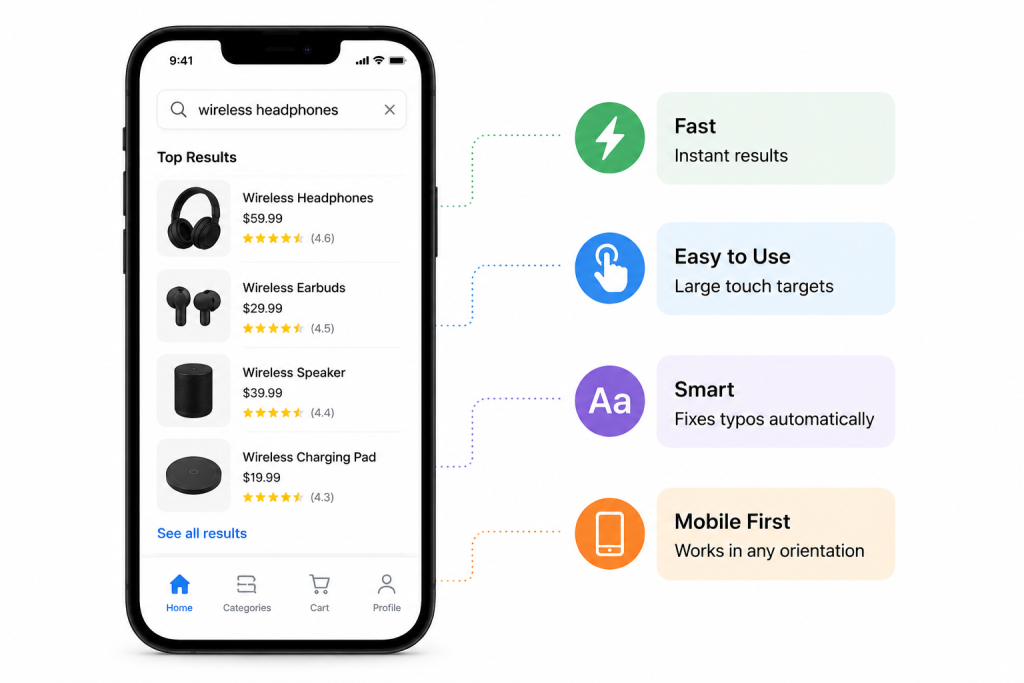
65% of e-commerce traffic comes from mobile devices. Yet mobile search abandonment rates are 74%—significantly worse than desktop. Why? Because ecommerce search designed for desktop breaks completely on 4-inch screens:
- Slow loading (1.2s+ average)
- Tiny tap targets that require precision
- No typo correction when thumbs miss keys
- Filters hidden behind multiple menus
- 156ms average response time
- Large touch-friendly interface elements
- 96.8% typo correction specifically trained on mobile keyboards
- Responsive grid that works perfectly in any orientation
The Technology Stack Behind Great E-Commerce Search
1. Large Language Models (GPT-4 class)
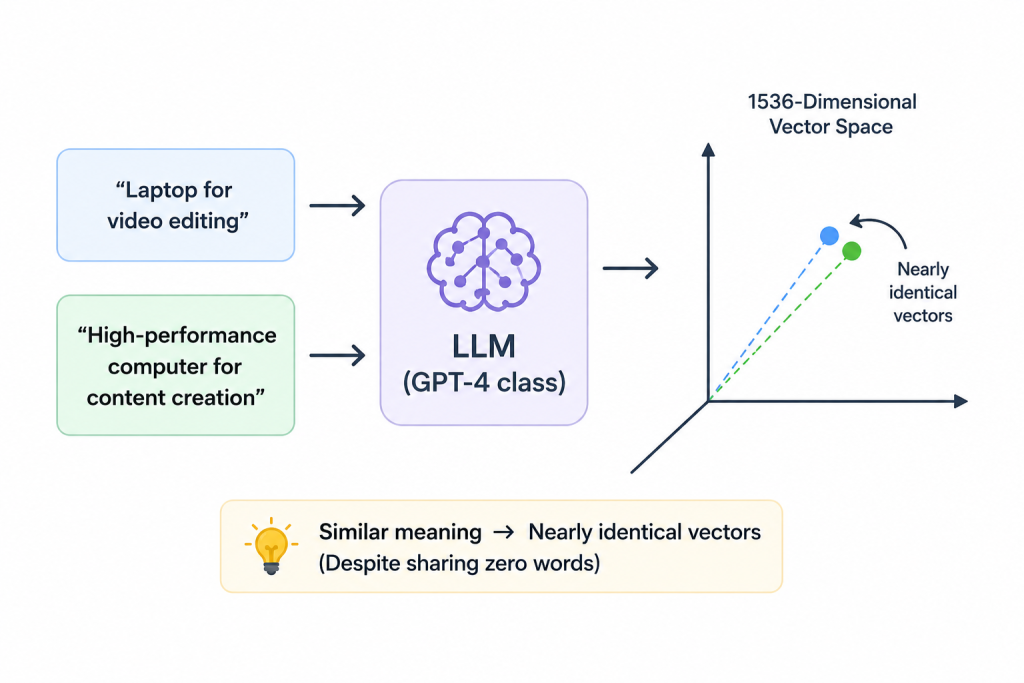
These handle semantic understanding, generating 1536-dimensional vector embeddings that capture meaning beyond keywords. "Laptop for video editing" and "high-performance computer for content creation" map to nearly identical vectors despite sharing zero words.
2. Vector Databases (Pinecone, Weaviate)
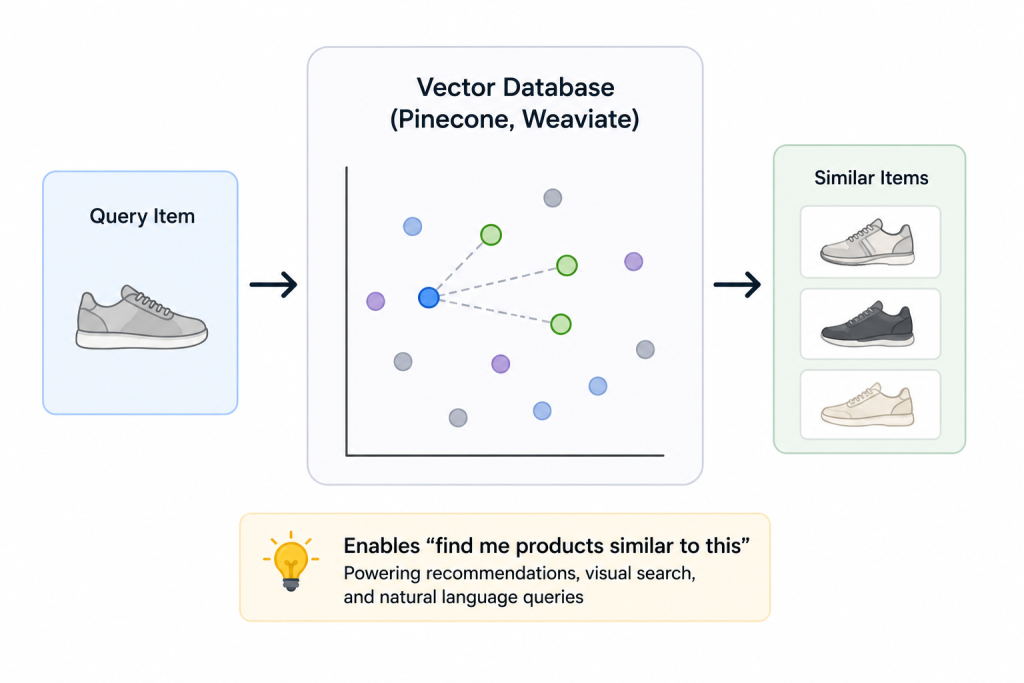
Traditional databases can't search by semantic similarity—they only match exact values. Vector databases enable "find me products similar to this" queries that power recommendations, visual search, and natural language queries.
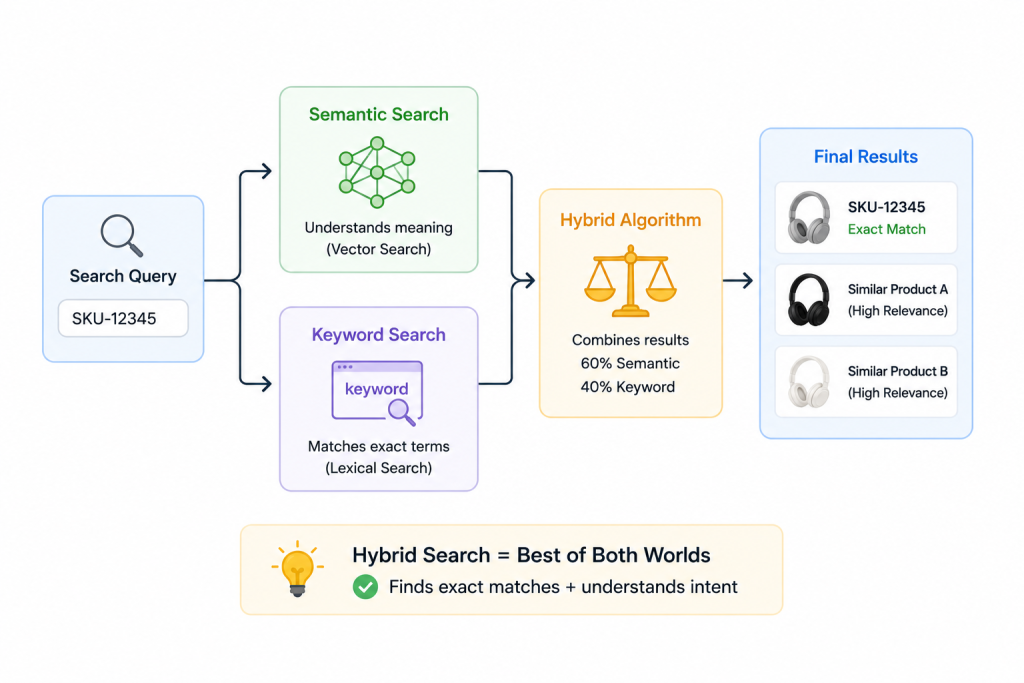
3. Hybrid Search Algorithms
Pure semantic search sometimes misses exact matches ("SKU-12345" should return that exact product, not semantically similar ones). Pure keyword search misses intent. Hybrid approaches combine both: 60% semantic, 40% keyword typically performs best.
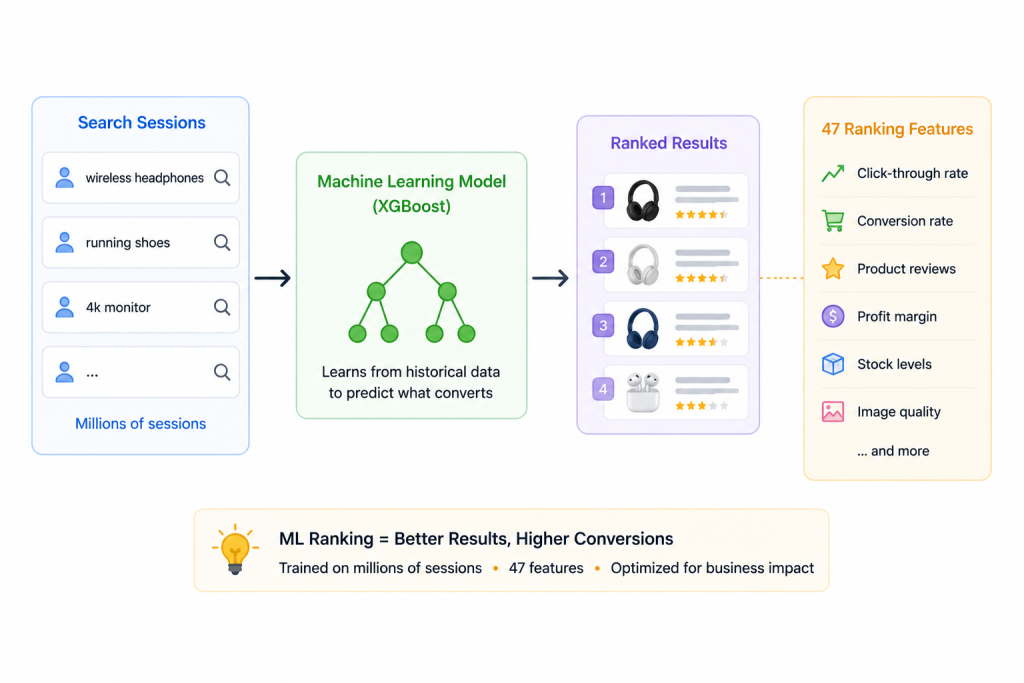
4. Machine Learning Ranking Models
Our XGBoost models train on millions of search sessions, learning which results actually convert. 47 features inform ranking: click-through rate, conversion rate, product reviews, profit margin, stock levels, image quality, and more.
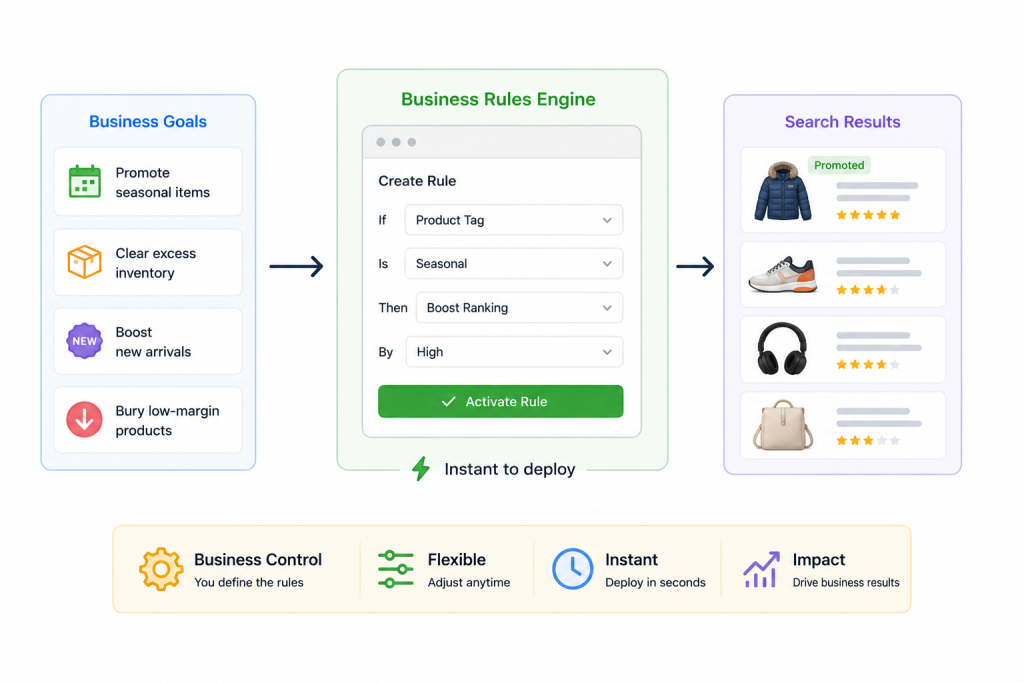
5. Business Rules Engines
Sometimes business logic overrides algorithms: promote seasonal items, clear excess inventory, boost new arrivals, or bury low-margin products. Our ecommerce search dashboard makes these rules simple to configure and instant to deploy.
Analytics That Drive Decisions
Top Searches Dashboard
See exactly what customers want. "Searches with zero results" reveals gaps in your catalog. "High-traffic searches with low conversion" shows where better merchandising would have outsized impact.
Trending Queries
Spot emerging demand before competitors. "Queries growing 200%+ week-over-week" helped one retailer stock weighted blankets three weeks before the trend exploded nationally.
Conversion Funnel Analysis
Where do searches fail? "Query → Results View → Product Click → Add to Cart → Purchase" breakdown shows exactly where customers drop off and why.
Revenue Attribution
Understand search's contribution to revenue with last-touch, first-touch, and multi-touch attribution models. Most retailers discover ecommerce search drives 40-60% of all revenue, making it the most important sales channel they weren't measuring properly.
Merchandising Control Without the Complexity
Pin Products
Lock specific items to top positions for branded searches, promotional campaigns, or seasonal pushes. "Winter coats" search? Pin your new puffer collection to positions 1-3 regardless of algorithmic ranking.
Boost by Attribute
"Increase all 'Sale' items by 15%" takes 10 seconds to configure. "Boost products with >4.5 stars and 50+ reviews by 10%" prioritizes quality without manual product selection.
Bury Poor Performers
"Demote products with <3 stars by 50%" automatically protects customers from bad experiences while giving you time to improve or delist those items.
A/B Test Everything
Split traffic 50/50 between two ranking strategies, measure conversion difference, and let data decide which performs better. Our ecommerce search platform includes built-in testing tools that make optimization continuous and data-driven.
Implementation Without Disruption

How AI-Powered E-Commerce Search Handles Edge Cases
🍎
Ambiguous Queries
“Apple” could mean fruit or a tech brand. Our AI uses browsing history, cart contents, and previous purchases to automatically understand context and return the correct results.
🎧
Long-Tail Searches
Complex queries with multiple filters, preferences, and price constraints are processed instantly using AI-powered semantic parsing.
✍️
Misspellings & Typos
Our typo correction engine automatically fixes spelling mistakes using Levenshtein distance algorithms trained on your actual product catalog.
🔄
Synonym Variations
Customers search differently than your taxonomy. AI dynamically generates synonyms using LLMs without requiring manual dictionary maintenance.
Security, Compliance, and Enterprise-Grade Reliability
SOC 2 Type II certified
annual audits
GDPR compliant
(EU customers)
CCPA compliant
(California)
99.99% uptime SLA
(we've never missed it)
SOC 2 Type II certified
for data security
Frequently asked questions
What does modern e-commerce search actually do that keyword search doesn't?
What technology powers an intelligent e-commerce search engine?
How does AI search handle messy real-world queries?
Why does mobile search fail on most retail sites?
What business results should I expect?
How long does implementation take, and does the live store go down?