
How ChatGPT finds products before it recommends anything
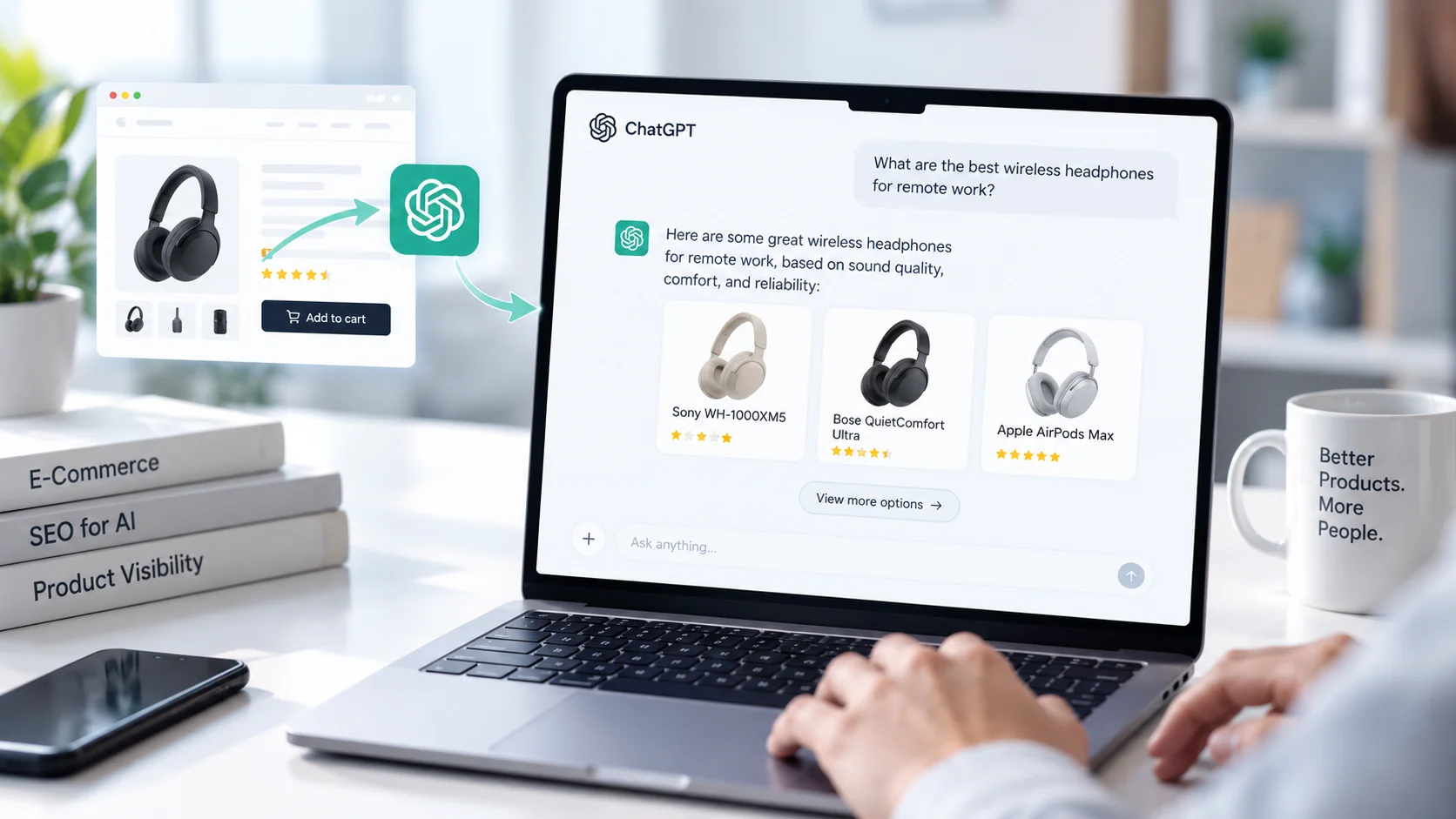
That relocates the whole problem. You are not trying to get into training data, an opportunity that closed and was never steerable. You are trying to be findable and parseable right now, which is an ordinary technical and content problem with ordinary solutions. Our how LLMs find products guide covers the retrieval pipeline in detail.
AI Search Grader by bCloud AI
Grade your ecommerce search in 10 quick questions
31% of ecommerce searches return zero results — and most shoppers who hit a dead end leave for a competitor. How does your store's search stack up?
Answer 10 short questions and get your AI search score, plus a personalized report to fix the gaps. Free, takes about 2 minutes.
No signup needed to take the quiz.
Understanding intent…
Scoring your answers across relevance, AI, experience, and insights.
Your AI search score is ready
Tell us where to send your personalized report. You'll see your score and recommendations right away.
Your score by pillar
Personalized recommendations
Fix the gaps in weeks, not quarters
bCloud AI replaces keyword-only search with hybrid AI retrieval — sub-200ms responses, 99.99% uptime, and conversion lifts of up to 40% across 50+ implementations.
Step 1: Let the right crawlers in, or you won’t be recommended by ChatGPT at all
This is where most stores fail before anything else matters, and it is the fastest thing to check. OpenAI operates separate crawlers for separate purposes, and blocking one does not block the others.
OAI-SearchBot
Powers ChatGPT search results. If you want pages appearing as sources in ChatGPT, this is the one that matters most, per OpenAI’s crawler documentation.
ChatGPT-User
Fetches pages when a user’s request triggers live browsing. Blocking it removes you from answers that depend on a live fetch rather than the search index.
GPTBot
Gathers content that may inform model training. Many stores block this one over training concerns and inadvertently assume they have covered everything.
Check three layers, not one. Robots.txt is the obvious place. Your CDN and WAF block crawlers independently and invisibly, with Cloudflare bot-fight mode and WordPress security plugins the common culprits. And your server may be returning 503s under crawler load without anyone noticing. Our AI crawlers guide has the full diagnostic, including pulling bot logs for 403s and 503s.
Blocking OAI-SearchBot removes you from ChatGPT search entirely while doing nothing at all about training. Decide each crawler deliberately rather than inheriting a plugin default.
Step 2: Render without JavaScript, or you can’t be recommended by ChatGPT
Many crawlers execute limited or no JavaScript. If your product name, price, description, and availability only appear after client-side rendering, the crawler sees an empty shell and you are invisible regardless of how good your products are.
Test it directly: fetch a product page with curl or any plain HTTP client and read the raw HTML. Can you see the price? The description? The attributes? If not, neither can the systems deciding what gets recommended.
Server-side rendering or static generation for product and category pages fixes this, and it is frequently the single highest-impact technical change for stores built on heavy front-end frameworks.
Step 3: Give the model facts it can extract
Being recommended by ChatGPT depends more on this step than any other. LLMs are fact-extractors. A paragraph full of adjectives gives them nothing to work with. A paragraph with specific dimensions, materials, weight limits, and tested conditions is what gets quoted.
This is where most catalogs quietly disqualify themselves. A shopper asks for a jacket with a 20,000mm waterproof rating. If your page does not state a rating anywhere a machine can find it, you are filtered out, not because your jacket is not waterproof, but because nothing said so.
Complete the attributes you’d filter on.
Dimensions, materials, compatibility, care requirements, capacity, ratings. Every missing attribute is a query you lose silently.
Add use-case language.
Shoppers ask by situation, not category. “Packs into its own pocket,” “wears over a suit,” “rated for coastal installation” creates matchable surface a spec table alone does not.
State constraints explicitly.
Size ranges, weight limits, compatibility exclusions. Models filter on these.
Keep prices and stock current.
A model reading stale data recommends products at wrong prices, which damages trust in both the assistant and your brand.
Our product findability guide covers the merchandising side of this work, including how to decide which products to enrich first.
Step 4: Add structured data so you can be recommended accurately
Product schema markup states your price, availability, brand, and attributes explicitly rather than leaving a model to infer them from prose. It does not guarantee recommendation, but it removes ambiguity at exactly the stage where products get filtered out of consideration.
Keep your structured data and your visible page text in agreement. If schema says one price and the page says another, you have introduced doubt at the worst moment.
Our product schema markup guide covers implementation, including the fields worth adding beyond the required minimum.
Step 5: Consider the product feed program
OpenAI documents a dedicated product feed program for commerce. Its documentation indicates feed onboarding is currently available to approved partners, and the feed helps ChatGPT index products and understand attributes so it can present more accurate shopping information.
For retailers serious about this channel, it is worth applying to if you qualify, because a structured feed is a materially more reliable path than hoping a crawler parses your HTML correctly. Check OpenAI’s current commerce documentation for status, since this program is evolving.
In the meantime, the crawl-and-parse path above is what is available to everyone, and it is the foundation a feed would sit on top of anyway. Nothing you do for it is wasted if you are approved later.
Step 6: Publish content that gets you recommended indirectly
Being recommended for a specific product query is one path. Being cited in the surrounding research is another, and it is often easier.
Shoppers ask comparison and guidance questions before product questions: what should I look for in a dual-boiler espresso machine, is merino worth it for hiking socks. Content that answers those directly gets cited, and citation builds the topical authority that makes your product pages more likely to surface later.
Answer first.
Analysis of AI citations found the large majority come from the opening portion of a page. Lead with the answer, then support it.
Question-shaped headings.
Frame H2s as the questions customers actually ask, so the question-answer relationship is explicit.
Self-contained sections.
Each should make sense quoted in isolation, because that is how it gets used.
Honest trade-offs.
Content acknowledging where a product is not the right choice reads as credible and gets cited for comparison questions where one-sided marketing does not.
Our answer engine optimization guide covers the content discipline in full, including how to structure a page so sections survive being quoted out of context.
What actually gets you into a comparison answer
Product pages are one route. Comparison and guidance content is the other, and it is frequently the easier one to win.
When a shopper asks what to look for in a dual-boiler espresso machine, the assistant retrieves explanatory content, not product listings. Brands that publish genuinely useful buying guidance get cited there, and that citation builds the topical association that makes their products more likely to surface when the conversation turns to specific recommendations.
Specific numbers over adjectives.
“Boiler temperature stability within 1 degree C” is quotable. “Exceptional temperature control” is not. Models extract facts.
Honest trade-offs.
One-sided marketing gets skipped, because a model composing a balanced answer needs balanced sources.
Complete coverage of the question.
Answer the whole question tree around a topic rather than one narrow slice. Assistants favour sources demonstrating subject depth.
Recent updates.
Analysis of citation patterns found content updated within the last 30 days carrying a substantial multiplier. Refreshing an existing guide often beats writing a new one.
This is also why review content matters. Customer reviews frequently contain the use-case phrasing your marketing copy omits, such as wide enough for my size 13s or fits a standard doorway, and that language is exactly what gets matched against a shopper’s specific constraint.
What you can’t control
Worth being clear about, so you do not waste effort chasing things that do not affect whether you get recommended.
There’s no ranking to reverse-engineer.
No keyword density, no submission form, no placement to purchase. Attempts to game it with stuffing or hidden text tend to backfire, since models read for meaning and retrieval systems apply their own quality judgments.
Results vary by phrasing.
The same question asked slightly differently returns different products. There is no stable position to track.
Retrieval is opaque.
You do not know which of your pages were considered, or why one was chosen over another.
Volatility is normal.
Grounding indexes get rebuilt, and sites have seen citations drop sharply for one to three weeks before recovering with nothing changed on their end. Judge trends over weeks, not days.
What you can control is crawlability, rendering, completeness, structure, and freshness. That list is genuinely within reach, and it is the whole game.
Measuring whether it’s working
Manual spot-checks.
Ask ChatGPT the exact questions your customers would ask and note whether you appear and how you are described. Crude, but it catches problems no dashboard surfaces and tells you the framing you are getting.
Referral traffic from chat.openai.com.
Volumes are modest but conversion is high, because these visitors arrive with a recommendation rather than a hypothesis. Semrush found AI search traffic converting at roughly 4.4x traditional organic rates.
Crawler logs.
Whether OAI-SearchBot and ChatGPT-User are arriving, and what status codes they receive. This is the leading indicator, since access problems precede visibility problems by days or weeks.
Cross-platform tracking.
ChatGPT and Google cite overlapping sources only about 8% of the time according to Ahrefs research, so measuring one engine tells you little about the others. Our AI visibility guide covers building a multi-engine view.
A two-week starting plan
Days 1 to 2 – access.
Verify OAI-SearchBot, ChatGPT-User, and GPTBot access across robots.txt, CDN, WAF, and server logs. Decide deliberately which to allow rather than inheriting defaults.
Days 3 to 4 – rendering.
Fetch five product pages with plain HTTP and confirm prices, descriptions, and attributes appear in the raw HTML. Fix rendering if they do not.
Week 2 – content.
Add product schema across the catalog. Then sample fifty long-tail products and read them as a shopper would. If you cannot tell what several are or when you would use them, enrich those first. They have the most to gain.
Then spot-check monthly.
Re-run the same customer questions each month and watch the trend rather than the day.
Frequently asked questions
How do I get my products recommended by ChatGPT?
Make your catalog retrievable and readable: allow OAI-SearchBot and ChatGPT-User, render product content server-side so crawlers do not see an empty shell, complete your product attributes, add product schema markup, and keep prices and availability current. There is no ranking to buy or algorithm to game.
Which OpenAI crawler matters most for shopping recommendations?
OAI-SearchBot, which powers ChatGPT search results. It is separate from GPTBot for training and ChatGPT-User for live browsing, and blocking one does not block the others. Many stores block GPTBot over training concerns and unintentionally leave search access unconsidered.
Does ChatGPT recommend products from its training data?
Minimally and unreliably. Product information changes constantly, so ChatGPT retrieves current information rather than depending on training. That is good news, because it means being findable now matters more than having been prominent earlier.
Can I submit my products to ChatGPT?
OpenAI documents a product feed program for commerce, with onboarding currently available to approved partners. Check OpenAI’s current commerce documentation for status. In the meantime, crawl-and-parse is available to everyone and is the foundation a feed builds on.
Why isn’t ChatGPT recommending my products?
Usually one of three reasons: crawlers cannot reach your pages, your content requires JavaScript so crawlers see an empty shell, or your product data lacks the attributes needed to match specific requests. Check crawler access first, since it is the most common and most fixable.
How do I track whether ChatGPT is recommending me?
Spot-check manually by asking the questions your customers ask, filter analytics for chat.openai.com referrals, and monitor crawler logs for OAI-SearchBot access and status codes. Track other engines separately, since citation overlap between platforms is low.
Make your catalog readable to the systems doing the recommending.
bCloud AI structures product data for external AI discovery and on-site search at once, one investment, two channels.
bcloud.ai