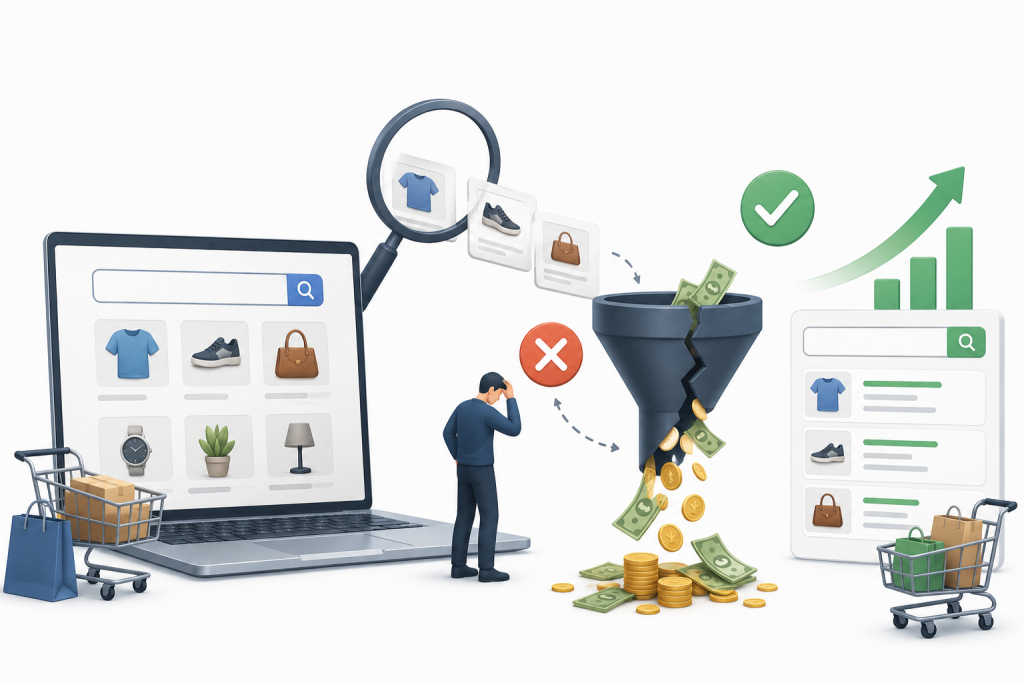
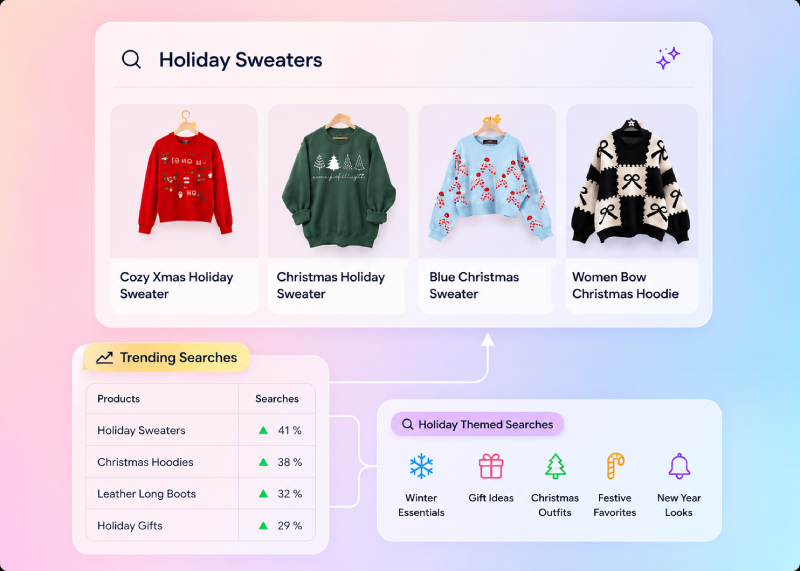

What is search reranking?
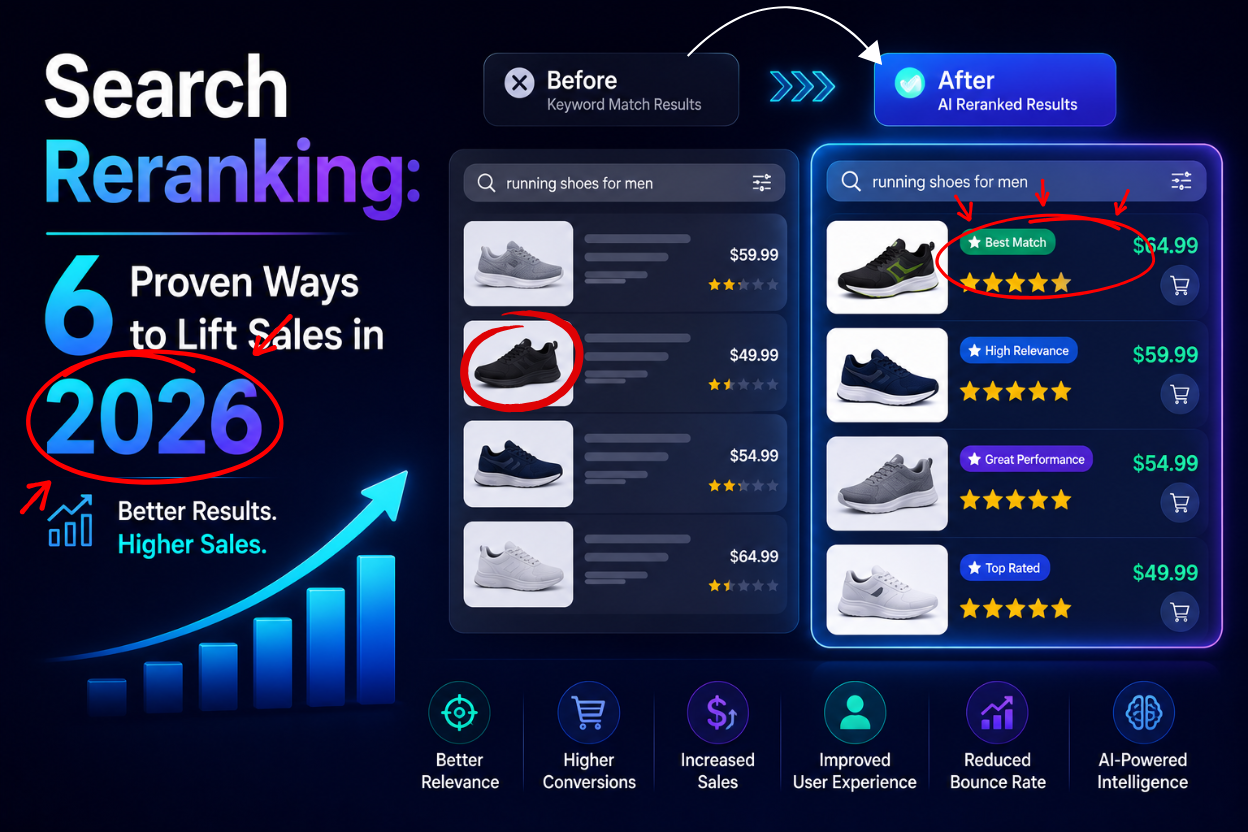
Almost every high-performing search system uses this two-stage design. A lightweight retriever — keyword search, vector search, or both — casts a wide net over your whole catalog in milliseconds. Then search reranking takes the top few dozen or few hundred candidates and applies heavier, smarter scoring that would be too slow to run across the entire catalog. That division of labor is what makes both fast and accurate search possible. Our AI ecommerce search guide shows where reranking fits in the full flow.
Why search reranking matters for ecommerce
Shoppers don’t scroll. On most stores, the top three to five results capture the overwhelming majority of clicks and conversions, so the order of results matters as much as which results appear at all. That’s exactly what search reranking controls — and why it’s one of the highest-leverage levers in ecommerce search. A few reasons search reranking pays off:
- It converts existing demand better. The same retrieved products, reordered well, produce more add-to-carts and sales.
- It aligns search with the business. Pure relevance ignores margin, stock, and what actually converts; search reranking can fold those signals in.
- It fixes the blind spots of retrieval. Vector search can drift on precise queries and keyword search misses meaning — reranking cleans up both before the shopper sees the list.
- It compounds with hybrid search. After a hybrid system fuses keyword and vector candidates, search reranking is what turns that merged pile into a revenue-optimized order.
How search reranking works
The workflow is straightforward. Stage one, retrieval, returns a candidate set — say the top 100 products for a query. Stage two, search reranking, scores each of those 100 candidates more precisely and sorts them. Because the reranker only looks at a small candidate set rather than the whole catalog, it can afford to be computationally expensive and therefore much more accurate.
The key architectural distinction is between bi-encoders and cross-encoders. First-stage retrieval typically uses a bi-encoder: it embeds the query and each product separately, then compares vectors — fast, but it never lets the query and product “see” each other directly. Search reranking often uses a cross-encoder: it feeds the query and a candidate product into the model together, so it can model the fine-grained interaction between them. Cross-encoders are far more accurate per comparison but too slow to run over millions of products — which is precisely why they’re used for reranking a short candidate list rather than for retrieval.
AI Search Grader by bCloud AI
Grade your ecommerce search in 10 quick questions
31% of ecommerce searches return zero results — and most shoppers who hit a dead end leave for a competitor. How does your store's search stack up?
Answer 10 short questions and get your AI search score, plus a personalized report to fix the gaps. Free, takes about 2 minutes.
No signup needed to take the quiz.
Understanding intent…
Scoring your answers across relevance, AI, experience, and insights.
Your AI search score is ready
Tell us where to send your personalized report. You'll see your score and recommendations right away.
Your score by pillar
Personalized recommendations
Fix the gaps in weeks, not quarters
bCloud AI replaces keyword-only search with hybrid AI retrieval — sub-200ms responses, 99.99% uptime, and conversion lifts of up to 40% across 50+ implementations.
6 search reranking methods that matter
Here are the six approaches to search reranking worth knowing for ecommerce, from purely relevance-focused to fully revenue-optimized.
1. Cross-encoder rerankers
Dedicated reranking models (from providers like Cohere and Voyage AI, or open-source options like Qwen3-Reranker) that jointly score query-product pairs. They deliver a big relevance jump over first-stage retrieval alone and are the most common drop-in form of search reranking. Best for: improving relevance quickly without building a custom model.
2. LLM (listwise) reranking
Large language models can rerank by reasoning over the whole candidate list at once, judging relevance with genuine language understanding. It’s powerful for complex, multi-constraint queries — but slower and costlier, so it’s usually reserved for high-value or conversational queries. Best for: nuanced, natural-language queries where reasoning helps.
3. Learning-to-rank (LTR)
Machine-learning models trained specifically to order results — algorithms like LambdaMART or gradient-boosted trees (XGBoost) — that learn from your historical click and conversion data. This is the workhorse of production search reranking; the Learning to Rank approach lets the model weigh dozens of signals automatically. Best for: stores with enough behavioral data to train on.
4. Business-signal reranking
Reranking that folds commercial signals into the score: profit margin, inventory levels, popularity, recency, and review quality. This is where search reranking stops being purely academic and starts protecting revenue — boosting high-margin, in-stock products and demoting out-of-stock ones. Best for: every store that wants search to serve the business, not just relevance.
5. Behavioral / conversion reranking
A specialized form of learning-to-rank that optimizes explicitly for outcomes: which products customers actually click and buy. A perfectly relevant product that nobody purchases gets ranked below a slightly less “relevant” one that converts. This is the search reranking philosophy behind conversion-optimized platforms. Best for: maximizing revenue per search.
6. Reciprocal Rank Fusion (RRF) for hybrid results
Technically a fusion step rather than a full reranker, RRF combines the ranked lists from keyword and vector retrieval into one merged order before a heavier reranker refines it. In hybrid search, RRF is the first pass of search reranking. Best for: blending keyword and vector candidates cleanly.
In practice, the best systems stack these: retrieval → RRF fusion → a cross-encoder or learning-to-rank model that also incorporates business signals.
What to rerank on in ecommerce
The signals your search reranking model weighs determine what “best” means for your store. The most valuable ecommerce reranking signals include semantic relevance to the query, historical click-through rate, conversion rate, profit margin, inventory availability, product popularity, recency, and review ratings. A strong search reranking setup blends relevance with these commercial signals so results are both useful to the shopper and good for the business. bCloud AI’s product search engine, for example, reranks with a model trained on millions of sessions across many such features — measured against a control group so the impact is provable, which ties directly to your search relevance metrics.
How many candidates should search reranking handle?
Candidate depth is the quietest setting in the pipeline. It is also one of the most consequential.
Too few and the best product never reaches the reranker. Too many and latency climbs for no gain. Four points help you find the number for your catalog.
Start at one hundred.
It suits most catalogs and keeps latency comfortable. Treat it as a baseline to move from, not a rule.
Test whether depth helps.
Raise it to two hundred and score the same query set. If relevance barely moves, the extra candidates were noise. Consequently you can drop back down.
Vary it by query type.
A SKU lookup needs almost no depth. A vague browse query needs plenty. Therefore one global number wastes effort on one side or the other.
Watch the tail, not the average.
Deeper reranking hits p99 hardest. Measure there before you commit, since that is where shoppers actually abandon.
In short, tune depth deliberately rather than accepting the default. It costs an afternoon and often buys back milliseconds you can spend elsewhere. Our nearest neighbor search guide covers the retrieval settings that feed it.
How to add search reranking to your store
There are three broad paths:
Add a reranker API.
The fastest route: keep your existing retrieval and pass the top candidates through a hosted reranking service. Low effort, immediate relevance lift, per-query cost.
Build a learning-to-rank model.
More work, but tailored to your catalog and behavior. You’ll need historical click/conversion data, a feature pipeline, and ongoing retraining — real engineering investment for real control.
Use a managed platform.
An AI-native search platform includes search reranking out of the box, blending relevance and business signals without you building or operating the model. bCloud AI’s AI search engine ships retrieval, hybrid fusion, and behavioral reranking as one managed capability — see the best AI ecommerce search platforms for the field.
Whatever route you choose, validate it: measure the reranking change with an A/B test on conversion and revenue per search before rolling it out.
Common search reranking mistakes to avoid
- Reranking on relevance alone. Ignoring margin, stock, and conversion leaves revenue on the table.
- Reranking too many candidates. Heavier models on huge candidate sets add latency; rerank a sensible top-N.
- No behavioral data. Learning-to-rank needs click/conversion history — without it, start with a cross-encoder.
- Skipping evaluation. Always confirm a search reranking change lifts conversion with a live test, not just offline metrics.
- Forgetting latency. Reranking adds compute; keep p95/p99 in check so speed doesn’t erase the relevance win.
When Should You Use Search Reranking?
Not every ecommerce store requires advanced reranking from day one. However, as catalogs expand and customer expectations grow, relying solely on retrieval often leads to less relevant results. The following situations are strong indicators that your search experience can benefit from reranking.
Large Product Catalogs
When your catalog grows into thousands of products, retrieval alone often returns many similar matches. Reranking helps surface the most relevant options first.
Low Search Conversions
If customers search frequently but rarely purchase, improving result ordering can significantly increase conversion rates without increasing traffic.
Hybrid Search Deployments
Combining keyword and vector search generates better candidate results, but reranking is what determines the final order shoppers actually see.
Business Priorities Matter
When inventory, profitability, seasonal campaigns, or customer behavior should influence rankings, reranking enables those business signals without sacrificing relevance.
Takeaway: Retrieval answers the question, “Which products could match this search?” Search reranking answers the more important business question, “Which of those products should the customer see first?” For growing ecommerce stores, that difference often determines whether a search ends with a purchase or an abandoned session.
Frequently asked questions
What is search reranking?
Search reranking is the second stage of a search pipeline that reorders an initial set of retrieved products to put the best results first. Retrieval finds candidates quickly; search reranking applies more powerful scoring to that small set to maximize relevance and, in ecommerce, conversion and revenue.
Why is search reranking important for ecommerce?
Because shoppers focus on the top few results, the order matters as much as which products appear. Search reranking controls that order, letting stores surface the most relevant and highest-converting products first — improving conversion on the same traffic.
What’s the difference between retrieval and reranking?
Retrieval quickly casts a wide net over the whole catalog to find candidate products (optimizing recall), usually with a fast bi-encoder. Reranking then reorders that small candidate set with a more powerful model like a cross-encoder or learning-to-rank model (optimizing precision and business value).
What is a cross-encoder in search reranking?
A cross-encoder is a model that scores a query and a candidate product together, capturing fine-grained interactions between them. It’s far more accurate than the separate-embedding bi-encoders used for retrieval, but too slow to run across a full catalog — so it’s applied to reranking a short candidate list.
How do I add search reranking to my store?
You can add a hosted reranker API on top of existing retrieval, build a learning-to-rank model trained on your click and conversion data, or use a managed AI search platform that includes reranking out of the box. Whichever you choose, validate the change with an A/B test on conversion and revenue per search.
Reorder results for revenue, automatically.
bCloud AI reranks every search with relevance and business signals — margin, stock, and what actually converts — measured against a live control. Start free or book a demo.
bcloud.ai