
What Is an Ecommerce Search Platform?
Ecommerce Search Platform vs. Ecommerce Search Solution: Are They the Same?
Mostly, yes. The terms “ecommerce search platform,” “ecommerce search solution,” and “ecommerce search software” are used interchangeably to describe the same category of technology — the system that runs onsite product search. You may see “solution” used to emphasize the business outcome and “platform” to emphasize the underlying technology, but they refer to the same thing. Whichever label you prefer, the buying criteria are identical: relevance, speed, personalization, and the ability to keep up with AI-driven shopping behavior.
Why Your Ecommerce Search Platform Matters
9 Powerful Features of a Modern Ecommerce Search Platform
When you evaluate any platform, these nine capabilities separate a true revenue engine from a basic search box.
AI Semantic and Vector Search
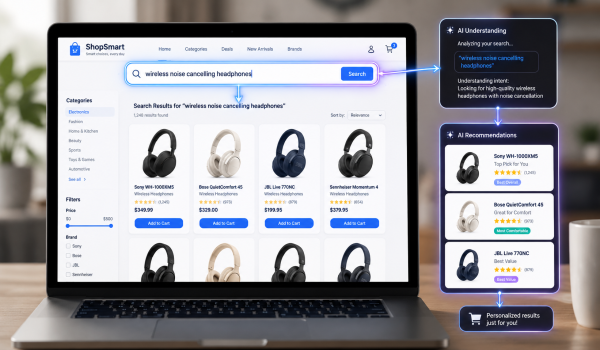
The foundation of a modern platform is meaning-based search. Using vector embeddings, the platform maps products and queries into a shared space so “noise-cancelling headphones” and “ANC headset” match even with no shared keywords. Our pillar AI e-commerce search guide explains the technology end to end.
Conversational and Natural Language Search
Shoppers now search the way they talk — “a waterproof jacket for hiking under $150.” A leading ecommerce search platform interprets natural phrasing and can return generative answers with product citations, the experience customers expect after using ChatGPT. bCloud delivers this through IntentAI conversational search.
Per-Shopper Personalization
Two shoppers, one query, different intentions. The platform should learn from behavior to deliver personalized rankings tuned to each visitor, surfacing the brands, styles, and price points they are most likely to buy.
Smart Autocomplete and Predictive Suggestions
Great autocomplete predicts intent as a shopper types, surfacing products and popular queries instantly — many shoppers never finish typing before they click straight to a product.
Faceted Filtering and Smart Navigation
Once results appear, shoppers refine. Strong faceted browse and filtering — price, brand, size, color, availability — narrows a large result set to the perfect product in a few taps, a pattern backed by years of Nielsen Norman Group search UX research.
Merchandising and Business Rules
Your search platform should serve your business, not just relevance. Look for no-code controls to boost high-margin products, pin campaign items, and demote out-of-stock SKUs.
Search Analytics and Insights
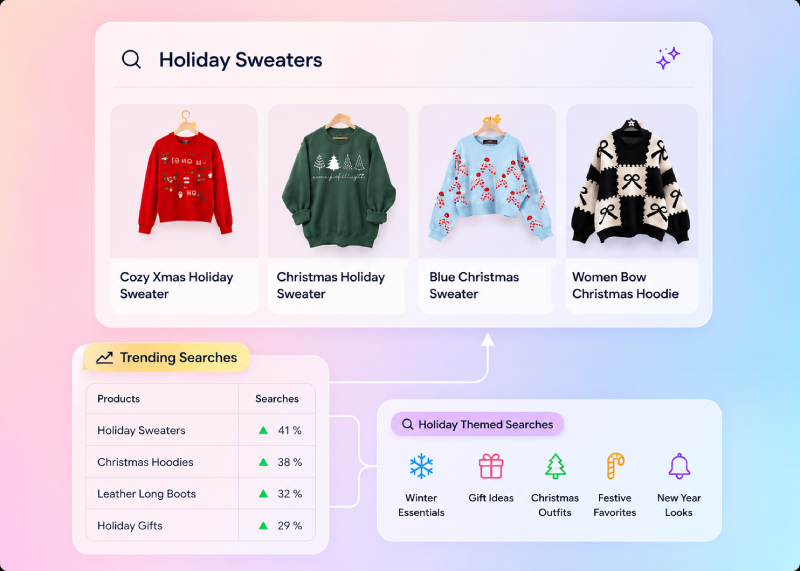
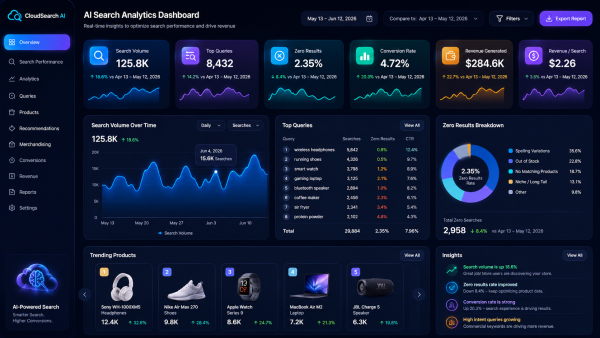
You cannot fix what you cannot see. A built-in search analytics dashboard reveals top queries, trending demand, and — critically — where searches fail, turning raw data into a prioritized roadmap.
Integrations and Scalability
The platform must connect cleanly to your stack — Shopify, BigCommerce, Magento, WooCommerce, or custom — through robust integrations, and stay fast (sub-200ms) as traffic and catalog size grow.
AI Visibility (AEO) Readiness
Shoppers increasingly start on ChatGPT and Google AI Overviews. The best ecommerce search platform helps structure your content and product data so AI assistants can read and recommend your store — a direction Google reinforces in its official guidance on AI features in Search.
How to Choose the Best Ecommerce Search Platform
Rather than chasing feature checklists, score every platform against the outcomes that matter to your store.
The 6-Point Evaluation Checklist
| Criterion | What to ask |
|---|---|
| Relevance | Does it truly understand intent and natural language? |
| Speed & scale | Can it stay sub-200ms under real traffic and catalog growth? |
| Personalization | Does it rank results per shopper automatically? |
| Integrations | Does it connect to your platform with minimal engineering? |
| AI visibility | Does it help you appear in AI Overviews and assistants? |
| Time to value | Live in weeks, not quarters? |
For a side-by-side ranking of the top providers on these criteria, see our roundup of the best ecommerce search engines for 2026. If product discovery specifically is your bottleneck, our product search engine page goes deeper, and the bCloud AI vs 50 competitors breakdown compares the field in detail.
Migrating to a New Ecommerce Search Platform Without the Risk
What Does an Ecommerce Search Platform Cost?
Which Stores Benefit Most?
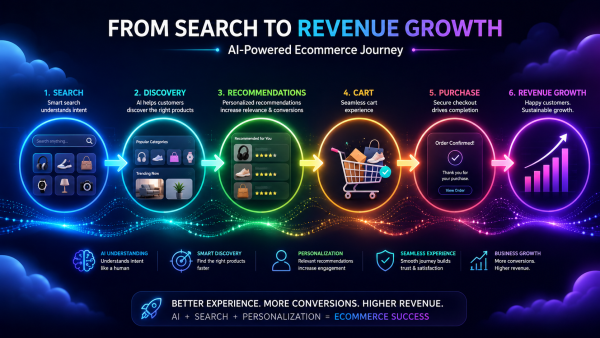
Any online store with more than a few hundred products gains from smarter search, but the impact is largest where discovery is hard: fashion and apparel, electronics, home and furniture, beauty, auto parts, grocery, and B2B distributors with deep, technical catalogs. These verticals share a trait — shoppers use varied, descriptive, and often imprecise language, which is exactly where keyword-only tools break down and AI-driven relevance shines. High-traffic stores benefit disproportionately too, because even a small percentage lift in search conversion compounds into substantial revenue at scale.
Signs You’ve Outgrown Your Current Search
Watch for these red flags: a rising zero-results rate, shoppers refining the same query several times, a search-to-conversion rate well below your site average, support tickets asking “do you sell X?” for products you actually stock, and no way to merchandise or personalize results without a developer. Any two of these together usually mean your current tool is leaving money on the table — and that a more capable, AI-driven upgrade will pay for itself quickly.
Build vs. Buy
Some large teams consider building search in-house on open-source tools for maximum control. It is a valid path, but it demands dedicated engineers, ongoing maintenance, and months of work to reach the relevance a managed AI tool delivers out of the box. For most retailers, buying a managed solution is faster, cheaper over time, and lower risk: you get enterprise relevance in weeks and your engineers stay focused on the rest of the store.
How bCloud AI Delivers an All-in-One Ecommerce Search Platform
Common Mistakes to Avoid When Choosing an Ecommerce Search Platform
Selecting the wrong ecommerce search platform can limit conversions, create unnecessary engineering work, and reduce customer satisfaction. Before making a decision, avoid these common mistakes that often lead to disappointing results.
Choosing Based Only on Price
A lower subscription cost can become expensive if poor search relevance reduces conversions and increases bounce rates.
Ignoring Integration Complexity
Verify that the platform integrates smoothly with Shopify, BigCommerce, Magento, WooCommerce, or your custom ecommerce stack.
Using Keyword-Only Search
Modern shoppers use natural language. Platforms without semantic AI often fail to understand search intent.
Overlooking Analytics
Without detailed search analytics, you’ll never know which searches fail or which products customers struggle to find.
No Personalization
Showing identical results to every shopper ignores buying behavior and reduces opportunities for higher conversions.
Not Planning for Growth
Choose a platform that can scale with increasing traffic, larger catalogs, and expanding product collections without sacrificing speed.
Quick Recommendation
The best ecommerce search platform is not necessarily the one with the most features—it is the one that delivers accurate AI-powered search, fast performance, seamless integrations, actionable analytics, and continuous personalization while remaining easy to manage as your business grows.
Frequently Asked Questions About an Ecommerce Search Platform
What is an ecommerce search platform?
An ecommerce search platform is the software that powers product search and discovery on an online store, indexing the catalog, interpreting shopper queries, and ranking the most relevant products in milliseconds. Modern platforms use AI, semantic search, and natural language processing to understand intent and personalize results.
What is the difference between an ecommerce search platform and a search solution?
There is no meaningful difference — “ecommerce search platform,” “ecommerce search solution,” and “ecommerce search software” all describe the same category of technology that runs onsite product search. The buying criteria are the same: relevance, speed, personalization, and AI readiness.
What features should an ecommerce search platform have?
Look for AI semantic and vector search, conversational and natural language search, personalization, smart autocomplete, faceted filtering, merchandising rules, search analytics, broad integrations and scalability, and AI-visibility (AEO) readiness.
What is the best ecommerce search platform in 2026?
The best ecommerce search platform combines semantic and conversational AI, personalization, sub-200ms speed at scale, broad integrations, and AI-visibility features. Leading options include bCloud AI, Algolia, Coveo, and Klevu; the right fit depends on your catalog size, ecommerce platform, and growth goals.
How much does an ecommerce search platform improve conversions?
Stores that move from basic keyword search to an AI-powered search platform commonly see conversion improvements of up to 40%, along with higher average order value and lower bounce rates, because shoppers find relevant products faster.
Is an ecommerce search platform hard to implement?
No. A modern platform like bCloud AI connects to Shopify, BigCommerce, Magento, WooCommerce, or a custom stack and typically goes live in about four weeks, with no internal machine-learning expertise required.
Does an ecommerce search platform support mobile and voice?
Yes. Leading platforms are mobile-first and increasingly support voice and conversational input, optimized for the majority of ecommerce traffic that now comes from mobile devices.
How does an ecommerce search platform help with AI visibility?
By structuring product data and content so AI engines like ChatGPT, Gemini, and Google AI Overviews can read and recommend your store, an AI-ready search platform turns AI-driven discovery into onsite traffic that converts.