
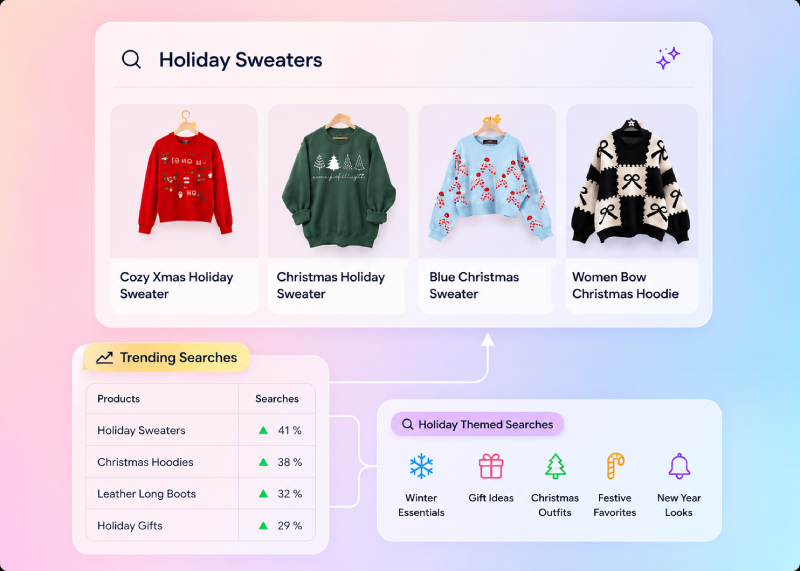
What is vector search product discovery ecommerce?
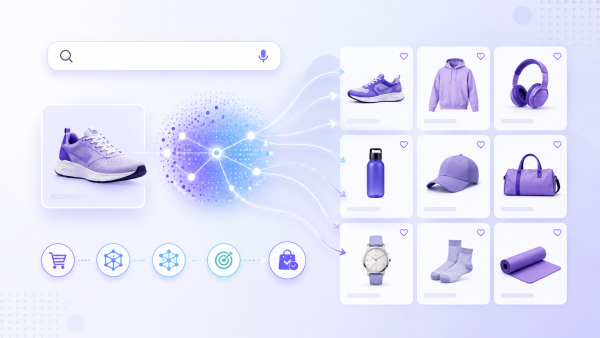
Keyword search vs vector search
| Keyword search | Vector search | |
|---|---|---|
| Matches on | Exact tokens / synonyms you configure | Semantic meaning |
| Handles typos & paraphrases | Limited | Strong |
| Long-tail / descriptive queries | Weak | Strong |
| Zero-result rate | Higher | Lower |
| Setup effort | Synonym/rule tuning | Model + embeddings |
| Best results | Hybrid: keyword + vector combined | |
The practical takeaway: the strongest production setups are hybrid, blending keyword precision with vector recall so you get exact matches and meaning-based matches. The Baymard Institute has documented for years how many stores fail on descriptive and non-exact queries — exactly the gap vector search closes.
AI Search Grader by bCloud AI
Grade your ecommerce search in 10 quick questions
31% of ecommerce searches return zero results — and most shoppers who hit a dead end leave for a competitor. How does your store's search stack up?
Answer 10 short questions and get your AI search score, plus a personalized report to fix the gaps. Free, takes about 2 minutes.
No signup needed to take the quiz.
Understanding intent…
Scoring your answers across relevance, AI, experience, and insights.
Your AI search score is ready
Tell us where to send your personalized report. You'll see your score and recommendations right away.
Your score by pillar
Personalized recommendations
Fix the gaps in weeks, not quarters
bCloud AI replaces keyword-only search with hybrid AI retrieval — sub-200ms responses, 99.99% uptime, and conversion lifts of up to 40% across 50+ implementations.
How vector search product discovery ecommerce works, step by step
Generate embeddings. Each product (title, description, attributes, sometimes image) is converted to a vector with an embedding model.
Index the vectors. Vectors are stored in a vector index optimised for nearest-neighbour search.
Embed the query. The shopper’s search is converted to a vector with the same model.
Retrieve nearest neighbours. The engine finds the closest product vectors (ANN).
Blend & re-rank (hybrid). Results are merged with keyword matches and re-ranked using business signals — popularity, margin, availability, personalisation.
Merchandise. Rules, pins and boosts apply on top so commercial priorities are respected.
Why vector search product discovery ecommerce matters beyond the search box
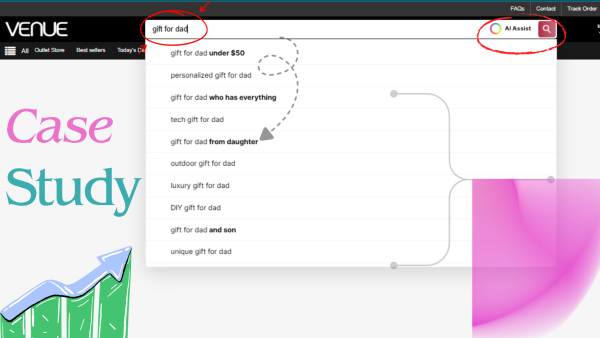
For a deeper platform-by-platform view, see our guides to the top semantic search solutions for ecommerce and the top e-commerce search solutions for large catalogs.
When you need it
You’ll see the biggest gains from vector search product discovery ecommerce when you have a large or growing catalog, lots of long-tail/descriptive queries, multi-attribute products, or high zero-result rates. Small catalogs with mostly exact-match queries may see less lift.
How to deploy vector search product discovery ecommerce
You can build it yourself (an embedding model plus a kNN-enabled Elasticsearch/OpenSearch index or a dedicated vector database) or use a managed AI search platform that handles embeddings, indexing, hybrid blending and merchandising for you — like [bcloud.ai]. The managed route trades some control for far faster time-to-value and no ML/ops burden. If raw speed and relevance are your priority, compare options in our API site search ecommerce comparison.
How Vector Search Improves the Ecommerce Shopping Journey
Vector search improves the ecommerce shopping journey by helping customers discover relevant products even when their search language does not exactly match the catalog. Shoppers can describe a product by its purpose, style, use case, or combination of attributes, and the search engine can connect that intent with products that have similar meaning. This is especially useful for long-tail and descriptive searches where traditional keyword matching may miss relevant items or return too few results. When vector search is combined with keyword precision, filters, personalization, merchandising rules, and accurate product data, retailers can create a more flexible discovery experience that helps shoppers move from an idea or need to suitable products with fewer searches and less frustration.
Common Mistakes When Implementing Vector Search
Vector search can dramatically improve product discovery, but its effectiveness depends on proper implementation. Avoiding a few common mistakes helps retailers deliver accurate, fast, and relevant search experiences from day one.
Ignoring Product Data Quality
Embeddings are only as good as the product data they represent. Incomplete titles, missing attributes, and inconsistent categories reduce search relevance.
Using Vector Search Alone
Relying only on semantic matching may weaken exact SKU or brand searches. Hybrid search combines keyword precision with semantic understanding for the best results.
Skipping Relevance Testing
Regularly test high-volume search queries to ensure rankings match shopper expectations and business goals.
Not Updating Embeddings
When products, descriptions, or inventory change, embeddings should be refreshed so search results always reflect the latest catalog information.
Best Practice: Successful ecommerce search platforms combine high-quality product data, hybrid retrieval, continuous relevance testing, and real-time indexing to maximize search accuracy and customer satisfaction.
FAQ
Is vector search product discovery ecommerce the same as semantic search?
They’re used interchangeably. Semantic search is the goal (matching meaning); vector/embedding search is the most common technique to achieve it.
Does vector search replace keyword search?
No — the best results come from hybrid search that combines keyword precision with vector recall, then re-ranks with business signals.
Do I need a separate vector database?
Not necessarily. You can use a kNN-capable engine (Elasticsearch/OpenSearch), a dedicated vector database, or a managed AI search platform that includes vector indexing.
Will it reduce zero-result searches?
Yes. Because it matches meaning rather than exact tokens, it typically lowers zero-result rates on descriptive and long-tail queries.
Is vector search expensive to run at scale?
Costs come from embedding generation and ANN indexing. Managed platforms fold this into pricing; self-built setups trade licence/infra cost for control. Model your real query volume before choosing.