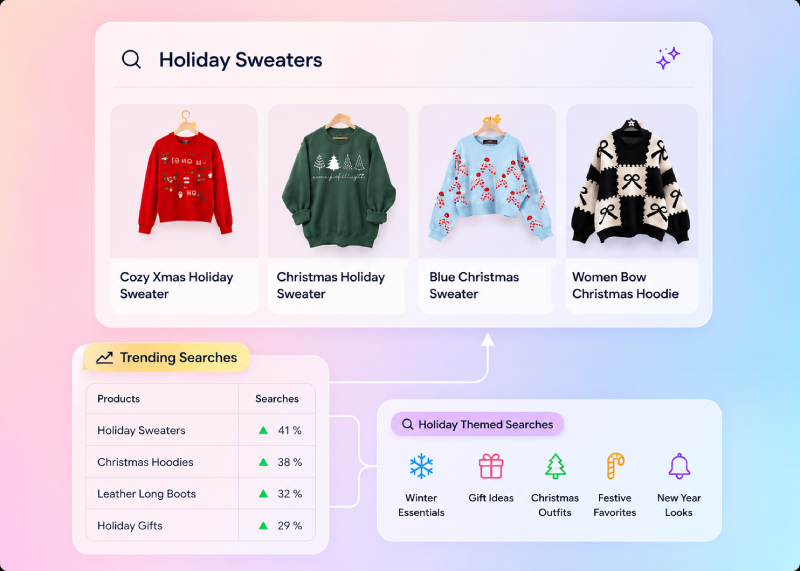

Why large catalogs break ordinary site search
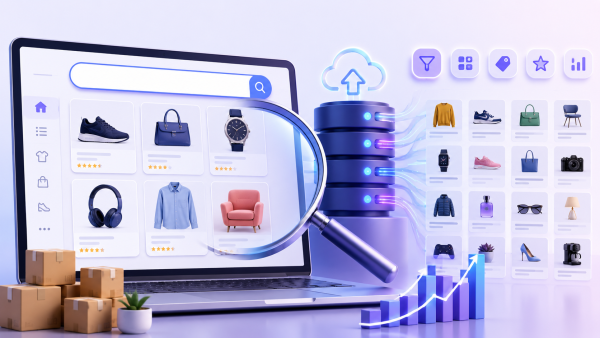
How we ranked them
We scored each platform on six criteria that matter specifically at large-catalog scale: (1) query latency at high QPS, (2) relevance on long-tail/ambiguous queries, (3) vector/semantic capability, (4) merchandising & rules control, (5) indexing throughput / real-time updates, and (6) total cost at scale.
AI Search Grader by bCloud AI
Grade your ecommerce search in 10 quick questions
31% of ecommerce searches return zero results — and most shoppers who hit a dead end leave for a competitor. How does your store's search stack up?
Answer 10 short questions and get your AI search score, plus a personalized report to fix the gaps. Free, takes about 2 minutes.
No signup needed to take the quiz.
Understanding intent…
Scoring your answers across relevance, AI, experience, and insights.
Your AI search score is ready
Tell us where to send your personalized report. You'll see your score and recommendations right away.
Your score by pillar
Personalized recommendations
Fix the gaps in weeks, not quarters
bCloud AI replaces keyword-only search with hybrid AI retrieval — sub-200ms responses, 99.99% uptime, and conversion lifts of up to 40% across 50+ implementations.
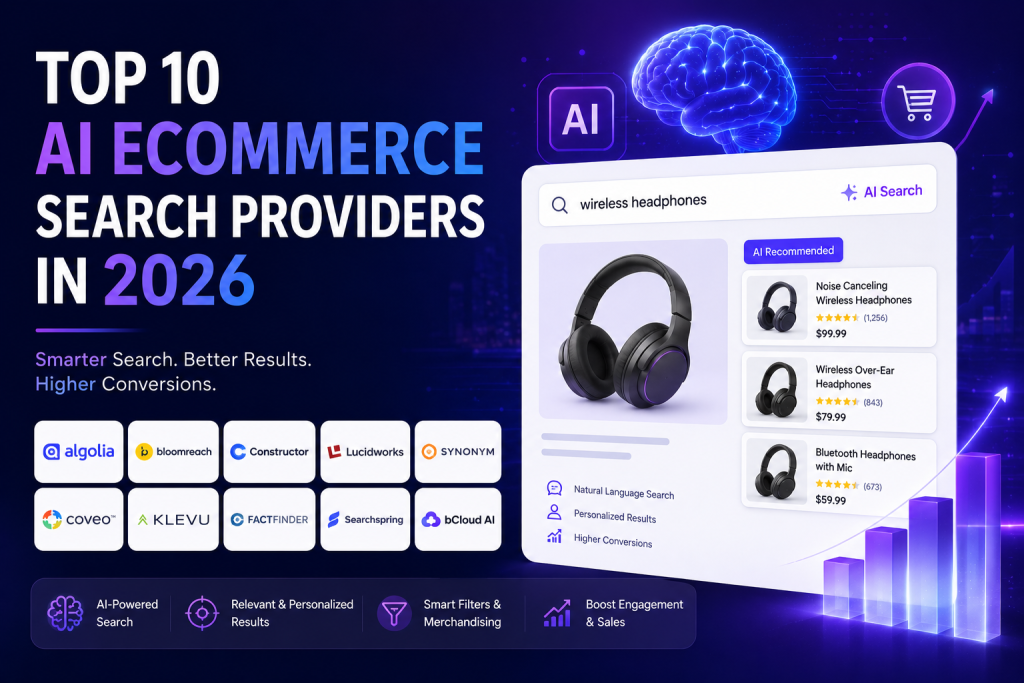
The top e-commerce search solutions for large catalogs
bcloud.ai — best overall for large catalogs
bCloud AI combines hybrid keyword + vector search (NeuralSearch) with real-time indexing built for high-SKU catalogs. Best for: retailers with 1M+ SKUs that need sub-200ms latency and AI relevance without managing infrastructure.
Standout: continuous behavioral reranking — an XGBoost model trained on millions of searches across 47 relevance signals — that auto-tunes long-tail queries with no manual synonym lists or re-tuning, included by default rather than locked behind an enterprise tier (the way Algolia gates NeuralSearch).
Pricing: free Core tier to start; Premium and Enterprise plans priced on catalog size and features, not per search (10K searches + 100K records included, then $0.40/1K and $1.10/1K searches respectively over the allowance), so bills don’t spike on Black Friday; Enterprise Plus is custom with volume discounts.
Algolia — fastest hosted keyword search, strong tooling
Algolia is a hosted, API-first search platform known for low-latency keyword search, a mature merchandising dashboard and strong developer tooling. Best for: teams that prioritise speed and ease of integration. Watch-outs at scale: usage-based pricing (per search/record) can rise sharply on very large catalogs and high traffic. Pricing: [verify current plans].
Constructor — relevance optimised for revenue
Constructor focuses on AI-driven product discovery that optimises for conversion and revenue rather than text-match alone. Best for: large retailers wanting outcome-based relevance and personalisation. Watch-outs: enterprise pricing, sales-led onboarding.
Coveo — enterprise relevance & AI personalisation
Coveo is an enterprise relevance platform with strong machine-learning ranking and personalisation across commerce and support. Best for: large enterprises with complex catalogs and existing data infrastructure. Watch-outs: heavier implementation, enterprise contracts.
Bloomreach Discovery — commerce-specific AI search
Bloomreach pairs search and merchandising with commerce-trained AI and content. Best for: mid-to-large retailers wanting search + merchandising + content in one suite. Watch-outs: suite pricing, broader than search alone.
Elasticsearch / OpenSearch — maximum control, self-managed
Elasticsearch (and the open-source OpenSearch fork) gives you full control of the index and relevance, with vector search support. Best for: teams with engineering resources who want to own the stack and avoid per-query fees. Watch-outs: you operate, scale, tune and secure it yourself — relevance and merchandising are DIY.
Klevu — AI search tuned for conversion
Klevu offers self-learning AI search with strong out-of-the-box relevance for mid-market and growing retailers. Best for: teams wanting low-effort relevance gains. Watch-outs: less control for very large or highly custom catalogs.
Nosto — discovery + personalisation suite
Nosto blends search, merchandising and personalisation aimed at commerce experience teams. Best for: retailers prioritising personalised discovery. Watch-outs: broader suite, search is one module.
Comparison table
| Platform | Best for | Vector/semantic | Real-time indexing | Pricing model | Self-managed? |
|---|---|---|---|---|---|
| [bcloud.ai] | Large catalogs, all-in-one | ✅ Hybrid | ✅ [real-time] | [tiered] | No (hosted) |
| Algolia | Speed + tooling | ✅ (NeuralSearch) | ✅ | Usage-based | No |
| Constructor | Revenue relevance | ✅ | ✅ | Enterprise | No |
| Coveo | Enterprise relevance | ✅ | ✅ | Enterprise | No |
| Bloomreach | Search + merchandising | ✅ | ✅ | Suite | No |
| Elasticsearch/OpenSearch | Full control | ✅ (kNN) | ✅ | Infra/licence | Yes |
| Klevu | Easy AI relevance | ✅ | ✅ | Tiered | No |
| Nosto | Personalised discovery | ✅ | ✅ | Suite | No |
Verify every pricing and feature claim against the vendor’s current docs before publishing.
How to choose for your catalog
Pick hosted AI search ([bcloud.ai], Algolia, Constructor, Coveo, Bloomreach, Klevu, Nosto) if you want managed scale, fast time-to-value and built-in merchandising. Pick self-managed (Elasticsearch/OpenSearch) if you have the engineering depth to own relevance and want to avoid per-query costs. For catalogs above [1M] SKUs with frequent price/stock changes, weight real-time indexing throughput and tail-query relevance most heavily — that is where large catalogs win or lose.
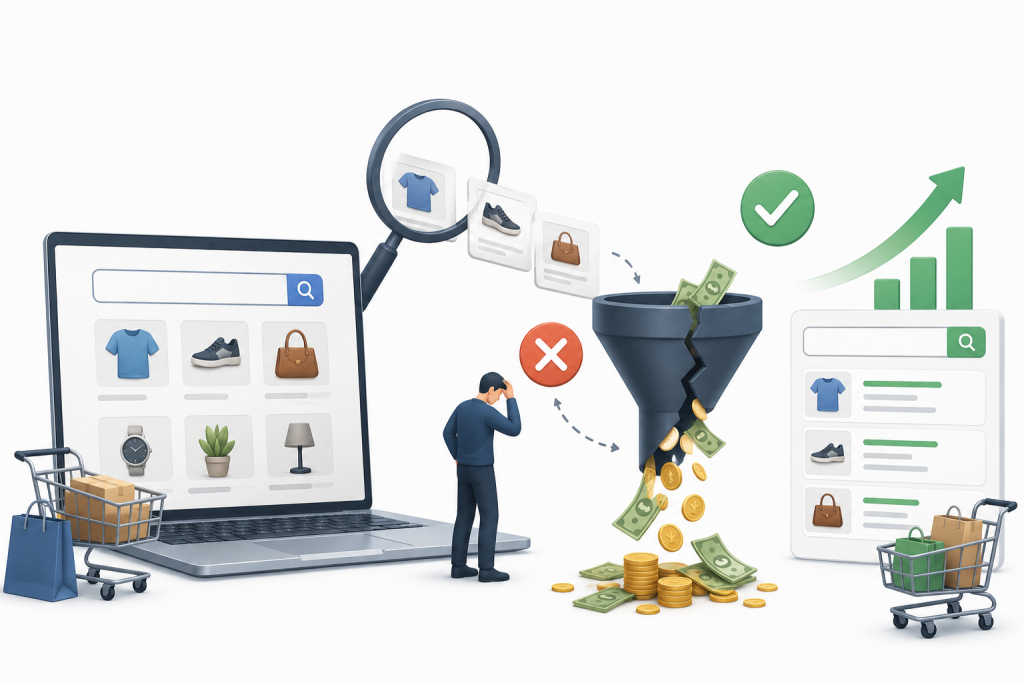
When your catalog runs into the hundreds of thousands — or millions — of SKUs, the search bar stops being a convenience and becomes the single biggest driver of revenue, and frustration, on your site. Basic keyword search buckles under that volume: it returns zero results for obvious synonyms, chokes on misspellings, and slows to a crawl as the index grows. That’s exactly why the conversation around the top e-commerce search solutions for large catalogs has shifted from “nice to have” to “business critical.” For high-SKU retailers, the right platform is the difference between shoppers finding what they want in milliseconds and abandoning the cart for a competitor who made it easier.
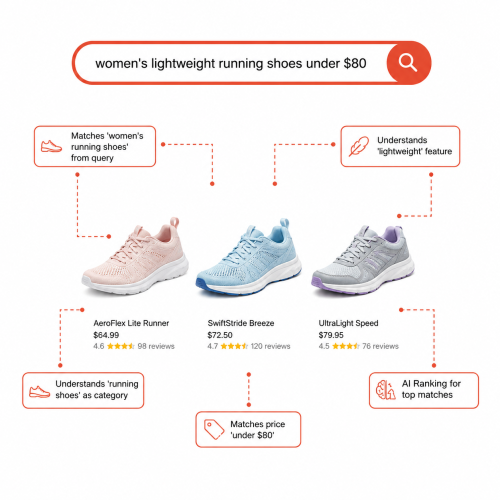
So what separates the leaders? When you evaluate the top e-commerce search solutions for large catalogs, look for hybrid retrieval that pairs keyword precision with vector semantics, real-time indexing that keeps results current as inventory and prices change, sub-200ms latency at scale, and deep faceted filtering so shoppers can drill through enormous assortments without losing the thread. Just as important is infrastructure that auto-scales through traffic spikes — Black Friday should never slow your search to a crawl — alongside analytics that flag zero-result queries and underperforming terms so your team can act on them quickly.
Pricing model matters too: many of the top e-commerce search solutions for large catalogs still bill per search, which penalizes you precisely as you grow, so favor platforms that price on catalog size and features instead. Among the top e-commerce search solutions for large catalogs, AI-native platforms like bCloud AI combine hybrid keyword-and-vector search, real-time indexing, and predictable pricing built specifically for high-SKU retailers — exactly the foundation a large catalog needs to turn search into its most reliable sales channel.
How Large-Catalog Search Improves Product Discovery
For retailers with hundreds of thousands or millions of products, search becomes one of the most important parts of product discovery because shoppers cannot realistically browse the entire catalog. A strong large-catalog search system needs to understand exact product terms as well as descriptive, ambiguous, and long-tail queries while keeping results fast and current as inventory and prices change. Hybrid retrieval can combine keyword precision with semantic understanding, while filters, merchandising rules, and personalization help narrow enormous assortments into useful results. When these capabilities work together, shoppers can find relevant products faster, even across complex catalogs, reducing search friction and creating more opportunities for engagement and conversion.
Migration Checklist for Large-Catalog Search
Migrating a catalog with hundreds of thousands or millions of products requires more than replacing a search endpoint. Planning the migration carefully minimizes downtime, preserves search relevance, and ensures shoppers continue finding products throughout the transition.
1. Audit Your Catalog
Identify duplicate products, missing attributes, inconsistent categories, broken images, and incomplete metadata before indexing. Better product data directly improves search relevance.
2. Export Search Rules
Document existing synonyms, redirects, merchandising rules, ranking boosts, and business logic so they can be recreated in the new search platform.
3. Run Parallel Testing
Keep the old and new search engines running simultaneously while comparing relevance, latency, autocomplete quality, and zero-result searches before switching production traffic.
4. Monitor After Launch
Track search conversion rate, click-through rate, response latency, failed searches, and indexing health during the first few weeks to quickly identify optimisation opportunities.
Large-Catalog Migration Checklist
- ✔ Clean and enrich product data before indexing.
- ✔ Preserve existing synonyms and merchandising rules.
- ✔ Enable real-time inventory and price synchronization.
- ✔ Test search relevance using your highest-volume queries.
- ✔ Validate autocomplete, filters, and category pages.
- ✔ Benchmark latency during peak traffic loads.
- ✔ Monitor analytics and optimise based on real shopper behavior.
FAQ
What counts as a “large catalog” in e-commerce search?
There’s no fixed line, but search behaviour changes meaningfully above roughly 100,000 SKUs and demands different architecture above ~1 million SKUs, where re-indexing frequency and tail-query relevance dominate.
Is Elasticsearch good enough for a large catalog?
Yes, technically — it scales to billions of documents and supports vector search — but you own the relevance tuning, merchandising and operations. Hosted AI platforms trade that control for faster results out of the box.
Do large catalogs need vector or semantic search?
For long-tail and descriptive queries, yes. Hybrid (keyword + vector) search materially improves relevance on the low-frequency queries that make up most large-catalog traffic. [Internal link → vector search article.]
What’s the biggest hidden cost at scale?
Usage-based pricing. On very large catalogs with high traffic, per-search or per-record pricing can grow faster than flat or infrastructure-based models — model your real query volume first.
How fast should large-catalog search respond?
Aim for sub-[X] ms median at your peak QPS; latency above ~[Y] ms measurably hurts conversion on big catalogs.