
What Is a Searchspring Alternative?
Why Retailers Look for a Searchspring Alternative
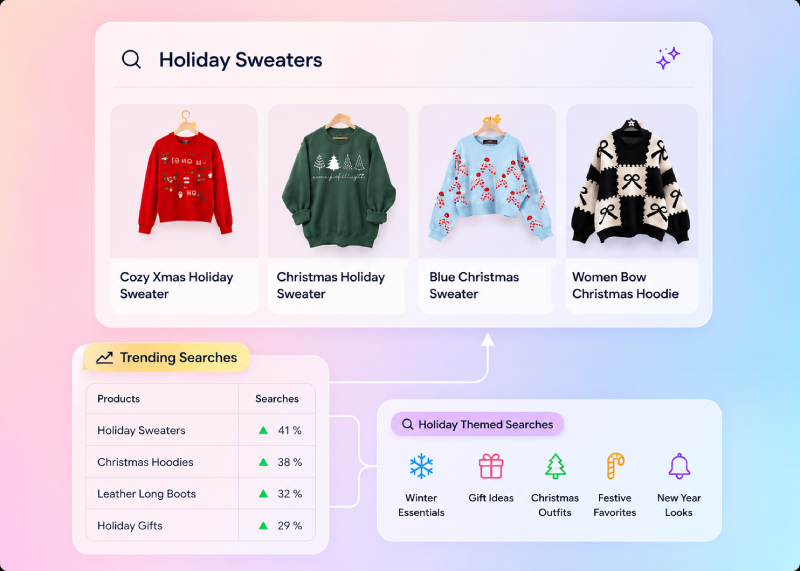
The reasons retailers shop alternatives tend to cluster in a few patterns. Many want AI-native semantic search that understands intent rather than keyword-and-rule-driven matching. Some find pricing unpredictable or steep at scale. Others want stronger support for conversational and visual search as AI assistants and image-led shopping grow. A common driver is implementation friction — retailers want to be live and lifting conversion in weeks, not quarters. And some simply want a vendor whose roadmap is moving in the AI-driven-shopping direction the market is heading. Switching is a real cost, but staying on a tool that no longer fits has its own.
AI Search Grader by bCloud AI
Grade your ecommerce search in 10 quick questions
31% of ecommerce searches return zero results — and most shoppers who hit a dead end leave for a competitor. How does your store's search stack up?
Answer 10 short questions and get your AI search score, plus a personalized report to fix the gaps. Free, takes about 2 minutes.
No signup needed to take the quiz.
Understanding intent…
Scoring your answers across relevance, AI, experience, and insights.
Your AI search score is ready
Tell us where to send your personalized report. You'll see your score and recommendations right away.
Your score by pillar
Personalized recommendations
Fix the gaps in weeks, not quarters
bCloud AI replaces keyword-only search with hybrid AI retrieval — sub-200ms responses, 99.99% uptime, and conversion lifts of up to 40% across 50+ implementations.
What to Look For in a Searchspring Alternative
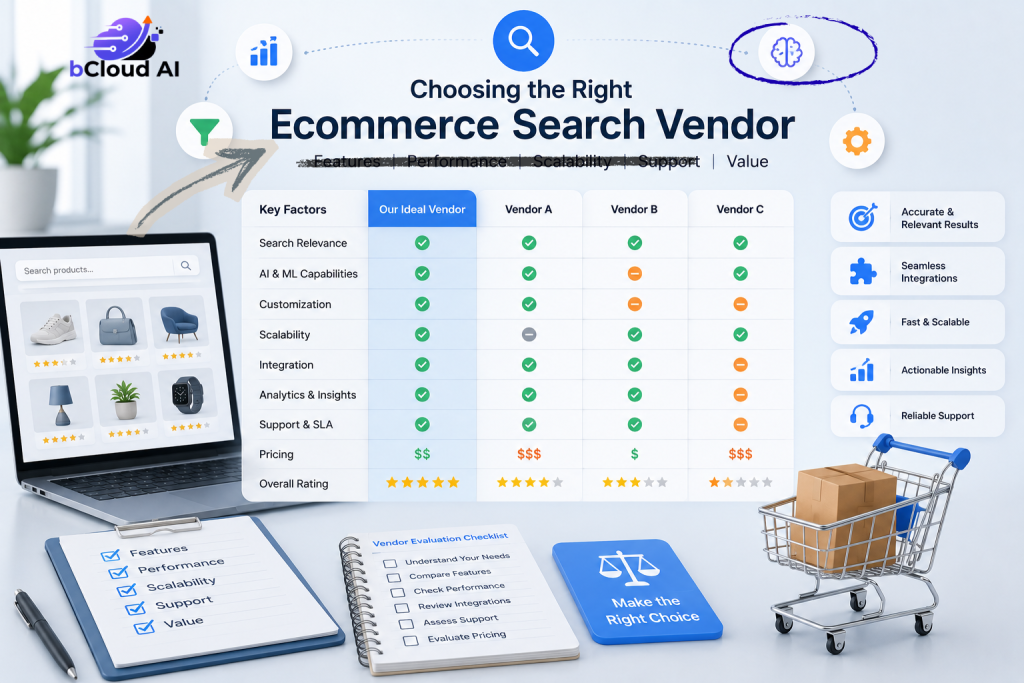
Strong alternatives share a handful of capabilities. AI-native semantic search that understands intent, not just keywords. Real-time personalization tuned to each shopper. Faceted filters and merchandising controls that don’t fight relevance. Conversational, visual, and voice search from one engine. Clean integrations with Shopify Plus, BigCommerce, Magento, WooCommerce, and headless stacks. Transparent, predictable pricing — ideally based on catalog size rather than per-search. And strong implementation and support that gets you live without months of services work. The ecommerce search vendor guide covers the full evaluation framework.
7 Searchspring Alternatives to Consider in 2026
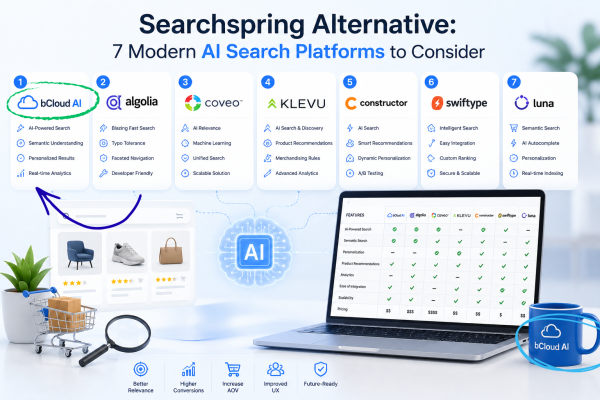
These seven platforms are the most commonly evaluated Searchspring alternatives, each with a different strength.
bCloud AI — AI-Native, Multimodal
bCloud AI is an AI-native platform built around NeuralSearch (hybrid vector + keyword), real-time personalization, generative experiences, and conversational, visual, and voice search from one engine. Predictable catalog-based pricing avoids per-search spikes, and native integrations cover Shopify Plus, BigCommerce, Magento, WooCommerce, and headless. See the in-depth bCloud vs. 50 competitors comparison and our roundup of the best ecommerce search engines for 2026 for full detail.
Algolia — Developer-First Search
Algolia is widely adopted for fast, developer-friendly search with strong APIs. It’s well suited to teams with engineering capacity. Watch pricing closely as scale grows — see our switch from Algolia guide for the comparison detail.
Hawksearch — Enterprise B2B Focus
Hawksearch is often shortlisted by B2B and complex-catalog retailers for its merchandising and rules-based control. Modern AI capabilities and implementation timelines are common evaluation points — see our switch from Hawksearch guide.
Constructor.io — Personalization-Led
Constructor focuses on AI-driven personalization and merchandising. A strong option for retailers prioritizing those capabilities specifically.
Bloomreach Discovery — Enterprise Discovery
Bloomreach is an enterprise-scale discovery platform with deep merchandising and content capabilities. Best fit for large brands with the budget and team to operate it.
Klevu — Mid-Market AI Search
Klevu offers AI-driven search and recommendations aimed at mid-market retailers, with native Shopify support that makes onboarding straightforward.
Fast Simon — Shopify-Native Search
Fast Simon combines AI search with personalization and merchandising, with strong Shopify integration. A common choice for smaller Shopify stores.
How to Compare a Searchspring Alternative
| Criterion | What to look for |
|---|---|
| AI capability | Semantic + vector search, conversational, visual, voice |
| Personalization | Real-time, behavior-driven, not just rules |
| Pricing | Predictable; catalog-based beats per-search at scale |
| Integration | Native Shopify/BigCommerce/Magento; headless support |
| Implementation | Weeks, not quarters; data enrichment included |
| Roadmap | Clearly investing in AI-driven shopping |
| Support | Real humans, fast response, proven at your size |
What to Test During a Trial
Marketing decks lie; hands-on tests don’t. During a trial, run your real catalog and your real shopper queries — especially the descriptive, intent-rich ones a keyword engine struggles with. Test zero-result queries, edge-case spelling and synonyms, mobile performance, and personalization across return visits. Check what happens at peak load. Look at the analytics: can you actually see what shoppers search and where they drop off? Talk to support like you would in production. The vendor that holds up across these real-world tests is the right alternative, regardless of feature-comparison tables.
Migration: What Switching Actually Involves
Switching search vendors sounds heavier than it usually is. The core steps are catalog export and indexing on the new platform, attribute mapping, integration with your storefront or headless layer, search-UI implementation, traffic ramp from old to new, and analytics setup. With native integrations and platform-side data enrichment, mid-market retailers commonly go live in roughly four weeks. The biggest risk is data quality — messy catalogs limit any new engine — which is why platforms with built-in search enrichment tend to deliver faster, cleaner cutovers.
Common Mistakes When Evaluating Alternatives
A few mistakes recur. Choosing on a feature checklist instead of a hands-on test with real data. Underestimating the impact of pricing model on your busiest days. Ignoring data quality and assuming the new engine will magically fix messy catalogs. Skipping the implementation and support conversations until after signing. And evaluating only today’s capabilities, missing the AI roadmap that will shape your discovery experience for years. The fix is a structured evaluation that mirrors how you’ll actually run the platform.
When NOT to Switch From Searchspring
Switching isn’t always the right call. If your current setup is performing well, the merchandising-led model fits your team, and your traffic and AOV are growing — staying put is sensible. Switching for the sake of features you don’t actually use is expensive and risky. The clearest signals it’s time to evaluate alternatives are: a stalled or declining search conversion rate; rising costs that don’t track with revenue; growing customer expectations for natural-language, visual, or voice search that your current platform can’t deliver; or a roadmap from your vendor that no longer aligns with where shopping is heading. Honestly auditing those signals saves you from both unnecessary switches and overdue ones.
Cost of Staying vs. Cost of Switching
Retailers often focus on the cost of switching while ignoring the daily cost of staying on a platform that’s no longer the best fit. Every shopper who can’t find what they want, every search that returns zero results, every visit lost to a sub-par mobile experience — those are revenue leaks that compound. A clean evaluation puts both costs on the same page: the one-time effort of migration against the daily revenue gain a better platform delivers. For most retailers seriously evaluating, the payback period on a strong switch is short — often within a quarter of going live.
Working With Internal Stakeholders
Switching ecommerce search isn’t just a procurement decision — it touches merchandising, engineering, marketing, and analytics. The smoothest transitions involve those stakeholders early: merchandising owns the experience, engineering owns the integration, marketing owns the customer-facing changes, and analytics owns the success metrics. A vendor with mature implementation services and clear documentation makes this multi-team coordination dramatically easier. Run a structured trial across departments rather than letting one team make the call alone — the buy-in pays off in adoption and results after go-live.
How bCloud AI Compares to Searchspring
bCloud AI was built AI-native from the ground up, with NeuralSearch fusing keyword precision and semantic intelligence, real-time personalization that adapts to behavior, generative experiences that dynamically tailor content, and conversational, visual, and voice search from one platform — areas where many legacy search providers treat AI as an add-on. Pricing is predictable based on catalog size, so peak days don’t blow up your bill. Native integrations and AI-driven data enrichment make implementation fast, typically in weeks. Compared against Searchspring’s merchandising-led strengths, bCloud AI leads on AI capability, multimodal discovery, and modern pricing — which is why it’s worth seeing on your real catalog.
Choosing the Right Searchspring Alternative for Your Store
The best Searchspring alternative is not necessarily the platform with the longest feature list, but the one that fits your catalog, technology stack, shopper behavior, and growth plans. Retailers should consider how well a platform understands natural-language intent, handles complex catalogs, personalizes results, supports merchandising, and scales across increasing traffic without creating unpredictable costs. Integration effort and data quality also matter because even advanced search technology depends on clean, structured product information. Evaluating these factors against real shopper queries and business goals helps retailers choose a search platform that improves product discovery today while providing the flexibility needed for future AI-driven shopping experiences.
Questions to Ask Before Choosing a Searchspring Alternative
Before committing to a new ecommerce search platform, make sure the vendor can answer these practical questions. The responses often reveal whether the platform is built for long-term growth or just today’s requirements.
- Can the platform understand shopper intent instead of relying only on keyword matching?
- Does pricing remain predictable as your product catalog and search traffic grow?
- How quickly can the platform be integrated with Shopify, BigCommerce, Magento, or your headless storefront?
- Does it include AI features such as semantic search, personalization, visual search, or conversational shopping?
- Can your team monitor search performance with detailed analytics and continuously improve the shopping experience?
Tip: The right Searchspring alternative should not only improve search relevance today but also provide the AI capabilities, scalability, and flexibility your ecommerce business will need as customer expectations continue to evolve.
Frequently Asked Questions About Searchspring Alternatives
What is a Searchspring alternative?
A Searchspring alternative is any competing ecommerce search and product-discovery platform retailers evaluate as a possible replacement. Common alternatives include bCloud AI, Algolia, Hawksearch, Constructor.io, Bloomreach Discovery, Klevu, and Fast Simon, each with different strengths.
Why do retailers look for a Searchspring alternative?
Common reasons include wanting AI-native semantic search rather than rule-driven matching, more predictable pricing, stronger conversational and visual search, faster implementation, and a vendor roadmap aligned with AI-driven shopping. Switching costs are real, but staying on a poor-fit platform has its own.
What should I look for in a Searchspring alternative?
Look for AI-native semantic search, real-time personalization, conversational/visual/voice modes from one engine, clean integrations with your stack, transparent catalog-based pricing, fast implementation with data enrichment, and a clearly AI-focused roadmap.
Is bCloud AI a good Searchspring alternative?
For retailers wanting AI-native search, multimodal discovery, real-time personalization, and predictable pricing, bCloud AI is a strong alternative. Its NeuralSearch combines vector and keyword retrieval, and conversational/visual/voice share one engine. A hands-on test with your catalog is the best way to confirm fit.
How long does it take to switch from Searchspring?
With native integrations and platform-side data enrichment, mid-market retailers commonly go live in roughly four weeks. The timeline depends on catalog complexity, attribute mapping, and how clean the data is — platforms with built-in enrichment typically deliver faster cutovers.
Is Algolia a Searchspring alternative?
Yes. Algolia is a developer-first search platform widely evaluated against Searchspring, especially by teams with engineering capacity. Pricing at scale and depth of AI capability are common comparison points — see our switch from Algolia guide for detail.
How do I evaluate a Searchspring alternative?
Run a hands-on trial with your real catalog and queries — especially intent-rich, zero-result, and edge-case queries. Test mobile performance, personalization across visits, peak-load behavior, analytics depth, and support quality. Decisions based on real-world tests beat feature checklists every time.
What is the best Searchspring alternative in 2026?
“Best” depends on your needs. For AI-native multimodal discovery with predictable pricing, bCloud AI leads. For developer-first APIs, Algolia is widely used. For enterprise B2B merchandising, Hawksearch is common. Compare options on your real catalog using the criteria above.
See an AI-Native Searchspring Alternative on Your Catalog
The right alternative lifts conversion every day after switching. Start for free or book a demo to compare bCloud AI side-by-side with your current setup.
Related resources: Switch from Algolia · Switch from Hawksearch · bCloud vs. 50 Competitors · Best Ecommerce Search Engines for 2026