
bCloud AI

FREE White Paper: How AI Search Generated $2.54M in 90 Days
⚡ Ecommerce Search Optimization

Search Relevance

Tuning Guide
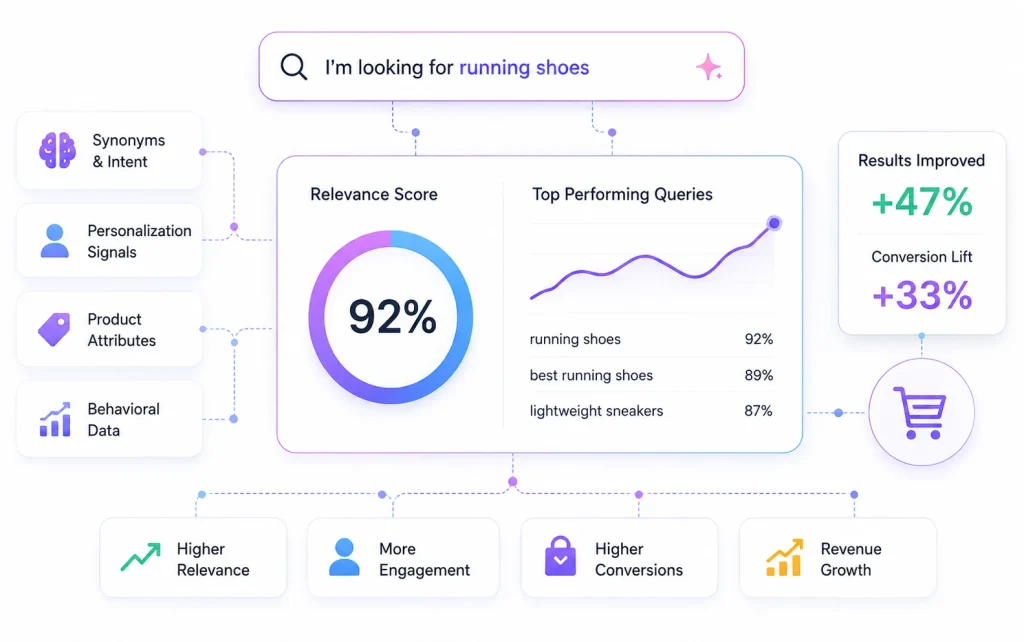
Search Relevance Tuning determines whether shoppers instantly find products they love — or bounce from your store frustrated. This guide breaks down the frameworks, mistakes, and AI systems driving ecommerce search in 2026.

How Ecommerce Site Search Search Works

Ranking Signals

Every relevance engine combines multiple signals into a final score: textual match (TF-IDF or BM25), recency, popularity, inventory status, margin, conversion rate, and increasingly, vector similarity. Effective search relevance tuning starts by deciding which of these signals matter most for your business and how heavily to weight each one.

Synonyms & Expansion

Shoppers don't speak your catalog's language. "Couch" should find sofas, "trainers" should find sneakers, "yoga pants" should find leggings. Synonym dictionaries are the unsexy backbone of search relevance tuning — and the first place legacy platforms fail because the dictionary requires constant manual upkeep.

Behavioral Signals

Click-through rate, add-to-cart rate, and purchase rate per query are the most important inputs for modern search relevance tuning. A product that gets searched 1,000 times but converts 0.1% should rank lower than one that converts at 4% — even if the textual match is weaker.

Boosts, burys, and business rules

Search relevance tuning isn't only about relevance — it's about commercial outcomes. Pin bestsellers to the top, boost high-margin items, push promotional brands during a campaign, and automatically bury out-of-stock products so shoppers don't get frustrated.

How AI Changes Search Relevance Tuning

Traditional Workflow
Merchandisers create rules, developers implement changes, analysts review results, and the optimization cycle repeats every few weeks.
AI-native Workflow
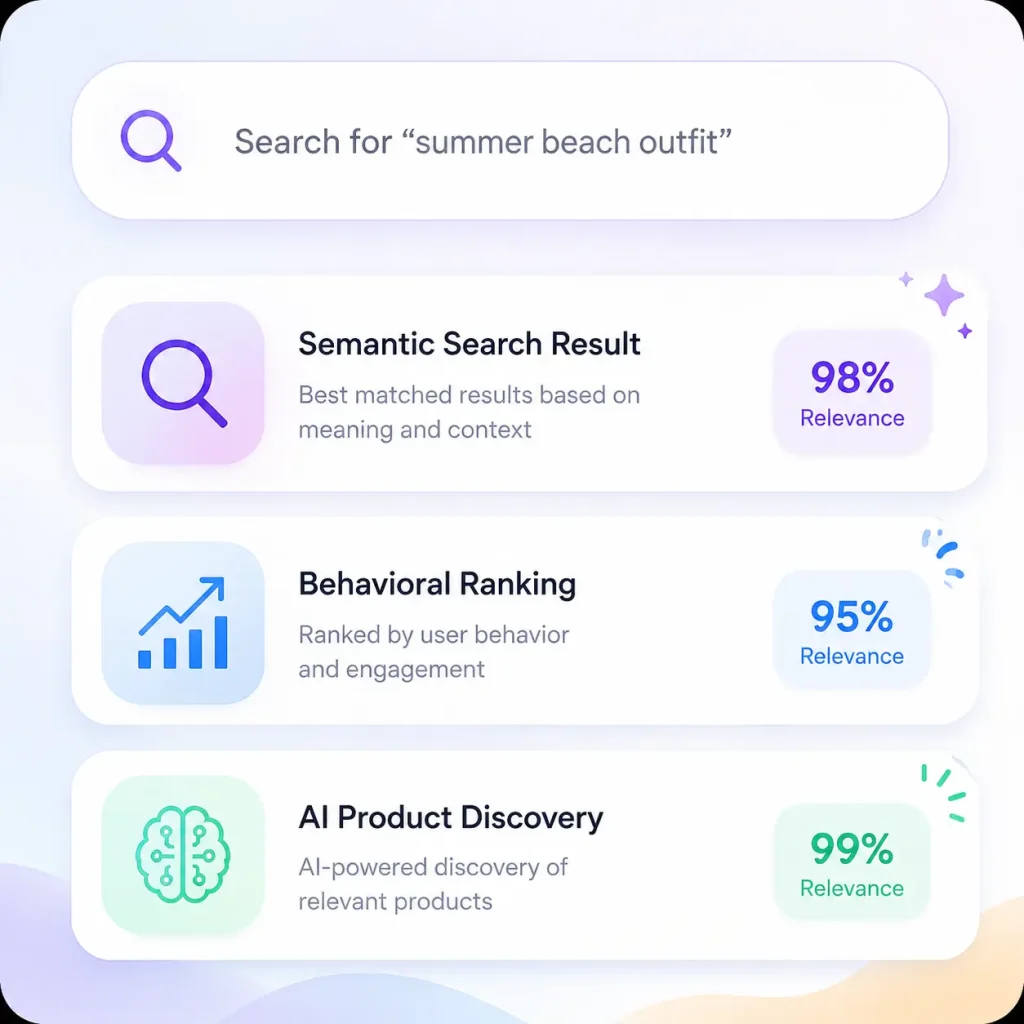
Vector embeddings, automatic synonym detection, and behavioral reranking continuously optimize search relevance without constant manual intervention.
Business Outcome Tuning
Instead of writing endless rules, teams define strategic goals like boosting margin, promoting inventory, or surfacing new arrivals.
Continuous Learning
Every click, add-to-cart action, and completed purchase continuously feeds valuable behavioral data into the ranking engine. Over time, the AI automatically learns customer preferences, improves product relevance.

The Most Common Relevance Tuning Mistakes

Ignoring Long-tail Queries

20–40% of ecommerce searches are unique. Focusing only on head queries leaves major revenue opportunities untouched.

Tuning By Anecdote

One executive typing a single query should never drive ranking decisions. Optimize using aggregate cohort behavior instead of isolated examples.

Manual Synonym Work

Maintaining synonym dictionaries manually becomes impossible at scale. AI-native systems automate this continuously.

No Measurement Loop

Without CTR, conversion, and zero-results dashboards, relevance tuning becomes guesswork instead of optimization.

How bCloud AI Automates Search Relevance Tuning

Manual relevance tuning is slow, subjective, and never done. bCloud AI replaces that cycle with a continuous, self-improving loop — so your search gets smarter every day without extra engineering effort.

Catalog Intelligence at Ingestion

When you connect your catalog, bCloud AI doesn't just index it — it enriches it. Product titles, descriptions, attributes, and categories are parsed through a retail-trained language model that builds semantic representations for every SKU. This means relevance starts strong on day one, not after months of manual synonym work.

Real-Time Behavioural Signals

Every shopper interaction is a signal — clicks, add-to-cart events, purchases, scroll depth, and zero-result exits all feed into the ranking model continuously. bCloud AI weights these signals by recency and business outcome, so trending products surface faster and low-performers drop without anyone touching a dashboard.

Automated Zero-Result Recovery

Zero-result queries are the single most damaging relevance failure in ecommerce search. bCloud AI detects them instantly, applies semantic fallback retrieval, and logs them for your team in the analytics dashboard. The result: up to 80% fewer dead-end searches, and a clear list of catalog gaps your buyers are already looking for.

Merchandiser Override Layer

AI sets the baseline — your team sets the strategy. A no-code dashboard lets merchandisers pin products, create synonym rules, boost high-margin SKUs, and bury clearance stock for any query. Changes go live instantly and stack on top of AI relevance, not against it.

⚠ Manual Relevance Tuning

✓ bCloud AI

80%

Fewer zero-result searches after switching

−62%

Avg. conversion uplift vs keyword search

Weekly dev time needed for search tuning

5 days

Typical time from signup to live search tuning

Frequently asked questions

What is search relevance tuning and why does it matter for ecommerce?
Search relevance tuning is the process of configuring your site search engine to return the most useful, conversion-driving results for every query. It involves setting ranking signals, handling synonyms, recovering zero-result searches, and applying business rules. Poor relevance is invisible to most teams — shoppers just leave silently — making it one of the most underinvested levers in ecommerce.
The key signals are: text relevance (how well a product’s title and description match the query), behavioural signals (clicks, add-to-cart, purchases from search results), popularity (units sold, view rate), inventory status (in-stock items rank higher), recency (new arrivals boost), margin or business priority, and personalisation signals (shopper history). The challenge is weighting these correctly — and keeping weights current as your catalog and customers evolve.
A zero-result query is one where the search engine returns no products. This is the worst possible search outcome — a shopper with clear buying intent leaves empty-handed. The industry target is a zero-result rate below 1%. Above 10%, you’re losing meaningful revenue daily. Solutions include synonym expansion, semantic fallback retrieval, “did you mean” suggestions, and curated fallback collections for your most common failing queries.
Manual relevance tuning relies on developers and merchandisers manually creating rules, synonym lists, and boosting configurations — and updating them every few weeks. This is slow, incomplete (especially for long-tail queries), and never reaches a steady state. AI-native search like bCloud AI learns continuously from real shopper behaviour, infers synonyms from catalog and query data automatically, and adjusts ranking weights based on actual conversion outcomes — without ongoing human effort.
bCloud AI uses vector embeddings — a mathematical representation of meaning — so “trainers”, “sneakers”, and “running shoes” map to the same semantic space, even if none of those exact words appear in a product title. Typos and phonetic variants are handled at the retrieval layer. Retailer-specific terminology is learned from your catalog automatically, so you don’t need to manually populate synonym tables before going live.
Yes — and this is by design. bCloud AI handles baseline relevance automatically, while a no-code merchandising dashboard gives your team full control over business logic. You can pin specific products to the top for a query, create boost rules for high-margin items, suppress out-of-stock or clearance products, and define category-specific ranking strategies — all without writing code. AI and merchandising work together, not against each other.
The core metrics to track are: zero-result rate (target <1%), click-through rate on search results, add-to-cart rate from search, search-driven conversion rate, and revenue per search session. bCloud AI's analytics dashboard surfaces all of these in real time, plus a ranked list of failing queries so you always know where to focus next. Built-in A/B testing lets you measure the revenue impact of any ranking change before rolling it out fully.
The four most damaging mistakes are: ignoring long-tail queries (20–25% of searches that collectively represent major missed revenue), tuning by anecdote instead of data (one vocal customer complaint driving changes that hurt the majority), manual synonym work that never scales (becoming impossible to maintain as your catalog grows), and having no measurement loop (making changes without tracking whether they actually improved conversion).
If your search relevance tuning workflow still relies on manual rules, our deep-dive on AI product search shows how vector embeddings and behavioral reranking automate most of it. Teams hitting high zero results e-commerce rates almost always have a relevance problem at the root. For the broader category landscape, see our guides to ecommerce site search software and the editorial pick for best e-commerce search. If you’re escaping a platform that’s making relevance tuning painful — or expensive — start with our breakdown on why teams find Algolia too expensive.

Related posts

bCloud AI vs Coveo

Coveo sits firmly in the enterprise tier of search and digital experience platforms. It’s a capable system with deep features — but enterprise pricing and long deployment cycles.
Semantic Search Product Catalog

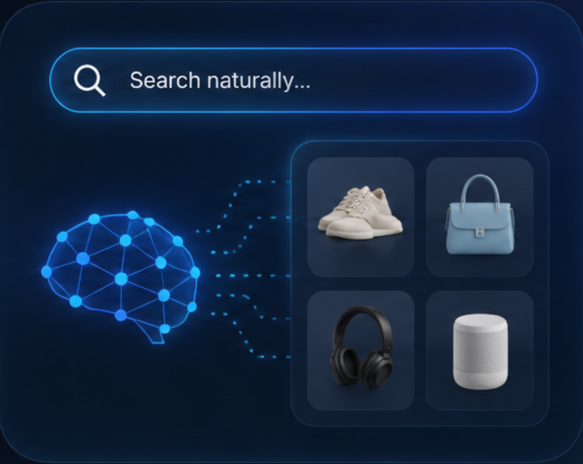
Semantic search applied to a product catalog is a retrieval system that understands shopper intent rather than matching keywords.

E-Commerce Search Engine

E-commerce search engine makes all the difference between a sale and an abandoned cart.

Product Search Engine

Intelligent AI search helps customers find products instantly using semantic search, vector ranking, and natural language understanding.

Vector Search Ecommerce

Vector Search Ecommerce is a retrieval method that converts shopper queries and product catalogs into high-dimensional numerical vectors and finds matches by mathematical similarity rather than literal word matching.

Best e-commerce search

The best e-commerce search platform is the one that turns more visitors into buyers — and in 2026, that means moving past keyword matching into AI-powered semantic understanding.

bCloud AI vs Meilisearch

Compare deployment speed, AI-native capability, infrastructure costs, and search performance to see which platform gives eCommerce teams the fastest ROI in 2026.

Zero Results Ecommerce

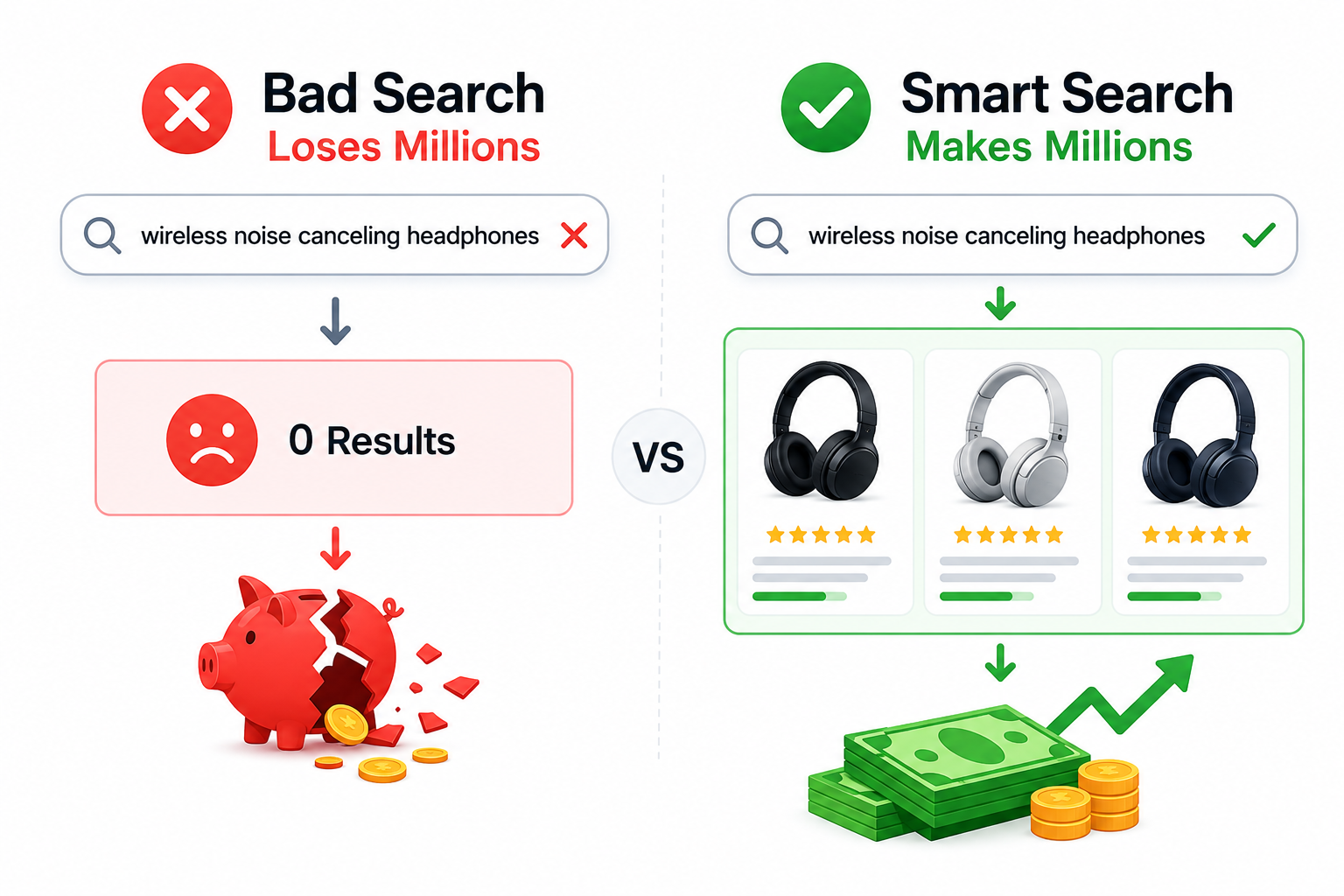
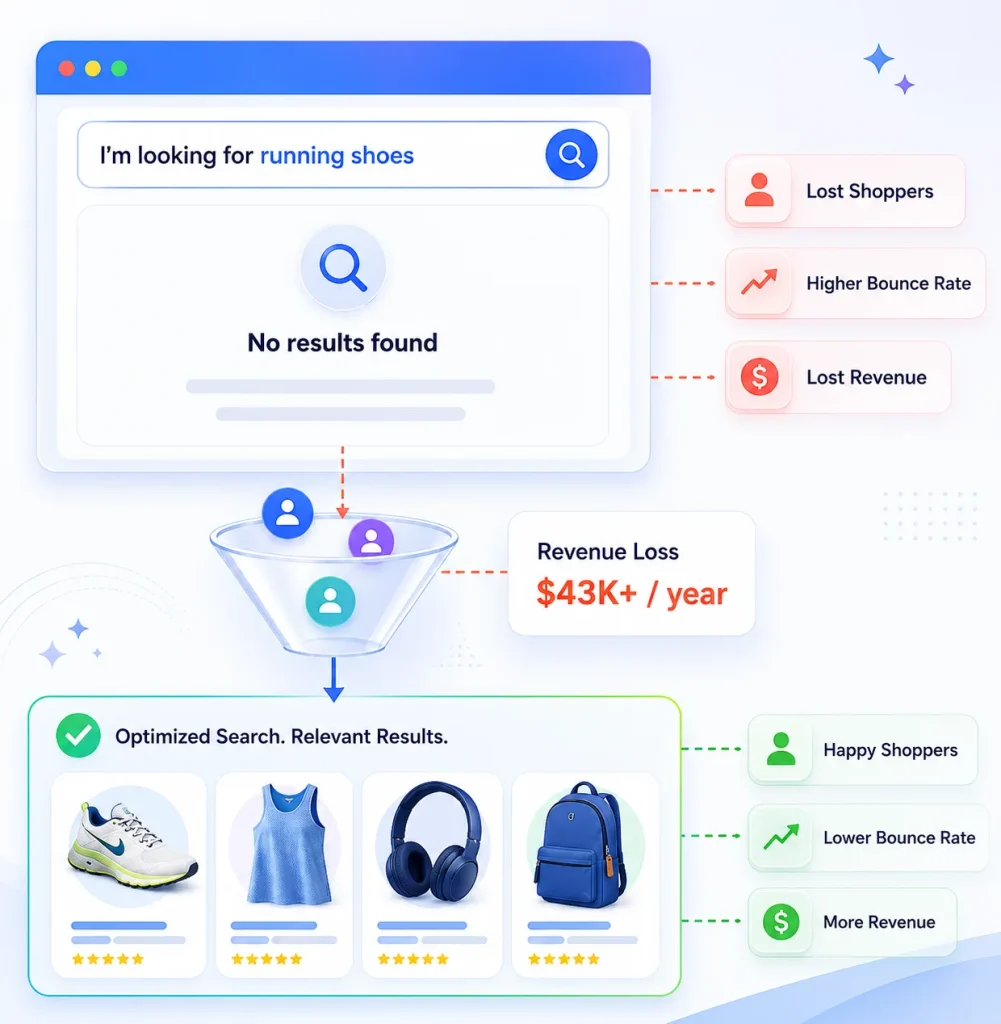
A zero-results page is the most expensive page on your store. Every empty search result silently destroys conversions, increases bounce rate, and damages shopper trust.

Ecommerce Site Search Software

If you’ve been searching for an Algolia alternative, you’re not alone. As Algolia’s pricing has shifted toward AI-tier paywalls and per-request billing, more e-commerce teams are evaluating other options.
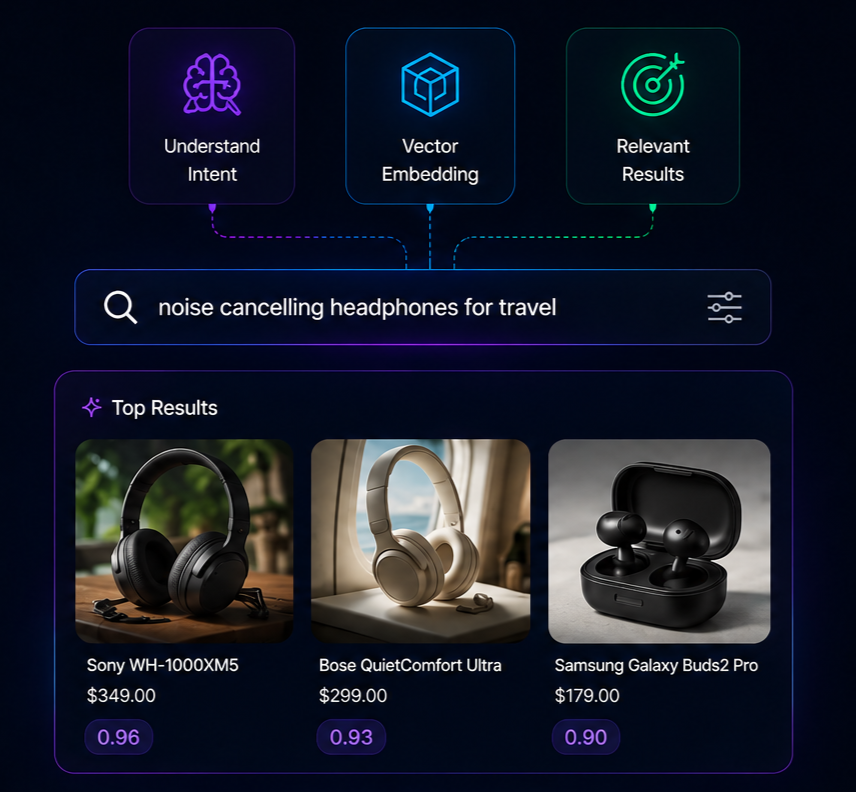
E-Commerce Search Advanced

Transform product discovery with AI-powered search experiences designed to improve conversions, engagement, and customer satisfaction.

Search Relevance Tuning That Drives More Conversions

Continuously optimize search rankings using customer behavior, product performance, and AI-powered relevance signals to ensure shoppers always discover the most relevant products first.
Scroll to Top