Semantic search is only as good as the vectors it indexes. Vectors are only as good as the source text they’re embedded from. And source text comes directly from your catalog. That creates a tight dependency: messy catalog → messy embeddings → mediocre search.
Three catalog problems sabotage semantic search more than any others:
Sparse descriptions
A product titled "Leather Jacket" with no description body produces a thin embedding. Add three sentences covering material, fit, occasion, and care — embedding quality jumps significantly.
Inconsistent attributes
When "color" is sometimes "navy," sometimes "blue," sometimes "midnight," and sometimes blank, faceted retrieval breaks. Normalize attributes before embedding.
Missing categorical context
Embedding a product with category breadcrumbs ("Apparel > Outerwear > Jackets > Leather") gives the model far more semantic signal than the product title alone.
The catalog schema for
production semantic search
A production-grade semantic search product catalog deployment requires a structured schema that the embedding pipeline can consume cleanly. The minimum viable schema:
Naively embedding only the product title is the most common mistake teams make. The fix is structured concatenation — building a single text input from multiple catalog fields with delimiters, then embedding the result.
[Brand] Acme Outdoors
[Category] Apparel > Outerwear > Jackets
[Title] Cascade Insulated Hiking Jacket
[Attributes] Color: Forest Green | Material: Recycled Polyester
[Description] A lightweight insulated jacket built for cold-weather
hiking. Water-resistant shell, 800-fill down lining…
Re-embedding cadence
Re-embed when
Title, description, brand, category, or core attributes change
Skip when
Price updates, inventory toggles, or stock status changes
Most teams re-embed too often. Catalogs change daily, but most changes don’t affect semantic meaning. Triggering only on meaningful field changes dramatically reduces embedding compute costs.
Choosing the right embedding
model for your catalog
Embedding models differ on three axes: dimension count (accuracy vs speed), domain training (general vs e-commerce-tuned), and language coverage.
Model
Dimensions
Best for
all-MiniLM-L6-v2
384
Small catalogs, low latency budgets
BAAI/bge-large-en
1,024
English-heavy mid-market catalogs
multilingual-e5-large
1,024
Multi-language storefronts
OpenAI text-embedding-3-large
3,072
API users, highest quality
Cohere embed-v3
1,024
Domain-tuned for retail
Implementation paths:
build, partner, or buy
Parent-product embedding
Embed only the parent SKU; let variants inherit. Simpler, but loses variant-specific context.
01
02
Per-variant embedding
Each variant gets its own vector. Most accurate, but explodes catalog size.
Hybrid
Parent embedding for retrieval, variant attributes layered on for filtering. The pragmatic default for most stores.
A semantic search product catalog system isn’t just embeddings. Real shoppers want to combine semantic intent (“comfortable office shoes”) with hard filters (size 9, under $200, in stock). The architecture combines two layers:
CTR, conversion rate, and margin signals reorder the final result set.
Tactical tip
When filters return zero results, surface the closest alternatives instead of an empty page. "No size 9 in stock — here are similar styles in size 10" recovers the session and prevents bounce.
The rollout playbook for
semantic search across your catalog
Week 1: Catalog audit and cleanup
Pull a sample of 100 random products and audit description quality, attribute completeness, and category consistency. Fix the gaps that affect the largest revenue tier first.
Week 2: Pick the platform and run the proof-of-concept
Run 50 real shopper queries from your search analytics through both your current engine and the candidate platform. Compare zero-results rate
and top-5 relevance side-by-side.
Week 3: Index and integration
Connect your product feed, embed the catalog, deploy the search frontend. Most modern AI-native platforms get to a working integration in under a week with a single async script.
Week 4: A/B test, measure, iterate
Run new search alongside existing search at 50/50 traffic split. Measure conversion rate, AOV, zero-results rate, and search abandonment. Promote to 100% when the lift is statistically significant.
What to expect:
realistic outcomes from semantic catalog search
Vendor benchmarks and case studies converge on a consistent set of numbers when stores migrate from keyword-only to hybrid vector search:
Metric
Before
After
Zero-results rate
8–15%
under 2%
Search-to-purchase
baseline
+30–50%
Long-tail query coverage
low
+40–60% recovered queries
Search session depth
baseline
+15–25% pages per session
Search abandonment
baseline
−40–60%
Common catalog-specific
pitfalls and how to avoid them
Style descriptors ("flowy," "cropped," "oversized") matter as much as colors and sizes. Make sure descriptions include style adjectives, not just spec lists. Semantic search loves descriptive language.
Room context ("for small living rooms," "fits studio apartments") and style context ("mid-century modern," "scandinavian") drive semantic relevance. Embed these even when they're in marketing copy rather than spec fields.
Compatibility data ("fits iPhone 15 Pro," "works with Sonos") is critical. Structure compatibility as an attribute array rather than burying it in the description.
Use-case language ("sensitive skin," "anti-aging," "fragrance-free") drives most semantic queries in this category. Audit descriptions for use-case completeness.
SKU-level exactness matters more than in B2C — hybrid retrieval (BM25 + vector) is non-negotiable. Pure vector search will return semantically related parts when a buyer needs the exact part number.
Multilingual embedding models (like multilingual-e5-large or Cohere's multilingual variants) embed queries and products
from different languages into the same vector space. A French shopper searching "veste d'hiver chaude" can match an English-titled "warm winter jacket" without any translation step. This is a significant operational win compared to maintaining per-language keyword indexes.
Implementing semantic search product catalog systems is just the start of the modern e-commerce search stack. The architectural foundations are covered in our deep dive on vector search ecommerce, while reasoning capabilities — handling complex multi-step queries — are detailed in the LLM search for e-commerce guide. For the customer-facing layer, our natural language product search playbook covers query understanding, autocomplete, and result presentation. And if you’re running on a specific commerce platform, see our integration guide on AI search BigCommerce for the drop-in deployment path.
Eliminate silos. Automate workflows. Connect Shopify, Salesforce, Adobe Commerce and more — all in one cloud-native platform built for modern commerce.
E-commerce search engine makes all the difference between a sale and an abandoned cart.
Frequently asked
questions
What is semantic search for a product catalog?
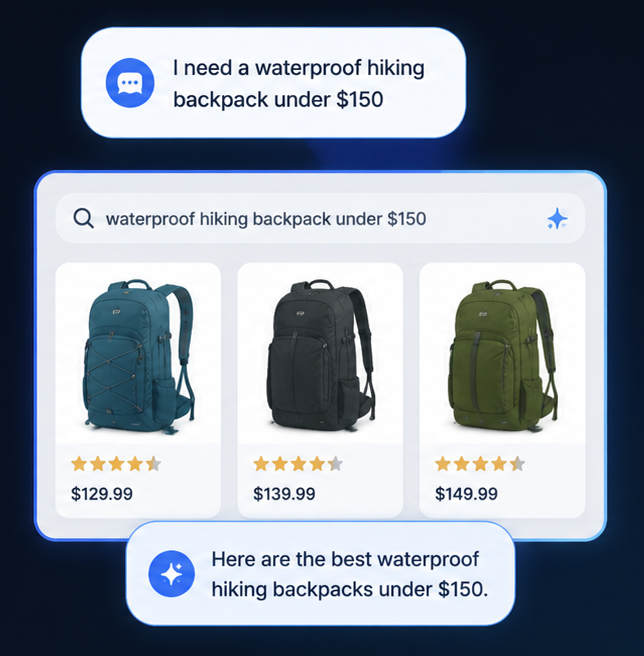
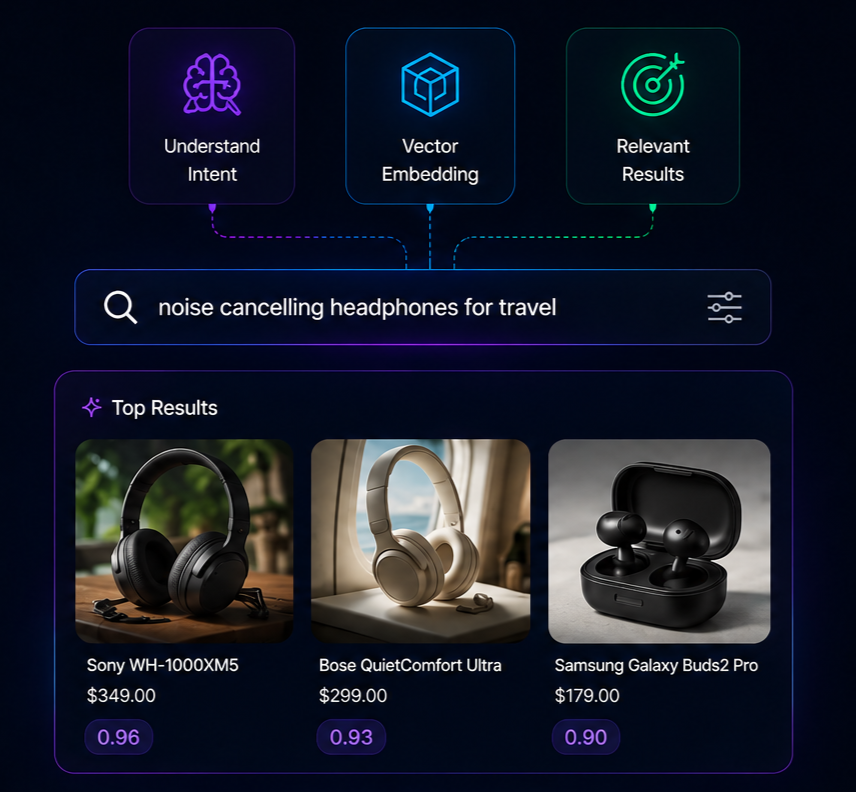
Semantic search for a product catalog is a retrieval method that understands the meaning of shopper queries rather than matching keywords. It uses neural network embeddings to find relevant products even when shoppers describe what they want in different language than the catalog uses.
How big does my catalog need to be?
Semantic search delivers value at any catalog size, but ROI compounds. Catalogs with 5,000+ SKUs see the most dramatic improvements because long-tail query coverage scales with catalog depth.
How long does implementation take?
With a modern AI-native platform: under a week from contract to live. With self-hosted open-source components: 3–6 months for production-grade deployment with one to three engineers.
Can I run semantic search alongside my existing keyword search?
Yes — A/B testing at the traffic-split level is the standard rollout. Most platforms support running both engines in parallel during the migration period.
Does semantic search handle typos automatically?
Yes. Embeddings are inherently typo-tolerant because misspelled queries produce vectors close to the correctly-spelled originals. No edit-distance dictionaries required.
Unlock Smarter Product Discovery with Semantic Search
Help shoppers find the right products faster with AI-powered semantic search that understands intent, context, and natural language across your entire product catalog.