

AI Search for B2B Ecommerce: What Actually Has to Work
Why B2B search is its own discipline
Every result depends on who's asking.
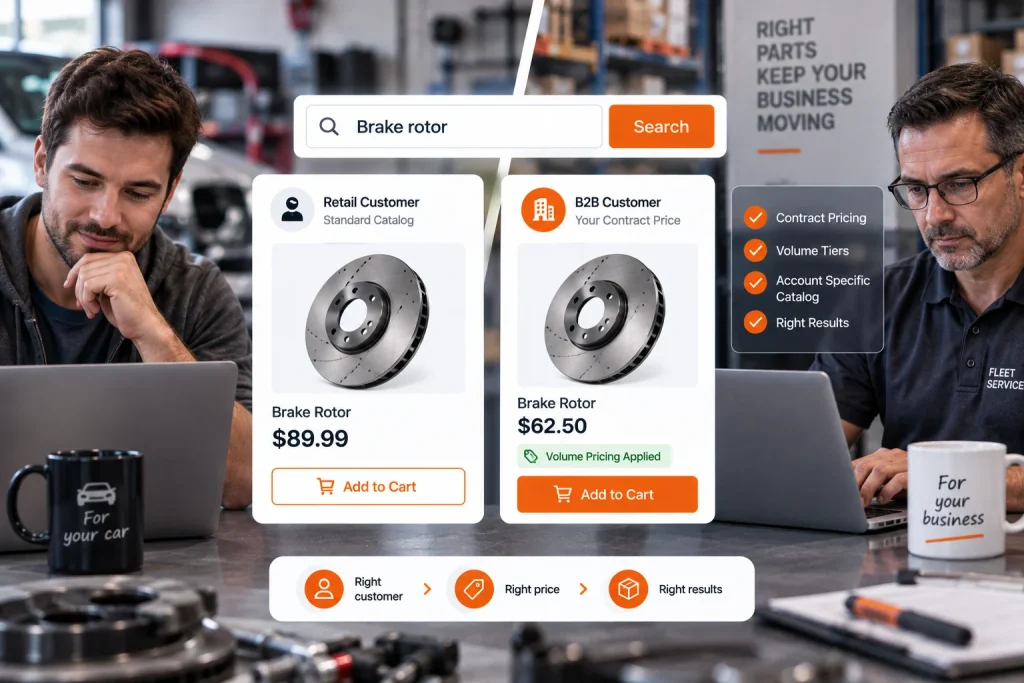
In retail, a product has a price. In B2B ecommerce, a product has your price — contract-negotiated, volume-tiered, and often different from the list price and from what the account next door pays. Search results that ignore account context are showing the wrong catalog to everyone.
In B2B ecommerce, not everyone can see everything.
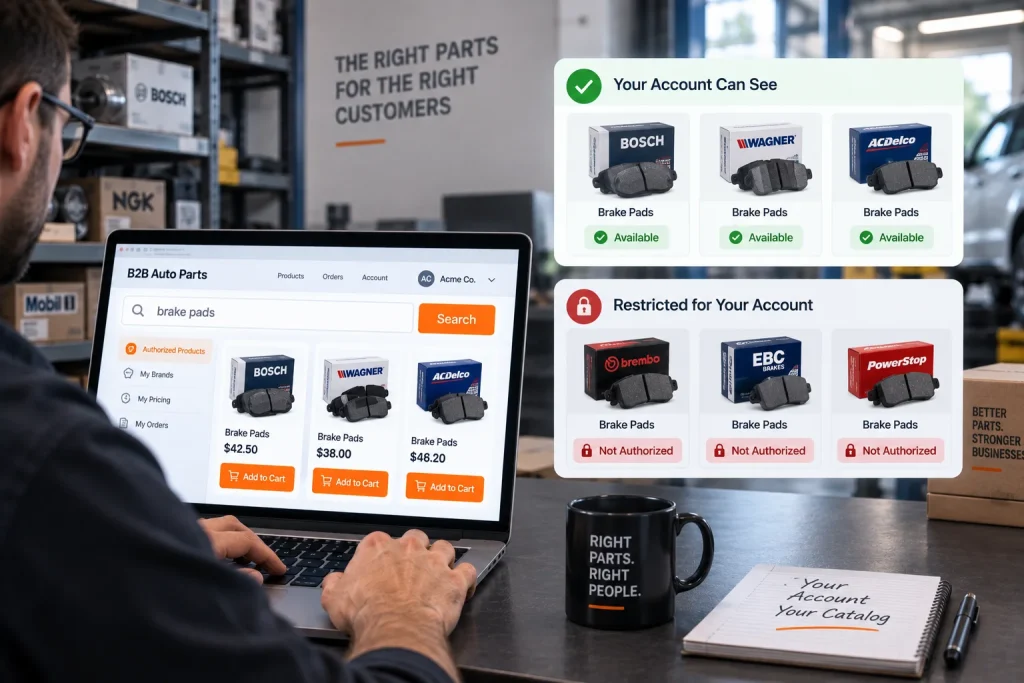
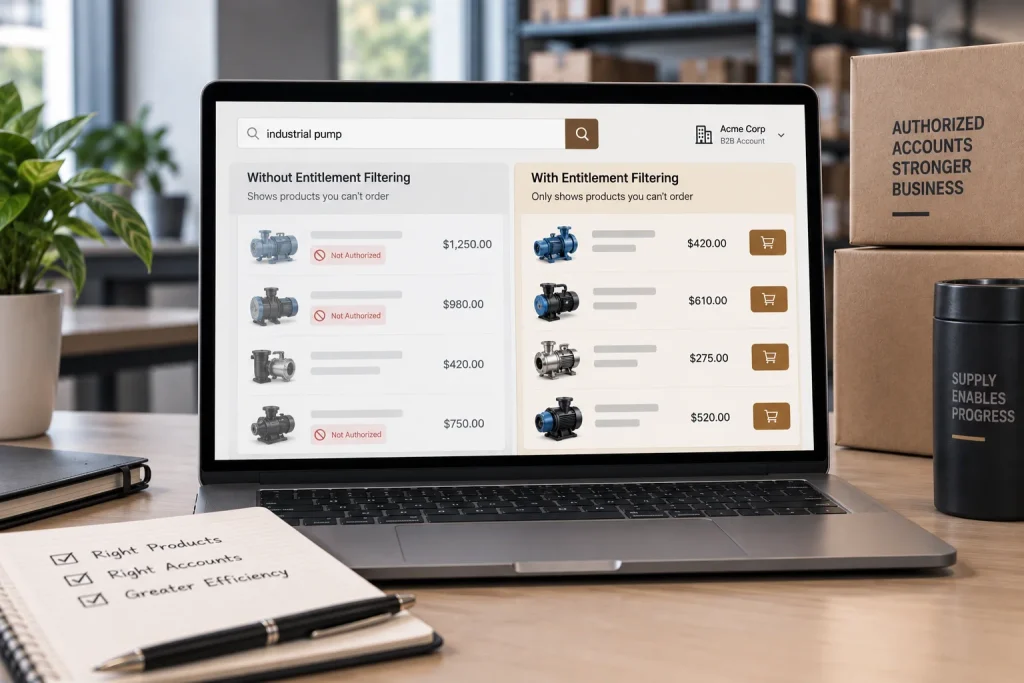
Entitlements restrict which products an account can order at all. A distributor might carry lines a given customer isn't authorized to buy. Search must filter on that before relevance ever enters the picture.
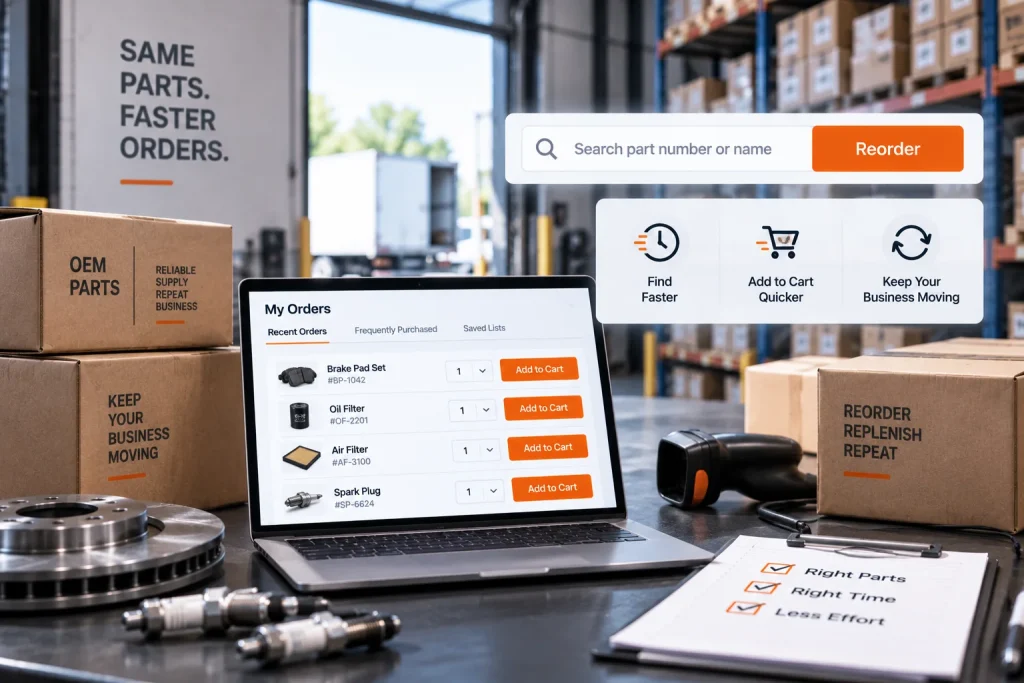
Most revenue is reorder.
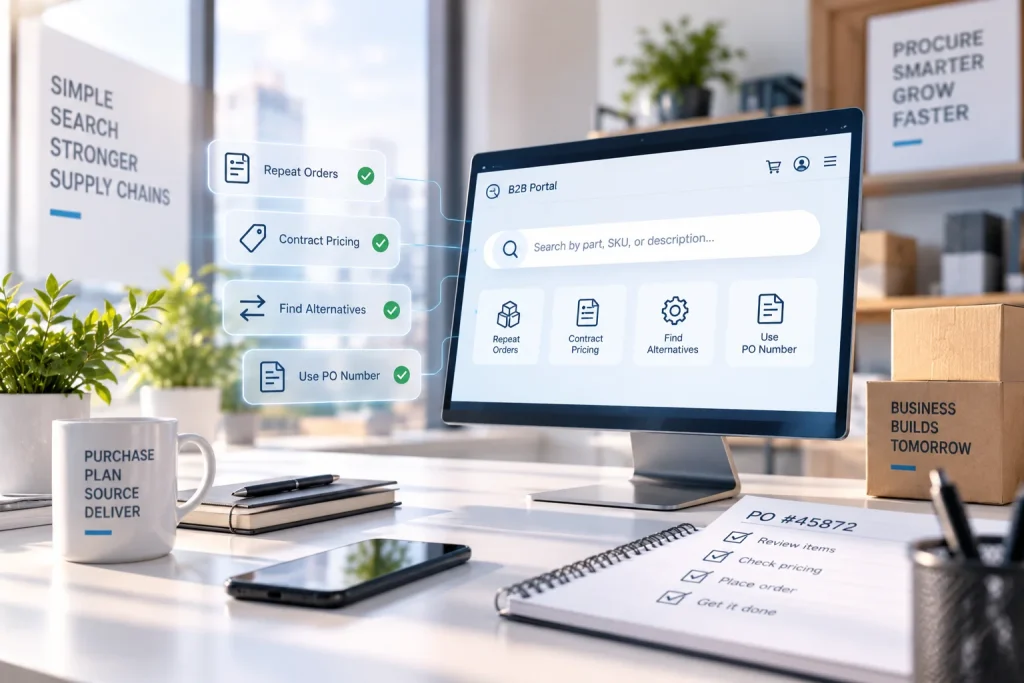
The bulk of B2B ecommerce revenue flows through repeat purchasing. That makes search less a discovery tool than a speed tool — the job is getting a known item into a cart quickly, not helping someone browse.
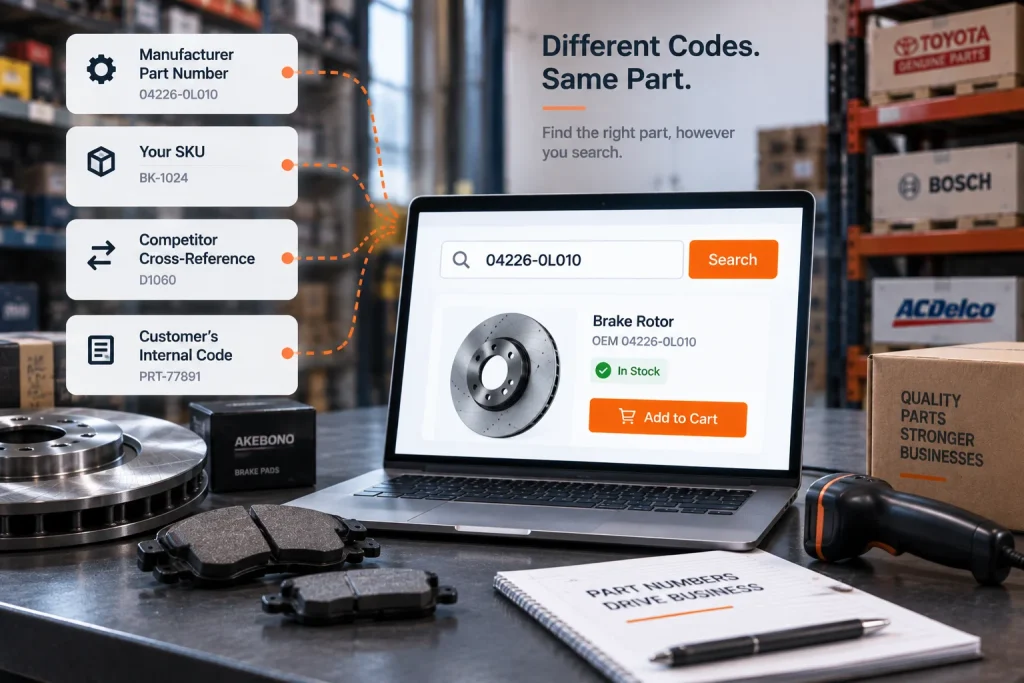
Identifiers dominate the query mix.
Manufacturer part numbers, your SKUs, competitor cross-references, and the customer's own internal codes. B2B product search traffic skews heavily toward exact strings in a way retail never does.
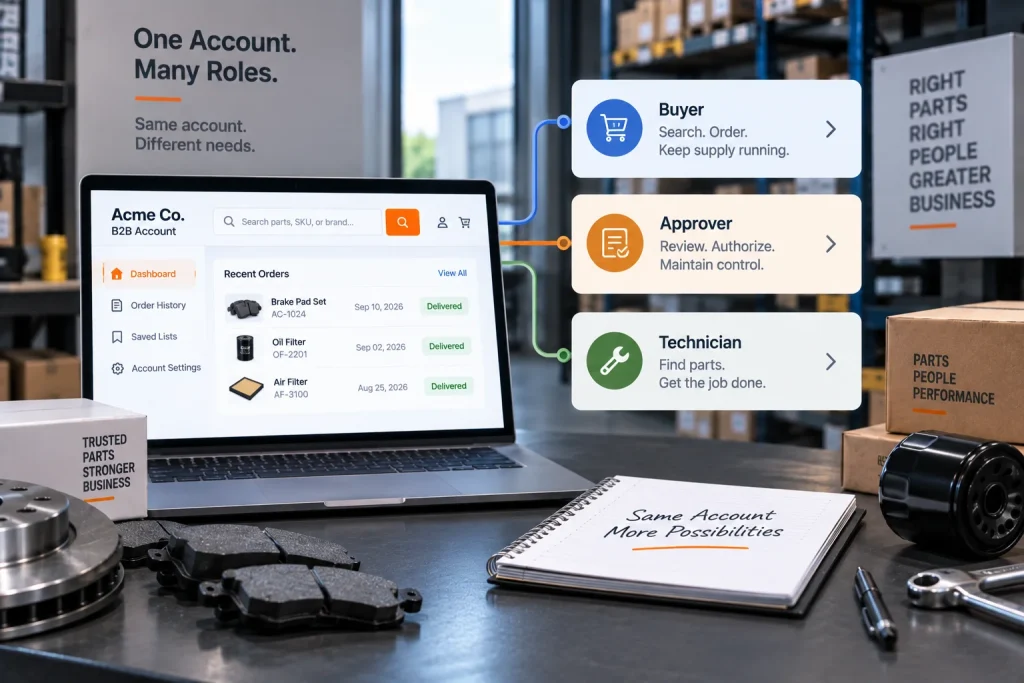
In B2B ecommerce, multiple people share one account.
A buyer, an approver, and a technician all use the same login context with different permissions and different needs. Purchase history belongs to the account, not the individual.
What AI actually adds
Descriptive queries are about half the traffic.
Buyers don't always know the part name. "Corrosion-resistant fastener for coastal installation," "quiet compressor for a small workshop," "replacement for the one that keeps failing in cold weather." B2B semantic search handles these; keyword matching has nothing to grab.
Specification extraction is where B2B semantic search pays off fastest.
"M8 stainless hex bolt 40mm A4 marine grade" should become structured filters automatically rather than forcing a buyer through six facet menus. This is one of the clearest wins in B2B product discovery, because it converts a tedious navigation task into a single query.
Cross-reference suggestion.
When a competitor's part number doesn't resolve, semantic similarity across specifications can propose likely equivalents — useful for building your mapping data, though it should be reviewed rather than published blind.
Symptom and application matching.
In technical verticals, B2B semantic search handles buyers who describe the problem rather than the part. Connecting "leaking at the flange under pressure" to gasket types requires understanding the relationship, which lives in semantic space rather than in a keyword index.
Vertical variations worth knowing
Industrial and MRO
B2B ecommerce carries the widest catalogs and the heaviest specification filtering. Attribute search matters most here.
Auto parts distribution
adds fitment as a dimension — the part must match a vehicle configuration, not just a specification.
Electrical and plumbing supply
B2B product discovery runs on manufacturer numbers and heavy cross-referencing, with branch-level availability driving most purchase decisions.
Medical and lab supply
B2B ecommerce layers regulatory constraints and approved-vendor lists onto entitlement filtering.
Packaging and print
depends on configurable specifications where the "product" is a set of parameters rather than a fixed SKU.
Account context: the requirement consumer platforms miss
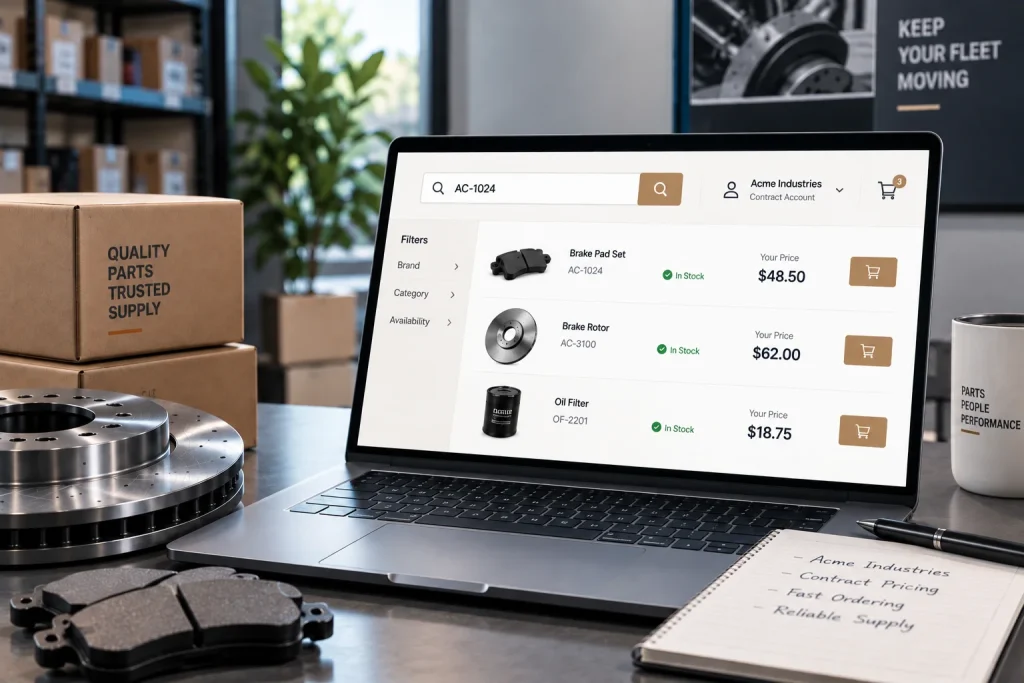
Contract pricing in B2B ecommerce search results.
A buyer should see their negotiated price in the result list, not list price with a surprise at checkout. This requires the search layer to resolve pricing per account at query time, which not every platform can do without a round trip that costs latency.
B2B ecommerce entitlement filtering must come before relevance.
Products an account can't order shouldn't appear at all. Filtering after retrieval produces thin result sets and wasted candidates; filtering as part of retrieval is the correct architecture.
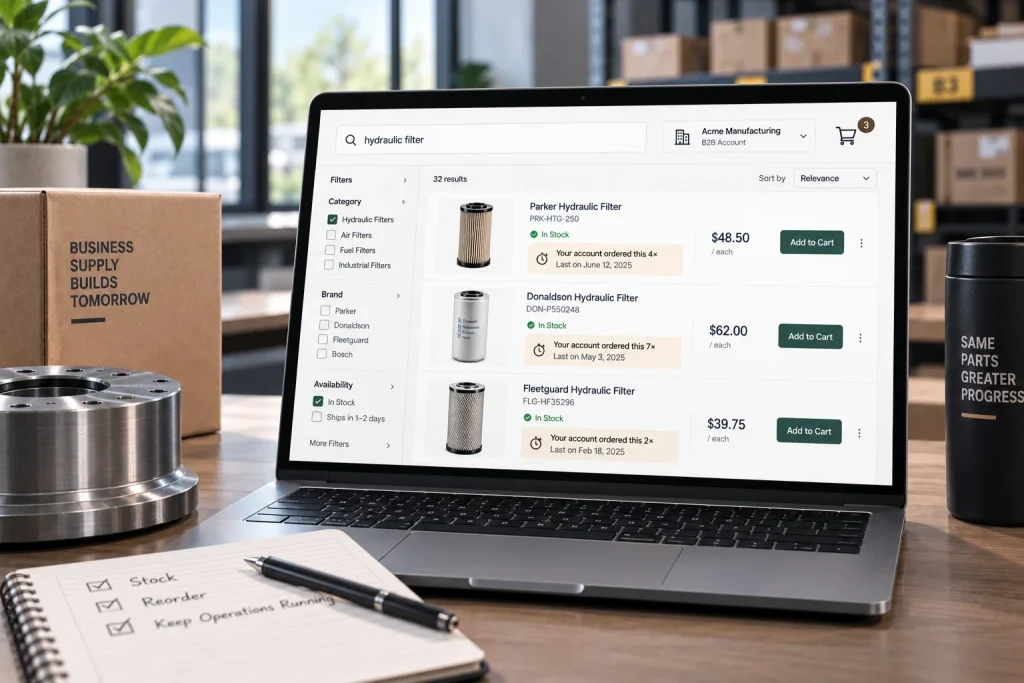
Account-level purchase history.
"Your account ordered this 4× — last on June 12" is the single highest-leverage feature in B2B product search, because it converts a search into a confirmation. It also has to be account-scoped rather than user-scoped, since the person searching often isn't the person who ordered last time.
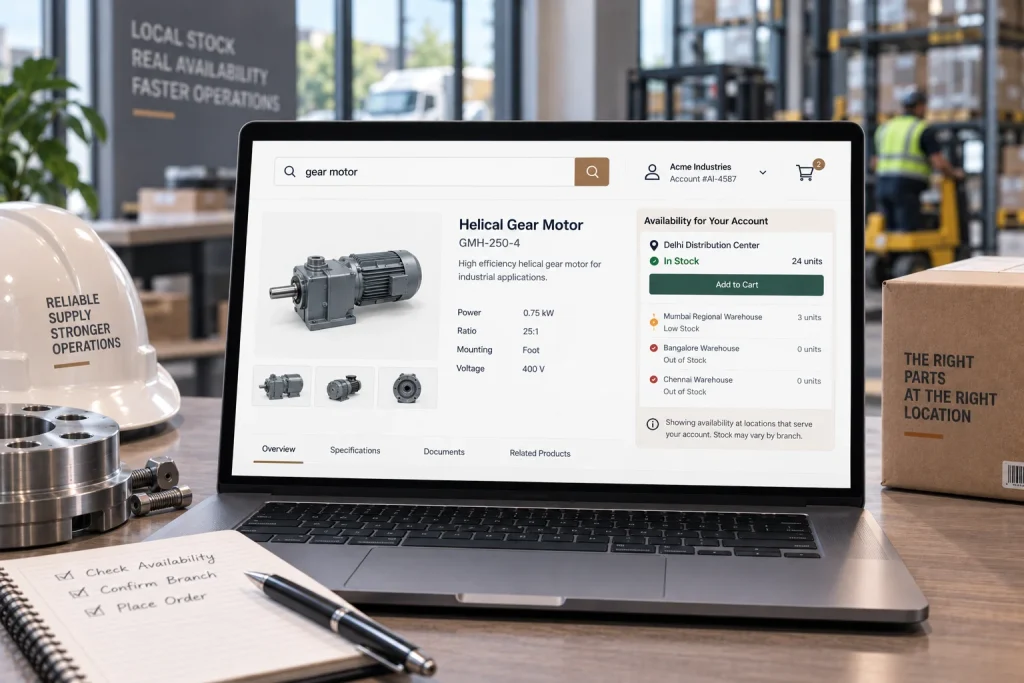
Region and warehouse availability.
Stock at the branch serving this account, not aggregate national stock. A part that's available three states away is not available.
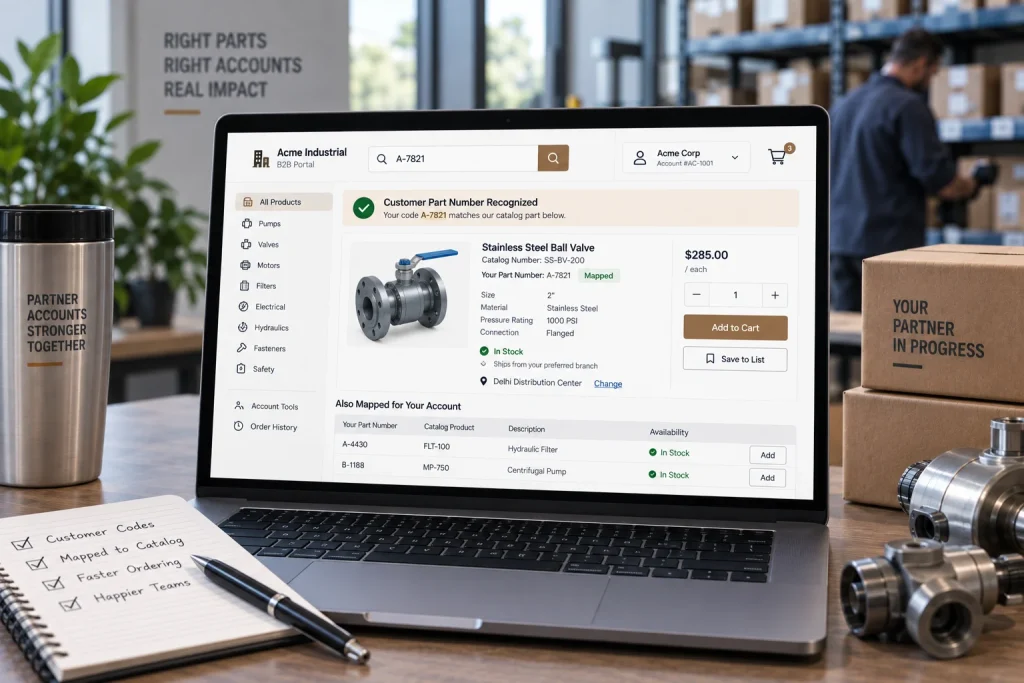
Customer-specific part numbers.
Large accounts maintain internal codes. Mapping those to your catalog is a genuine competitive advantage and almost nobody implements it — which means the accounts you map become measurably stickier.
Procurement integration
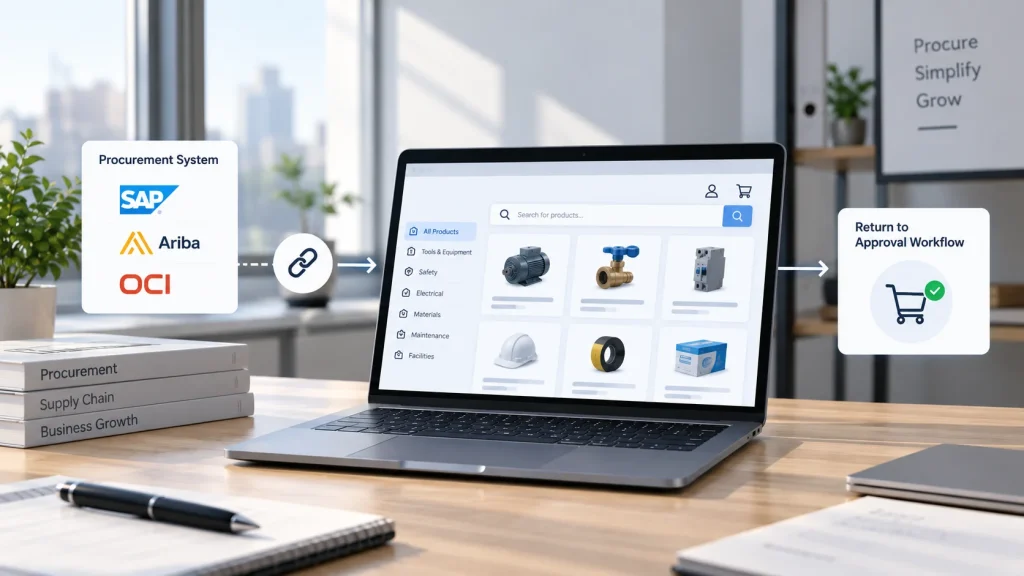
Punchout catalogs
let a buyer's procurement system — Ariba, Coupa, SAP — hand off into your storefront, shop, and return a cart into their approval workflow. The connection typically runs over cXML or OCI. If your search is slow or unhelpful inside a punchout session, you've lost an account that already chose you.
Requisition and approval flows
mean the person searching may not be the person buying. Search should support saving lists, sharing carts, and requesting quotes rather than assuming an immediate transaction.
Quote requests keep B2B product discovery from dead-ending.
When a part number doesn't resolve, "request a quote" captures demand instead of ending the session. Those unmatched numbers are also a ranked list of products you might want to stock.
Bulk entry.
Many B2B ecommerce buyers arrive with a list of twenty part numbers. A paste-and-match interface that resolves them in one action — including formatting variations and cross-references — is worth more than any relevance improvement to that buyer.
Hybrid retrieval is the architecturehere
Candidate Lists
The two candidate lists are fused, then reranked with business signals like stock, contract pricing, and purchase history.
Hybrid retrieval
Pairs keyword scoring — which resolves part numbers, model codes, and specifications literally — with vector search that matches meaning.
What to require from a platform
01
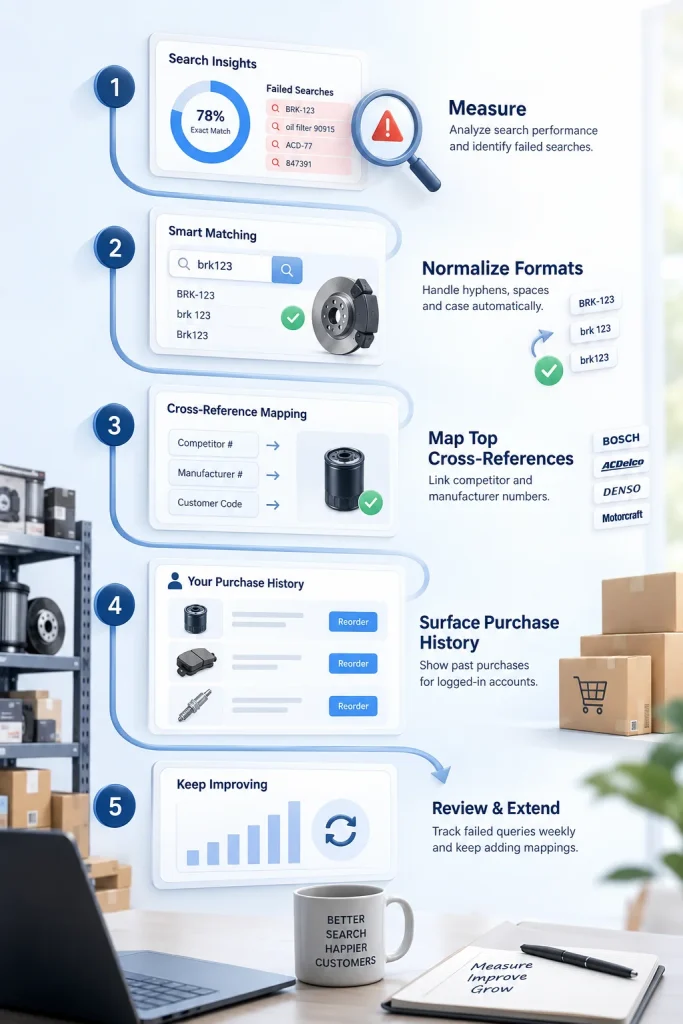
Exact-identifier resolution with format tolerance.
AB-1234, AB1234, and ab 1234 are one part. Non-negotiable.
02
Account-aware pricing and entitlements
Applied at query time, not post-filtered.
03
Filtered-query performance at scale.
B2B catalogs are large and B2B queries carry heavy constraints — category, manufacturer, specification, availability, entitlement. Filtered latency at high SKU counts is where platforms diverge most. Benchmark p95 and p99 with your real facets. Our AI search for large catalogs guide covers the mechanics.
04
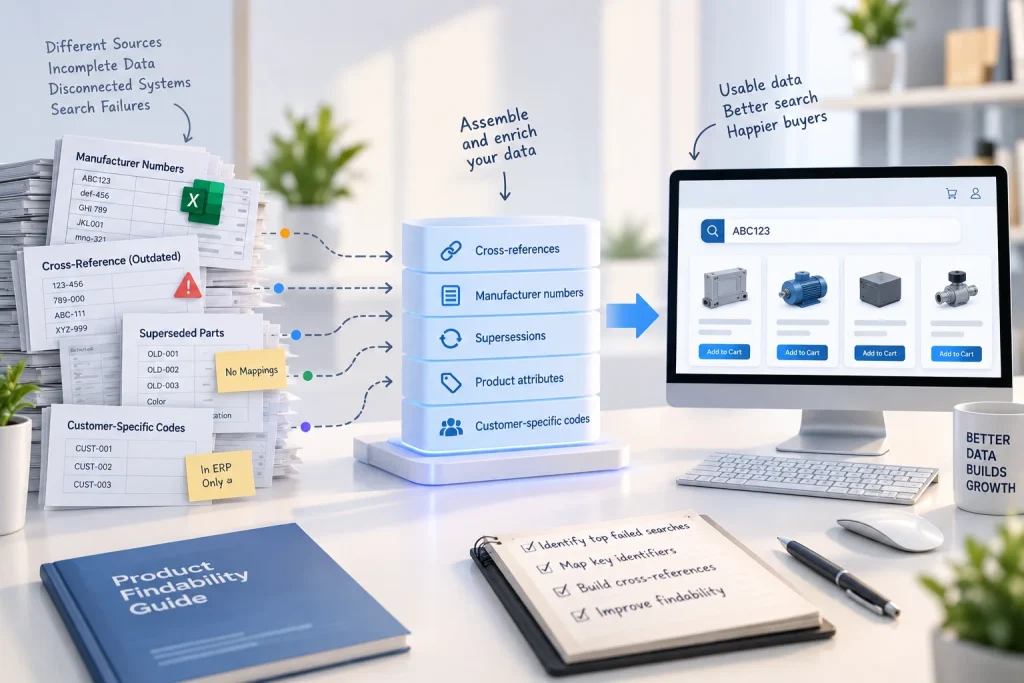
Cross-reference and supersession mapping
The platform can actually use.
05
Real-time inventory and pricing.
In B2B, freshness is correctness. A quoted price that's wrong at checkout is a credibility problem, not an inconvenience — see our real-time indexing guide.
06
Attribute-level search
So specifications are searchable, not merely displayable.
07
Purchase history surfaced in results
account-scoped.
08
Failed-query analytics.
A ranked list of unresolved searches is simultaneously your cross-reference backlog and a demand signal. Our ecommerce search analytics guide covers instrumentation.
Where the real work is
Measuring B2B search
Exact-match resolution rate.
Of identifier-shaped queries, what share resolved to a product? This is the headline number for B2B ecommerce search, and most distributors have never calculated it.
Time to reorder.
The defining B2B ecommerce speed metric, from login to submitted cart for a repeat order. This is the metric your best accounts feel daily, and cutting it from fifteen minutes to ninety seconds is retention you can quantify.
Self-service rate.
What share of B2B ecommerce orders complete without a rep call? Search improvements show up here before they show up anywhere else, and it's the number that funds the work with leadership.
Failed-query rate by account.
Segment this. An account whose searches start failing is an account about to phone a competitor, and no other system gives you that early warning. Our search relevance metrics and A/B testing guides cover scoring and validation.
A 30-day plan
B2B ecommerce FAQs
What is AI search for B2B ecommerce?
How is B2B ecommerce search different from retail search?
Do B2B buyers use semantic search or just part numbers?
What is punchout and why does it matter for search?
What breaks most often in B2B product search?
How do I measure B2B product discovery?
Does AI search work for technical and industrial catalogs?