
What answer engine optimization means
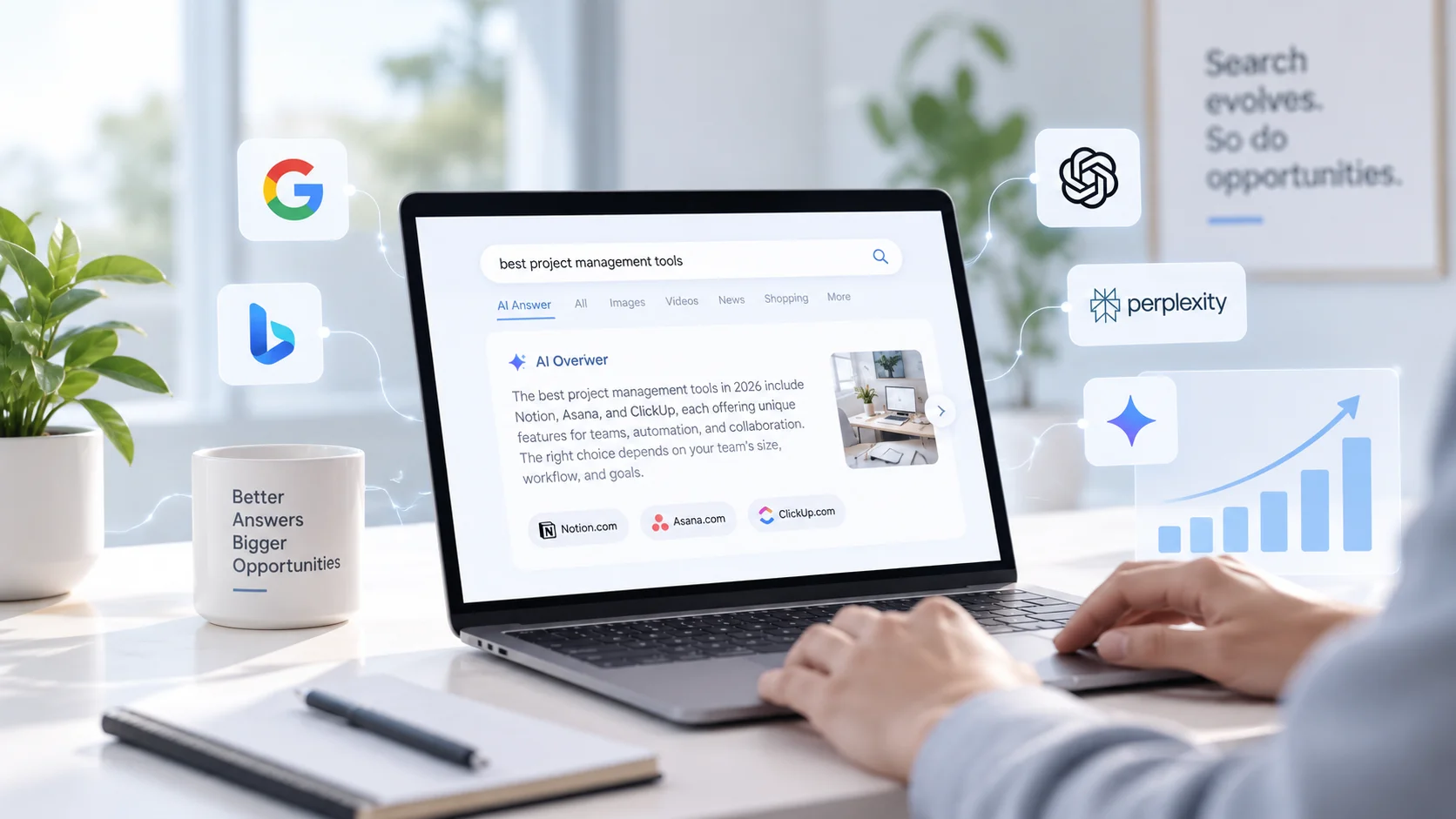
GEO, LLMO, AEO: same problem.
Most practitioners use these interchangeably. Strictly, GEO refers to the framework from the Princeton, Georgia Tech, and IIT Delhi academic study, while AEO is the broader practice. Do not let vocabulary debates distract from the work.
The audience is already there.
Google reported AI Overviews reaching more than 2.5 billion monthly active users in 2026, with AI Mode passing 1 billion monthly users within a year of launch and query volume more than doubling every quarter since.
Consumer behaviour has moved.
A national Elon University survey found 52% of US adults now use large language models, the shift that Wikipedia’s search engine optimization entry now describes as reshaping the discipline.
This is no longer an emerging channel. It is where a growing share of product discovery already happens, which is why the work belongs on the roadmap now rather than next year.
The uncomfortable truth about AEO
Before techniques, a correction that saves money: answer engine optimization is not a replacement for SEO, and most of what works is what already worked.
Google states explicitly that established SEO practices remain relevant to its AI features. Retrieval still requires discoverable, high-quality, crawlable sources. The brands already cited in AI Overviews are overwhelmingly the ones that invested in SEO previously, because their content was findable, so it got retrieved.
What changes is what you measure and what you optimize the content for. You are no longer optimizing for a click. You are optimizing for being quotable. That is a meaningful shift in content structure, built on the same technical foundation.
llms.txt does not work for Google.
Google’s 2026 guidance states plainly that it does not use llms.txt for Search. Vendors selling llms.txt implementation as an AEO service are selling something Google has publicly said it ignores.
There is no magic paragraph length.
Google explicitly rejects the idea of an ideal citation-sized section. Answer clearly, then provide enough evidence to make the answer useful.
Two pieces of snake oil worth naming, because both are actively sold as services. If a proposal leads with either one, treat the rest of it with the same scepticism.
AI Search Grader by bCloud AI
Grade your ecommerce search in 10 quick questions
31% of ecommerce searches return zero results — and most shoppers who hit a dead end leave for a competitor. How does your store's search stack up?
Answer 10 short questions and get your AI search score, plus a personalized report to fix the gaps. Free, takes about 2 minutes.
No signup needed to take the quiz.
Understanding intent…
Scoring your answers across relevance, AI, experience, and insights.
Your AI search score is ready
Tell us where to send your personalized report. You'll see your score and recommendations right away.
Your score by pillar
Personalized recommendations
Fix the gaps in weeks, not quarters
bCloud AI replaces keyword-only search with hybrid AI retrieval — sub-200ms responses, 99.99% uptime, and conversion lifts of up to 40% across 50+ implementations.
What the data says actually works
Five answer engine optimization findings from measured studies, each with a practical implication.
Position within the page matters.
SparkToro’s January 2026 citation analysis found 44.2% of citations came from the first 30% of content. Put your direct answer near the top rather than building to it, the inverted-pyramid structure journalists use, applied to product and guide content.
Freshness multiplies results.
ConvertMate’s study of 80 million citations found a 3.2x freshness multiplier for content updated within 30 days. This is the single most actionable finding in AEO: updating existing content may outperform publishing new content, which inverts most content calendars.
Question-formatted structure helps.
AirOps research found FAQ sections correlate with higher citation rates, with an additional boost when each answer is self-contained. Google phased out its FAQ rich result in 2026, so the value is in retrieval rather than SERP display. Frame H2s and H3s as the questions your customers actually ask.
Topical depth beats single pages.
Answer engines favor sources that demonstrate coverage of a whole subject, not one page hoping to rank. This is the practical argument for content clusters: a hub with genuine supporting depth rather than isolated articles.
Results differ by platform.
Ahrefs’ Brand Radar study across 15,000 prompts found only 8% citation overlap between ChatGPT and Google, and 28% between Perplexity and Google. Winning on one engine does not mean winning on another, so measuring a single platform gives a misleading picture.
Answer engine optimization for ecommerce specifically
Retail has a dimension general answer engine optimization advice misses: your product feed is content too.
Google announced AI performance insights in Merchant Center in 2026, covering discovery across AI Mode and AI Overviews with metrics on visibility, product terms, attributes, and completeness. OpenAI documents a dedicated product feed program for commerce, currently available to approved partners, which helps ChatGPT index products and understand attributes for more accurate shopping answers.
That reframes the work. For ecommerce answer engine optimization, five things matter most.
Crawler access first.
No answer engine optimization work counts if AI crawlers cannot reach you. Allow OAI-SearchBot for ChatGPT search appearance, plus GPTBot, Bingbot, PerplexityBot, ClaudeBot, and Google-Extended, each controlled separately. Our AI crawlers guide covers the diagnostics, including the WAF and CDN rules that block crawlers invisibly.
Attribute completeness.
LLMs are fact-extractors. A paragraph of adjectives is useless to them. Dimensions, weight limits, materials, compatibility, and tested ranges are what get quoted. Every missing attribute is a query you silently lose.
Structured data.
Product schema stating name, price, availability, brand, and attributes removes ambiguity at the stage where products get filtered out. See our product schema markup guide.
Reviews and customer sentiment.
User-generated content frequently contains the use-case language your marketing copy omits, and it is often what models quote when explaining fit.
Server-side rendering.
Many crawlers execute limited JavaScript. If price and description only appear client-side, they see an empty shell.
Our how LLMs find products guide covers the retrieval mechanics underneath all of this, from how a product gets into a grounding index to why two near-identical listings can get different treatment.
Content structure that gets cited
Six structural choices for answer engine optimization, drawn from what citation studies found.
Answer first, evidence second.
Lead each section with the direct answer, then support it. Given that 44.2% of citations come from the first 30% of content, burying your answer costs you.
Question-shaped headings.
H2s and H3s phrased as customer questions make the question-answer relationship explicit for retrieval.
Self-contained answers.
Each section should make sense quoted in isolation, because that is how it will be used. Avoid “as mentioned above.”
Hard facts over adjectives.
Specific numbers, measurements, and named conditions. “Sub-200ms at p95” is quotable. “Blazing fast” is not.
Original data where you have it.
Brands publishing original research, case studies with specific numeric outcomes, and benchmarking data get cited as authoritative sources. This is the strongest long-term AEO asset available, and almost nobody does it.
Honest limitations.
Content acknowledging trade-offs reads as balanced, and balanced sources get cited for comparison questions where one-sided content does not.
Measuring answer engine optimization
You cannot manage answer engine optimization without instrumentation, and the tooling is immature.
Platform-native reporting.
Bing Webmaster Tools has an AI Performance report showing citations from Copilot and partners, sampled and lagged two to three days. Google introduced generative AI performance reporting in Search Console in June 2026, and AI insights in Merchant Center for commerce.
AI referral traffic.
Filter analytics for chat.openai.com, copilot.microsoft.com, perplexity.ai, and gemini.google.com. Volumes are modest, but Semrush found AI search traffic converting at roughly 4.4x the rate of traditional organic. These visitors arrive with a recommendation rather than a hypothesis.
Prompt-level monitoring.
Manual spot-checking works for a handful of prompts and breaks down beyond that. Track citation frequency across multiple engines, surface the prompts your audience actually asks, and connect citations back to specific pages. Start by being your own customer.
Expect volatility. Grounding indexes get rebuilt, and sites have seen citations collapse for one to three weeks before recovering with nothing changed on their end. Watch trends over weeks, not days. Our semantic search analytics guide covers the measurement discipline.
How long it takes
Reported timelines cluster at two to six weeks for early signals, with brands that already invested in SEO seeing results faster because their content was already retrievable. One documented case saw a client appear in AI Overviews two weeks after publishing a long-form informational article.
That is faster than traditional SEO, which is genuinely one of the more attractive properties of AEO, and also why the freshness multiplier matters so much.
Updating within 30 days compounds. A refresh cycle on your top pages does more for citation share than the same hours spent on net-new articles.
The connection to your own site search
The work that makes external answer engines recommend your products is largely the same work that fixes your on-site search. Both need complete structured product data, accurate current prices and availability, descriptions expressing what a product is for, and consistent categorization.
That is a genuine two-for-one, and it is the honest case for treating catalog enrichment as infrastructure rather than housekeeping.
Our AI site search and top semantic search solutions for e-commerce guides cover the internal half, and AI visibility covers measuring the external one.
Where answer engine optimization goes wrong
Five failure patterns account for most disappointing results.
Treating AEO as a replacement for technical SEO.
The most expensive error. Retrieval requires crawlable, indexable, fast pages. Teams who redirect budget away from technical foundations toward AI optimization services usually end up less visible, not more.
Chasing a single engine.
With only 8% citation overlap between ChatGPT and Google, optimizing against one engine and assuming the rest follow is guesswork. Measure at least two.
Publishing new instead of refreshing.
Given the 3.2x freshness multiplier, a content calendar that only produces new articles while older ones decay is leaving the easier win untouched. Build a refresh cycle before expanding output.
Confusing citation with traffic.
Being cited is not being visited. Some answer engine optimization work produces citations that never convert to sessions, which is why referral traffic and conversion belong in the scorecard alongside citation counts.
Reacting to volatility.
Citation data is sampled, lagged, and genuinely noisy. Teams that adjust strategy weekly make worse decisions than teams reviewing monthly, and platform-side events get misdiagnosed as content failures.
Every one of these costs the same thing: work that looked like progress while the pages that actually get retrieved were left alone.
Answer engine optimization and E-E-A-T
One area where the old discipline transfers into answer engine optimization almost unchanged. Answer engines favor sources that demonstrate experience, expertise, authoritativeness, and trust, the same signals Google’s quality guidelines have emphasized for years, now applied to citation selection rather than ranking.
For ecommerce, four things carry that signal practically.
First-hand experience.
Shown through genuine testing, use, and specifics rather than repackaged manufacturer copy.
Named authorship.
Real credentials attached to the content. This remains a common gap: a great deal of ecommerce content publishes under a brand account with no human attached.
Original data.
The strongest available differentiator, since almost nobody in retail publishes benchmarks or research.
Transparent sourcing.
Citing where claims come from rather than asserting them.
Answer engines also weigh topical breadth. Covering the full question tree around a subject signals depth; a single page hoping to rank signals the opposite. That is the structural argument for building clusters rather than isolated articles.
A starting sequence
Week 1 – verify access.
Check robots.txt, then check your WAF and CDN separately. Pull crawler logs for 403s and 503s. Fetch a product page with a plain HTTP request and confirm content appears in raw HTML.
Week 2 – structured data and feeds.
Product schema on every product page, and an audit of your Merchant Center feed for attribute completeness.
Weeks 3 to 4 – restructure your best content.
Answer-first, question-shaped headings, self-contained sections, hard facts. Start with pages already getting traffic rather than writing new ones.
Ongoing – refresh on a 30-day cycle.
Run the cycle on your most important pages, and instrument citations across at least two engines.
Frequently asked questions
What is answer engine optimization?
Answer engine optimization is structuring content and product data so AI systems select it as a cited source when generating answers. Unlike traditional SEO, which competes for a position in a list of links, AEO competes for inclusion in a synthesized answer, a different target requiring different content structure on the same technical foundation.
Is AEO different from GEO and LLMO?
Mostly terminology. Most practitioners use them interchangeably. Strictly, GEO refers to the framework from the Princeton, Georgia Tech, and IIT Delhi academic study, while AEO describes the broader practice of optimizing for AI answer systems. The underlying work is the same.
Does answer engine optimization replace SEO?
No. Google states explicitly that established SEO practices remain relevant to its AI features, and retrieval still requires discoverable, crawlable, high-quality sources. What changes is what you measure and how you structure content: you are optimizing for being quotable rather than clicked.
Does llms.txt help with AI visibility?
Not for Google. Google’s 2026 guidance states it does not use llms.txt for Search. Prioritize crawlability, indexability, useful content, supported structured data, and accurate product feeds instead.
How long does AEO take to show results?
Reported timelines cluster at two to six weeks for early signals, faster for brands with existing SEO investment since their content is already retrievable. Content updated within the last 30 days shows a measured 3.2x citation multiplier, so refreshing often outperforms publishing new.
How do I measure answer engine optimization?
Use Bing Webmaster Tools’ AI Performance report and Google’s Search Console generative AI reporting, filter analytics for AI assistant referral domains, and monitor prompt-level citations across multiple engines. Platform overlap is low, only 8% between ChatGPT and Google in the Ahrefs study, so measuring one engine misleads.
What matters most for ecommerce AEO?
Crawler access first, since nothing else counts if AI crawlers cannot reach you. Then attribute completeness, since LLMs extract facts rather than adjectives, product structured data, customer reviews for use-case language, and server-side rendering so crawlers do not see an empty shell.
Being found by AI starts with a catalog machines can read.
bCloud AI structures your product data for both on-site search and external answer engines, one investment, two channels.
bcloud.ai