
Multilingual Ecommerce Search: Let Every Shopper Search in Their Own Language
What Is Multilingual Ecommerce Search?
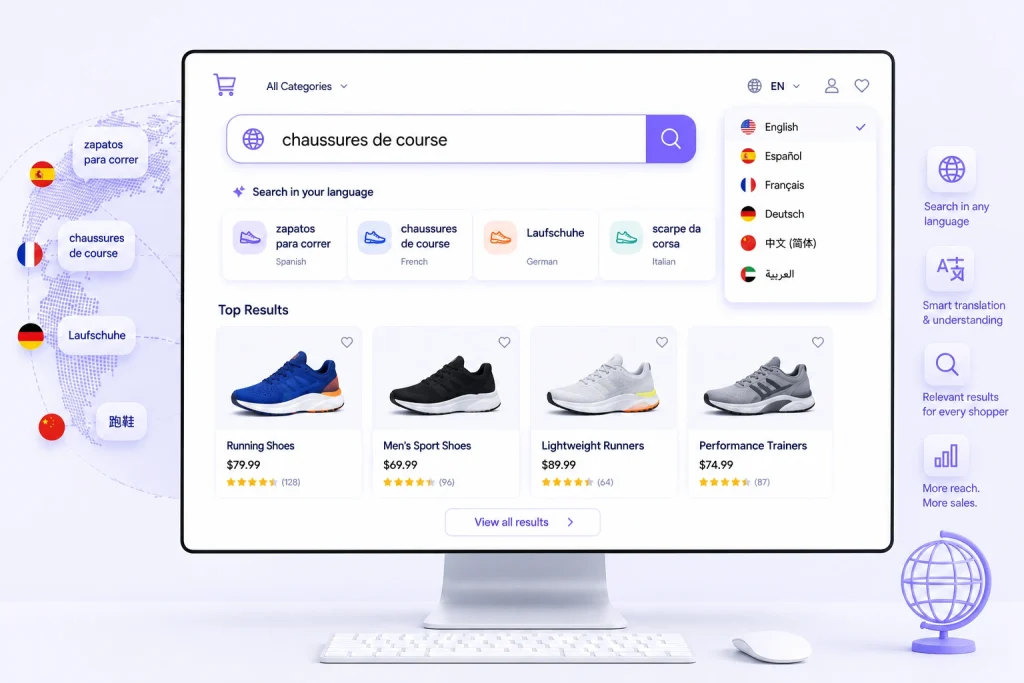
AI-powered multilingual search understands meaning rather than exact words, connecting searches like "zapatos de correr" with "running shoes."
Search Journey
🌍
Cross-Language Search
Find products across languages
🧠
Semantic AI
Understands search intent
🔤
Transliteration
Supports mixed-language queries
📍
Regional Terms
Recognizes local vocabulary
Why Multilingual Search Matters
Today's Shoppers Are Multilingual
The user is already multilingual. In the U.S. alone, tens of millions of shoppers speak a language other than English at home and naturally search using the language they think in.
Global Expansion Brings New Languages
Every new country introduces different languages, regional terminology, and shopping vocabulary. Search must adapt to each market to deliver relevant results.
Unsupported Queries Become Lost Sales
Every search submitted in an unsupported language can silently produce zero results, creating missed opportunities that often go unnoticed without search analytics.
Recover Hidden Demand
Supporting the languages your shoppers actually use uncovers hidden demand and increases conversions—often at a much lower cost than acquiring additional traffic.
Where Traditional Approaches Fail

How AI Multilingual Search Works
Language Detection
Automatically identifies the language used in every shopper query.
Semantic AI
Converts products and queries into multilingual vector embeddings.
Cross-Language
Finds relevant products even if the catalog uses another language.
Localization
Applies regional terminology, sizing, currencies, and translations.
Personalized Results
Returns the most relevant products with localized experiences.
Meaning Over Words
Shared Semantic Space
Search understands concepts instead of exact keywords, enabling accurate multilingual matching.
Regional Synonyms
Recognizes local terminology, brand names, and shopping vocabulary unique to every market.
Transliteration Support
Handles phonetic typing and non-Latin scripts for a seamless global search experience.
Localized Experience
Displays products with local currency, sizing formats, and translated content whenever available.
7 Smart Wins From Multilingual Ecommerce Search
Win
Why it works
Multilingual Search and International Expansion
Semantic Multilingual Matching
Start with semantic multilingual matching so search works in target languages from day one, even against a not-yet-localized catalog.
01
02
Localize High-Traffic Content
Localize the highest-traffic catalog content next, guided by what shoppers in each market actually search.
Market-Specific Terminology
Layer in market-specific synonyms and terminology as query data accumulates.
03
04
Localized Presentation
Localize currency, sizing conventions, formats, and presentation to deliver a familiar shopping experience.
Multilingual Search in B2B
Exact-Match Identifiers
Part numbers, SKUs, and technical identifiers must always match perfectly, regardless of the surrounding language.
Semantic Understanding
AI understands technical specifications and industry terminology that vary between countries and languages.
Catalog Enrichment
Normalized product attributes improve multilingual relevance and create consistent search experiences worldwide.
Common Multilingual Search Mistakes
❌ Common Mistakes
✅ Better Approach
Measuring Multilingual Search Performance
Measure by language, not in aggregate.
Track query volume by detected language (this alone often surprises teams — the demand is bigger than assumed), zero-results rate per language, search conversion per language, and the gap between your primary language and others.
The gaps quantify the opportunity; closing them is the roadmap.
As with all search improvement, run the weekly loop: find the highest-volume failing queries in each language, fix the cause (semantic matching, synonyms, enrichment, or genuine assortment gaps), and re-measure.
Language-level dashboards turn "we should support Spanish" from a hunch into a business case with a number attached.
Multilingual Ecommerce Search and AI Assistants
AI Discovery Ecosystem
Semantic Product Catalog
Clean, structured, multilingual-ready product data powers every discovery channel.
Multilingual Search
Better onsite search experiences.
Global AI Visibility
Higher visibility across AI assistants.
Measuring Multilingual Search Performance
Choosing a Multilingual Ecommerce Search Platform
When evaluating platforms for multilingual ecommerce search, test with real queries in your target languages against your actual catalog — not vendor demos in convenient languages. Check whether matching is genuinely semantic (a Spanish query retrieving untranslated English products) or just translation bolted onto keyword search. Verify language detection handles mixed-language and transliterated queries. Confirm analytics segment by language natively. Ask how synonyms and terminology are managed per market and who maintains them. And check the languages on the roadmap versus in production — multilingual claims vary enormously in depth, and the difference only shows up under real queries.
A Practical Rollout Sequence
Roll out multilingual ecommerce search in the order your data suggests: detect which non-primary languages already appear in your query logs (they're almost always there), enable semantic matching for the top one or two, measure recovered zero-results and conversion, then expand. Starting from observed demand rather than assumed markets keeps the effort focused where revenue already waits, and each language you add generates the analytics that justify the next.
Frequently asked questions
What is multilingual ecommerce search?
How does multilingual search work?
Why is multilingual search important?
Do I need to translate my whole catalog?
How does multilingual search help international expansion?
How does multilingual search work in B2B?
How do I measure multilingual search performance?
What is the best multilingual ecommerce search platform?