
What is voice search for ecommerce?
Why voice commerce matters now
Several trends have pushed voice from gimmick to genuine channel. Smart speakers sit in millions of U.S. homes, and shoppers use them for reorders and quick purchases. Mobile voice search is everywhere — it’s faster to ask than to thumb-type on a phone. And the rise of voice-enabled AI assistants has normalized speaking to technology to get things done, including shopping. Each of these trains shoppers to expect that they can simply ask for what they want.
For brands, mastering Voice Search for Ecommerce is a crucial step toward innovation.
There’s an accessibility dimension too: voice opens your store to shoppers who find typing difficult, and to hands-busy moments — cooking, driving, holding a baby — when speaking is the only practical way to search. Meeting shoppers in those moments isn’t just inclusive; it’s incremental revenue you’d otherwise never see. As with replacing legacy keyword tools with an intelligent product search engine, the principle is the same: remove friction between intent and purchase.
By optimizing for Voice Search for Ecommerce, you can attract a wider customer base.
AI Search Grader by bCloud AI
Grade your ecommerce search in 10 quick questions
31% of ecommerce searches return zero results — and most shoppers who hit a dead end leave for a competitor. How does your store's search stack up?
Answer 10 short questions and get your AI search score, plus a personalized report to fix the gaps. Free, takes about 2 minutes.
No signup needed to take the quiz.
Understanding intent…
Scoring your answers across relevance, AI, experience, and insights.
Your AI search score is ready
Tell us where to send your personalized report. You'll see your score and recommendations right away.
Your score by pillar
Personalized recommendations
Fix the gaps in weeks, not quarters
bCloud AI replaces keyword-only search with hybrid AI retrieval — sub-200ms responses, 99.99% uptime, and conversion lifts of up to 40% across 50+ implementations.
How voice search works
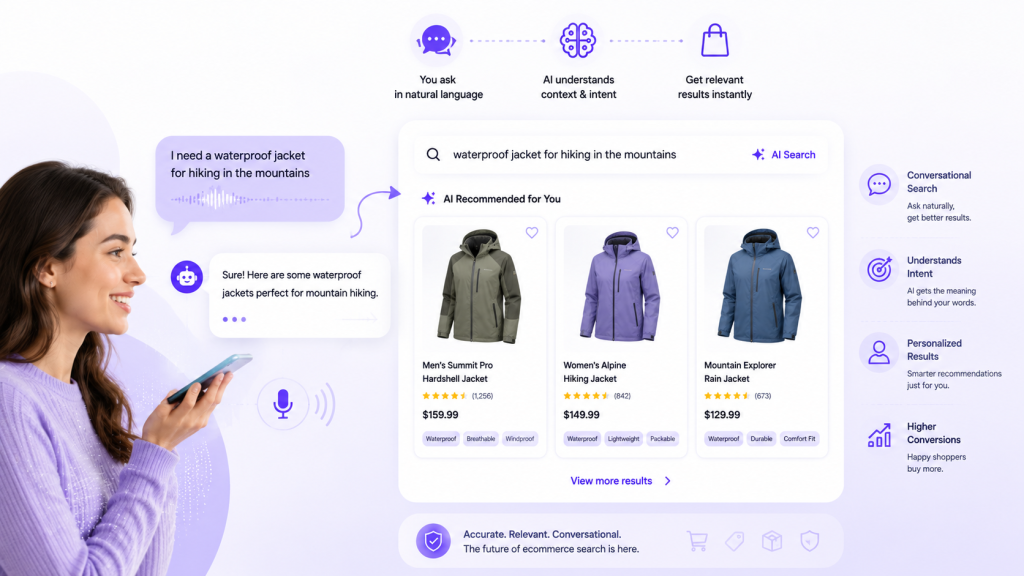
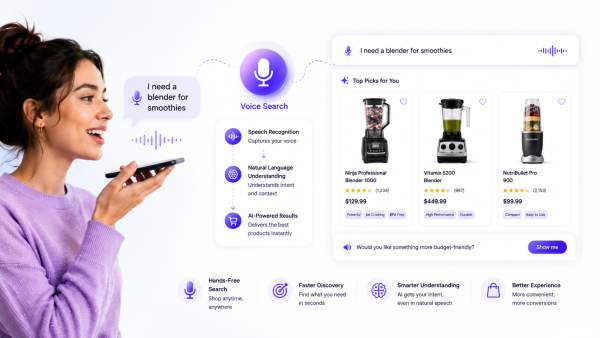
That last part matters: real voice shopping is a conversation, not a single command. bCloud AI’s conversational AI layer is built for exactly this — natural-language questions, generative answers, and multi-turn follow-ups that hold context across the session, so a spoken exchange feels like talking to a knowledgeable associate rather than barking commands at a search box.
Where voice search shows up
Voice discovery spans several surfaces, and the strongest platforms power them from one search infrastructure:
On-site voice search
A microphone in your store’s search bar that understands spoken, conversational queries.
Smart speakers & voice platforms
Alexa Skills, Google Actions, and similar let shoppers query your catalog by voice — “Ask [Your Store] for wireless headphones under $100.”
AI assistants
As shoppers ask voice-enabled assistants for recommendations, your products need to be understandable to those systems.
Mobile
Tap-to-speak search on phones, where a growing share of voice queries begin.
bCloud’s guide to advanced ecommerce search details how a single search engine can power voice across smart speakers, marketplaces, and omnichannel touchpoints — so customers get a consistent experience wherever they discover you.
The business case for voice search
Voice search drives revenue in ways text alone can’t:
↑ Reorders
Faster reorders
“Order more of X” is the lowest-friction purchase there is.
↑ Long-tail
Long-tail capture
Specific conversational queries that signal a ready-to-buy shopper.
↓ Dead ends
Fewer dead ends
Conversational understanding turns vague spoken requests into matches.
↑ Reach
Wider reach
Hands-free and accessibility moments competitors ignore.
For omnichannel brands, voice also reinforces a consistent discovery experience across web, app, speaker, and assistant — wherever the customer happens to be.
How to optimize your store for voice search
Optimizing for voice is mostly about making sure your store understands and answers natural language. A few priorities:
Voice search and AI visibility
Common voice search mistakes to avoid
Voice search creates a more natural path from shopper intent to product discovery by allowing customers to describe what they want in the same way they would ask another person. Instead of reducing a request to a few keywords, shoppers can mention their budget, preferences, use case, or specific requirements in one conversational query. An intelligent search engine can interpret those details, match them with relevant products, and maintain context when the shopper asks follow-up questions or narrows the request. By removing the need to type, rephrase, or restart a search, voice commerce reduces friction across the shopping journey while helping retailers capture more long-tail demand, improve accessibility, and create a more conversational buying experience.
Real Voice Search Queries Customers Use Every Day
Voice searches sound very different from typed searches. Instead of entering a few keywords, shoppers ask complete questions and include details such as budget, size, color, or intended use. An AI-powered ecommerce search engine must understand these conversational requests to deliver accurate product recommendations.
| Typed Search | Voice Search | AI Understands |
|---|---|---|
| wireless headphones | Find me wireless noise-canceling headphones under $100. | Product type + budget + feature |
| running shoes | What are the best running shoes for marathon training? | Purpose + activity + recommendations |
| office chair | Show me an ergonomic chair for working eight hours a day. | Comfort + use case + product attributes |
| gift ideas | What’s a good birthday gift for someone who loves photography? | Intent + recipient + interests |
The more naturally shoppers can speak, the more information your search engine receives. Modern AI search converts these conversational requests into structured intent, helping customers discover the right products without needing perfect keywords.
Frequently asked questions
What is voice search for ecommerce?
Voice search for ecommerce lets shoppers find products by speaking — using a phone, smart speaker, or AI assistant — instead of typing. The system converts speech to text, interprets the natural-language query, and returns relevant products. Because people speak in full sentences, it depends on understanding intent rather than matching keywords.
How is voice search different from typed search?
Voice queries are longer, more conversational, and usually framed as questions (“where can I buy…”), while typed queries tend to be short keyword fragments. Voice search therefore needs strong natural-language understanding to interpret meaning and intent accurately.
How do I optimize my ecommerce store for voice search?
Run a semantic search backend that understands natural language, write product content and FAQs in natural question-based phrasing, add clean structured data, support conversational follow-ups, and integrate with voice platforms like Alexa and Google Actions where relevant.
Does voice search help with AI visibility?
Yes. When shoppers ask voice-enabled AI assistants for recommendations, those engines perform natural-language search — the same capability behind on-site voice. A store and catalog that understand conversational queries are more likely to be understood and recommended by AI.
Is voice commerce worth it for smaller stores?
If your shoppers use voice at all — for reorders, mobile search, or via assistants — yes. The same AI search that improves typed search powers voice, so you’re enhancing one system rather than building a separate channel.
Give your store a voice shoppers can talk to.
bCloud AI understands natural, conversational queries — typed or spoken — and answers with relevant products in under 200ms, with multi-turn follow-ups built in. See conversational and voice search on your catalog.
bcloud.ai