
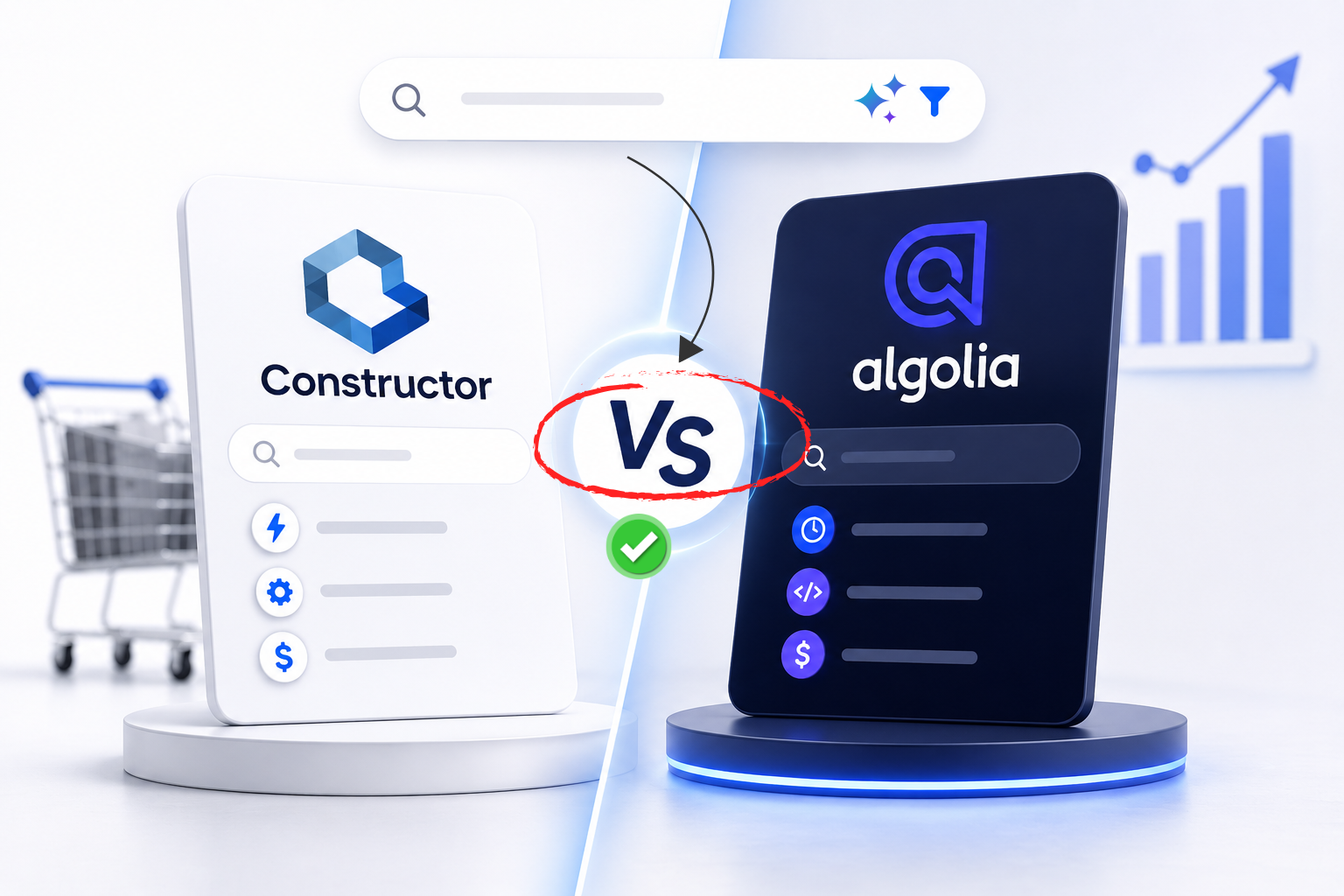
Constructor vs Algolia at a glance
| Constructor | Algolia | |
|---|---|---|
| Approach | Commerce-native, revenue/KPI-optimized discovery | Developer-first search API, cross-vertical |
| AI relevance | Learns from clickstream + purchase behavior to optimize ranking toward conversion | NeuralSearch (vector/AI) — available only on the top-tier Elevate enterprise plan |
| Personalization | Deep, behavior-driven, built in | Available, but less commerce-specific out of the box |
| Speed | Fast | Sub-millisecond (1–20ms), a core strength |
| Pricing | Custom/enterprise, sales-led (30-day trial) | Usage-based; free Build tier (10,000 requests/mo); scales with query volume |
| Setup | More involved, sales-led onboarding | Fast, developer-friendly, ship in days |
| Best for | Enterprise, 100K+ SKUs, conversion focus | Dev teams, search beyond ecommerce, budget-conscious start |
Constructor: strengths and considerations
The considerations are the flip side of “enterprise.” Pricing is custom and sales-led with no free or entry tier (a 30-day trial and a “Proof” revenue assessment are offered), and third-party estimates put annual cost anywhere from roughly $24K to $150K depending on query volume. Setup is more involved than a plug-in search bar, and it’s genuinely aimed at larger operations — smaller stores may find it more platform than they need. In a Constructor vs Algolia evaluation, Constructor is the pick when conversion outcomes matter more than raw speed or developer ergonomics.
Algolia: strengths and considerations
Algolia is a developer-first search API famous for sub-millisecond results, typo tolerance, faceting, and its InstantSearch libraries, backed by 200+ integrations and a huge developer community. It offers a genuinely useful free Build tier (10,000 requests/month) and usage-based paid plans, and it’s flexible enough to power search well beyond ecommerce — content, media, docs, and SaaS. Setup is fast; a small team can ship search in days. Its 2023 acquisition of Searchspring has strengthened its ecommerce-specific tooling.
The considerations: Algolia’s AI vector layer, NeuralSearch, is gated behind the top-tier Elevate enterprise plan, so the deepest AI relevance isn’t on lower tiers. Usage-based, per-query pricing can climb sharply at scale — a real factor for high-traffic stores — and Algolia generally rewards having a search engineer to own ranking rules and keep results tuned. For pure ecommerce revenue optimization out of the box, it’s less specialized than commerce-native platforms. Our Algolia switch guide covers these trade-offs in depth. Constructor vs Algolia
AI Search Grader by bCloud AI
Grade your ecommerce search in 10 quick questions
31% of ecommerce searches return zero results — and most shoppers who hit a dead end leave for a competitor. How does your store's search stack up?
Answer 10 short questions and get your AI search score, plus a personalized report to fix the gaps. Free, takes about 2 minutes.
No signup needed to take the quiz.
Understanding intent…
Scoring your answers across relevance, AI, experience, and insights.
Your AI search score is ready
Tell us where to send your personalized report. You'll see your score and recommendations right away.
Your score by pillar
Personalized recommendations
Fix the gaps in weeks, not quarters
bCloud AI replaces keyword-only search with hybrid AI retrieval — sub-200ms responses, 99.99% uptime, and conversion lifts of up to 40% across 50+ implementations.
Constructor vs Algolia: which should you choose?
There’s no universal winner in the Constructor vs Algolia debate — there’s a winner for your situation:
- Choose Constructor if you’re a mid-market or enterprise retailer with a large catalog (100K+ SKUs), you want ranking optimized toward conversion and revenue rather than just relevance, deep behavioral personalization matters, and you have the budget for enterprise, sales-led pricing.
- Choose Algolia if developer experience and speed are priorities, you need search beyond ecommerce (content, docs, marketplaces), budget matters and you want a free or usage-based path, and you have engineering resources to own ranking and setup.
The tie-breaker is usually team and budget: Constructor for commerce teams chasing revenue lift with enterprise backing; Algolia for engineering-led teams that value control, speed, and a low-cost start. Whichever you lean toward, test it on your real catalog and real queries — Baymard Institute research shows most search failures happen on messy, human queries, so a demo on clean data tells you very little. Constructor vs Algolia
How to run the comparison on your own catalog
Feature tables narrow the field. A short trial decides it.
One platform is sales-led and the other is self-serve, so the trials will not feel alike. Therefore fix the rules first, or you end up comparing onboarding rather than search. Four points keep it fair.
Send the same catalog to both.
Same fields, same messy tail records. Cleaning the feed for one vendor turns the test into a measure of your own prep work.
Use one hundred real queries.
Pull them from your logs, including typos and long descriptions. Invented queries flatter both platforms equally and teach you nothing.
Cap the tuning time.
Give each the same fixed window. A platform that needs weeks of configuration to look good will need that attention forever.
Price it at three times traffic.
Per-query and enterprise models diverge sharply as you grow. Consequently today’s quote tells you very little about next year.
In short, agree what a win looks like before the first index loads. A scorecard written afterwards tends to match whatever happened. Our search relevance metrics guide covers how to build that scorecard.
A third option: bCloud AI
If the Constructor vs Algolia trade-off feels like choosing between “powerful but heavy and expensive” and “fast but AI-gated and metered,” there’s a middle path worth evaluating. bCloud AI is an AI-native platform that combines hybrid keyword + vector search with behavioral re-ranking and a conversational AI shopping assistant — so you get Algolia-style speed (sub-200ms) and ease alongside Constructor-style commerce relevance, without either compromise. Crucially, hybrid vector search is included by default rather than locked behind a top enterprise tier, and pricing is based on catalog size and features rather than per-query, so bills don’t spike as traffic grows. Implementation runs about four weeks with no in-house ML expertise. For a fuller field, see the best AI ecommerce search platforms and our guide to the best hybrid search systems.
Migration Tips: Moving Between Constructor and Algolia
Whether you’re switching from Constructor to Algolia for greater flexibility or moving to Constructor for stronger ecommerce optimization, a structured migration plan helps preserve search quality and minimizes disruption for shoppers.
1. Review Your Current Search Performance
Export your top search queries, zero-result searches, click-through rates, and conversion metrics before migrating. These benchmarks make it easier to compare results after launch.
2. Validate Catalog & Ranking Rules
Ensure product attributes, filters, synonyms, merchandising rules, and ranking priorities are configured correctly before directing live traffic to the new platform.
3. Monitor the First Few Weeks
Track search latency, conversion rate, click-through rate, and customer feedback after launch. Small ranking adjustments during the first weeks often deliver the biggest improvements.
Migration insight: A successful migration isn’t measured by how quickly the new search engine goes live—it’s measured by maintaining or improving search relevance, customer engagement, and ecommerce conversions from day one.
Frequently asked questions
Constructor vs Algolia: which is better for ecommerce?
Both are strong, but they optimize differently. Constructor is commerce-native and tunes ranking toward conversion and revenue using behavioral data, making it ideal for enterprise, high-SKU stores. Algolia is a fast, developer-first search API with a free tier and broad flexibility, ideal for engineering-led teams and search beyond ecommerce. The right choice depends on your catalog size, team, and budget.
Is Algolia cheaper than Constructor?
At the entry level, yes. Algolia offers a free Build tier (10,000 requests/month) and usage-based pricing, while Constructor uses custom, enterprise-only pricing with no free tier. However, Algolia’s per-query costs can climb at high volume, so compare total cost at your actual traffic.
Does Algolia have AI vector search like Constructor?
Yes — Algolia’s NeuralSearch provides AI vector search, but it’s available only on the top-tier Elevate enterprise plan. Constructor’s ranking is AI/behavior-driven across its platform. Some alternatives, like bCloud AI, include hybrid vector search by default on all plans.
Which is faster, Constructor or Algolia?
Algolia is known for sub-millisecond (1–20ms) response times and is typically the speed leader. Constructor is fast but emphasizes conversion-optimized relevance over raw latency.
Is there a good alternative to both Constructor and Algolia?
Yes. bCloud AI combines hybrid keyword + vector search, behavioral re-ranking, and conversational commerce with sub-200ms speed and predictable catalog-based pricing — pairing Algolia-style ease with Constructor-style commerce relevance, without per-query billing or an AI paywall.
Skip the trade-off.
bCloud AI gives you Algolia-fast, Constructor-smart search — hybrid vector relevance and conversational commerce, priced on your catalog, not per query. Start free or book a demo.