
How native BigCommerce search works
Product filtering
is BigCommerce’s faceted search. According to the BigCommerce Developer Center, a storefront can display up to 12 filters per page, and filters can be configured per channel and category.
Storefront frameworks
also matter. BigCommerce supports Stencil, its traditional theme engine, and Catalyst, a newer composable framework built on Next.js. Your framework affects how search and filters are implemented.
The plan gate on product filtering
This is the limitation that surprises BigCommerce merchants most.
Product filtering is a Pro and Enterprise feature. Stores on Standard or Plus plans don’t get native faceted search at all.
As a result, a growing store on a lower plan often has search without meaningful filters. Shoppers can type a query but can’t narrow the results by size, color, or price.
For catalog-driven stores, that’s a real conversion problem. Our faceted search guide explains why filtering carries so much discovery work.
Where BigCommerce search runs out
Even on higher plans, native BigCommerce search has limits that show as stores grow.
The 12-filter ceiling.
Stores with many product attributes can hit it quickly, especially in technical categories.
Keyword matching.
Native search leans on keyword matching, so descriptive queries like “quiet dishwasher for a small kitchen” often miss.
Limited ranking control.
Adjusting which products rank first usually means working around the platform rather than configuring it.
Limited per-storefront customization.
BigCommerce supports multiple storefronts, but native search offers limited customization for each one.
No built-in testing.
Proving whether a search change helped requires tools native search doesn’t include.
AI Search Grader by bCloud AI
Grade your ecommerce search in 10 quick questions
31% of ecommerce searches return zero results — and most shoppers who hit a dead end leave for a competitor. How does your store's search stack up?
Answer 10 short questions and get your AI search score, plus a personalized report to fix the gaps. Free, takes about 2 minutes.
No signup needed to take the quiz.
Understanding intent…
Scoring your answers across relevance, AI, experience, and insights.
Your AI search score is ready
Tell us where to send your personalized report. You'll see your score and recommendations right away.
Your score by pillar
Personalized recommendations
Fix the gaps in weeks, not quarters
bCloud AI replaces keyword-only search with hybrid AI retrieval — sub-200ms responses, 99.99% uptime, and conversion lifts of up to 40% across 50+ implementations.
7 proven fixes for BigCommerce search
Fix 1: Enable product filtering if your plan allows
If you’re on Pro or Enterprise, turn on product filtering and configure it properly. Many stores enable it but leave the defaults.
Configure filters per category, since different categories need different attributes. Then order them by what shoppers actually use.
Fix 2: Complete your product attributes
Filters and search can only use data your catalog contains. So audit attribute coverage before anything else.
A filter populated on half your products hides the other half. Either complete the data or remove the filter.
Fix 3: Use custom fields and search keywords
BigCommerce lets you add search keywords to products. Use them to cover vocabulary gaps, such as alternate names, common misspellings, and regional terms.
However, manual keywords have a ceiling. Nobody can anticipate every phrasing. That’s the limit semantic search removes, as covered in our what is semantic search guide.
Fix 4: Improve the search experience in your theme
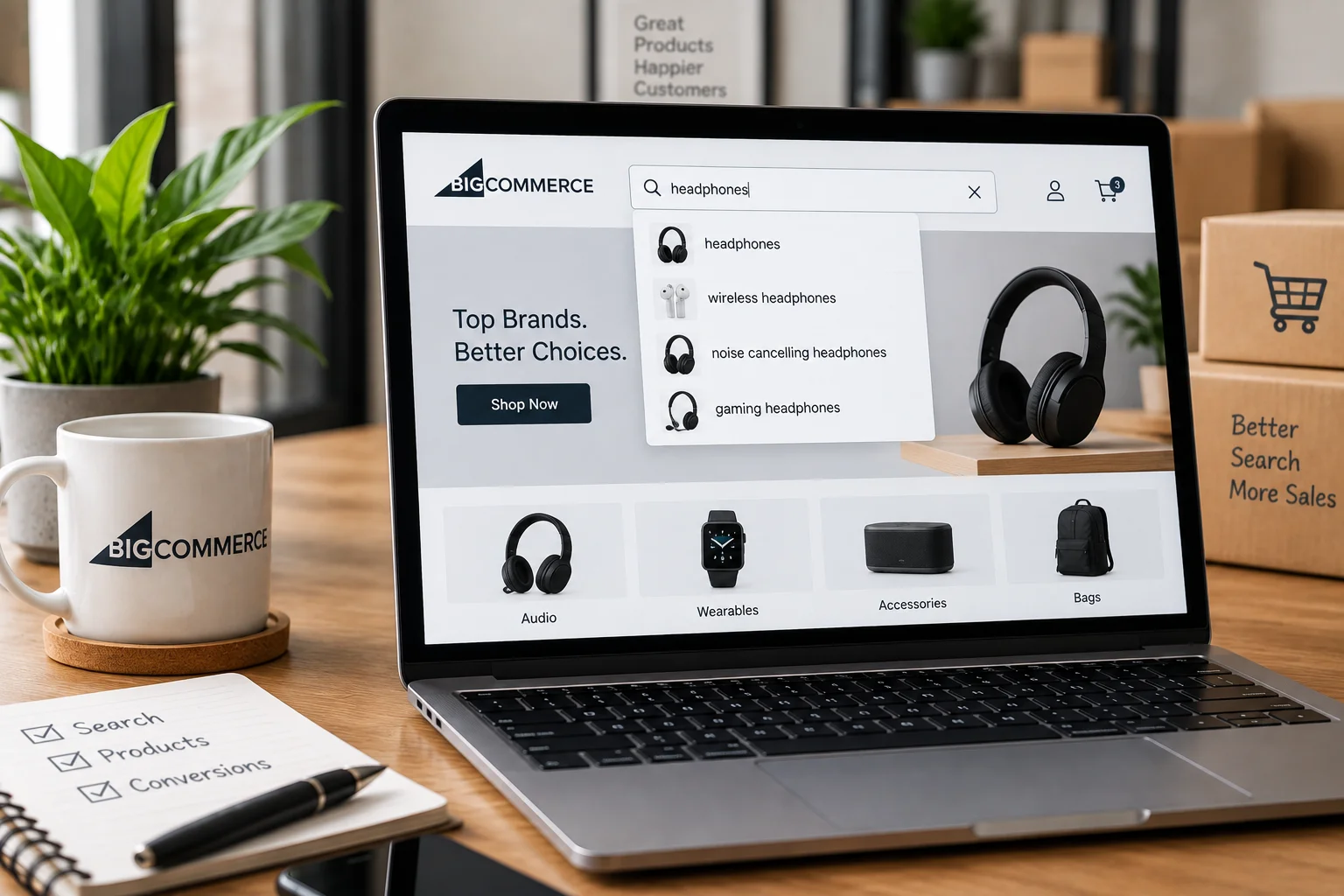
Check what your theme does with search. Make quick search suggestions show products, not just text, and make sure results update smoothly.
Our search autocomplete guide covers what good suggestions look like.
Fix 5: Handle zero results properly
When search finds nothing, don’t show an empty page. Suggest alternatives, correct spelling, and link to related categories.
Also track failed searches. They show you exactly where the catalog and the shopper’s language don’t line up. Our search returned no results guide covers recovery design.
Fix 6: Configure contextual filters via API
For more control, BigCommerce’s Contextual Filters API lets you configure different filter sets for different categories programmatically. This helps stores with diverse product lines.
Note one limit from BigCommerce’s documentation: the API currently supports the default channel only. Multi-storefront stores should plan around that.
Fix 7: Add a dedicated search app
When native BigCommerce search can’t keep up, a dedicated search app replaces or extends it. These apps index your catalog, including titles, descriptions, and custom fields, and serve results from their own engine.
As a result, you typically get richer filtering, typo tolerance, autocomplete, merchandising controls, and analytics. More advanced options add semantic search and personalization.
When a search app makes sense
A dedicated search app is usually worth it when one or more of these apply.
You’re on Standard or Plus
and need filtering without upgrading your whole plan.
You’ve hit the 12-filter ceiling
on complex categories.
Shoppers search descriptively
and native keyword matching misses too often.
You run multiple storefronts
and need different search behavior on each.
You need proof.
You want to test changes and measure revenue impact.
Your catalog is large or B2B.
BigCommerce is popular with B2B merchants, who need SKU precision and account-specific pricing. Our AI search for B2B ecommerce guide covers those needs.
What AI adds to BigCommerce search
AI-powered BigCommerce search goes beyond keyword matching in four ways.
Semantic understanding
matches meaning, so descriptive queries return relevant products without matching titles.
Hybrid retrieval
keeps exact matching for SKUs while adding semantic understanding. This matters for BigCommerce’s many B2B stores. See our hybrid search guide.
Query understanding
extracts filters automatically. “Black office chair under $300” applies color and price without the shopper touching a filter.
Learning ranking
improves results based on clicks and purchases.
Headless BigCommerce and search
If you run Catalyst or another headless setup, search becomes an API integration rather than a theme feature.
That’s actually an advantage. Headless stores can connect any search platform through its API, with full control over how results appear. Our ecommerce search API guide covers what to look for.
Measuring BigCommerce search
Track five numbers before and after any change.
Zero-result rate
and your top failed searches.
Search conversion rate
compared to your site average.
Filter usage rate,
if filtering is enabled.
Search response time
under real load.
Revenue per search,
the number that justifies investment.
Validate changes with a controlled test. Our A/B testing guide covers the methodology. UX research from the Baymard Institute is also a useful benchmark for what good search and filtering look like.
A practical BigCommerce search plan
Week 1: measure.
Check your plan’s filtering access, pull failed searches, and note your filter usage.
Week 2: quick wins.
Enable and configure product filtering if available, complete attributes, and add search keywords for your top failed queries.
Week 3: experience.
Improve autocomplete and your zero-result page.
Week 4: evaluate.
If you’re gated on filtering, capped at 12 filters, or losing descriptive queries, trial a dedicated search app.
Common BigCommerce search mistakes to avoid
Merchants improving BigCommerce search often repeat the same six mistakes.
Upgrading plans only for filtering.
Moving to Pro just for faceted search is expensive. So compare that cost with a BigCommerce search app first.
Leaving filters at default.
Enabling product filtering is only step one. Therefore, configure filters per category and order them by usage.
Stuffing search keywords.
Adding dozens of keywords to every product adds noise. Instead, target the specific vocabulary gaps your failed searches reveal.
Ignoring multi-storefront differences.
Each storefront may serve different shoppers. Consequently, BigCommerce search behavior should reflect that where possible.
Skipping mobile testing.
Most traffic is mobile. As a result, test BigCommerce search suggestions and filters on a phone.
Never measuring.
Without tracking, you can’t tell whether a change helped. So set up search analytics before you change anything.
BigCommerce search for B2B merchants
BigCommerce is especially popular with B2B sellers, and they need more from BigCommerce search than retail stores do.
Part numbers first.
First, B2B buyers search by part number. Exact SKU matching, including formatting variations, is non-negotiable. Our B2B SKU search guide covers the common failures.
Account-specific pricing.
Second, buyers expect their own pricing. BigCommerce supports customer group pricing and price lists, so BigCommerce search results should show each buyer’s actual price.
Reordering.
Third, buyers reorder constantly. Surfacing purchase history in results turns a search into a quick reorder.
Finally, B2B catalogs tend to be large and heavily filtered. That makes filtered BigCommerce search performance a real priority. In short, B2B merchants usually outgrow native search sooner than retail stores.
Choosing a BigCommerce search app
When comparing apps, focus on five practical questions.
Does it work on your plan?
The main reason many merchants add an app is filtering on Standard or Plus.
Does it support your storefronts?
Check multi-storefront and price list support.
Does it handle SKUs precisely?
Test real part numbers, not demo data.
Does it understand meaning?
Try descriptive queries your shoppers actually type.
Can you measure results?
Look for analytics and testing, not just features.
A quick BigCommerce search checklist
Before changing anything, confirm where you stand.
✓ You know whether your plan includes product filtering.
✓ Filters are configured per category, not left at default.
✓ Attribute coverage is complete for every filter shown.
✓ Search keywords cover your top failed queries.
✓ Quick search shows products, not only text.
✓ Zero-result pages suggest alternatives.
✓ SKUs resolve exactly, including formatting variations.
✓ Search analytics are tracking before any change.
If several points fail, begin with filtering and attributes. Those two usually move BigCommerce search results the most.
Finally, record each change with its date. When conversion shifts, you’ll know which BigCommerce search change caused it.
Key takeaways
Native BigCommerce search handles the basics, yet product filtering requires a Pro or Enterprise plan and caps at 12 filters per page. So check your plan first. Then configure filters per category, complete attributes, and add search keywords for vocabulary gaps. Improve autocomplete and zero-result pages next. When you’re gated on filtering or losing descriptive queries, a dedicated search app is usually the faster, cheaper fix than a plan upgrade.
Who owns BigCommerce search?
On many stores, BigCommerce search belongs to nobody in particular. The agency built the theme, the team adds products, and marketing handles campaigns. Consequently, failed searches go unnoticed for months.
Give one person responsibility for BigCommerce search metrics. They should review failed searches monthly, manage search keywords, and decide when an app or plan change is justified. That ownership turns search from a set-and-forget feature into a steady source of conversion gains. It also creates a clear record of what changed, which makes every later decision about apps or plans easier to justify.
Frequently asked questions
Does BigCommerce have built-in search?
Yes. BigCommerce includes storefront search with quick search suggestions in most themes. It handles basic keyword matching well, but advanced features like rich filtering, semantic understanding, and merchandising controls usually require a higher plan or a search app.
Is BigCommerce product filtering available on all plans?
No. Product filtering, BigCommerce’s faceted search, is a Pro and Enterprise feature. Stores on Standard or Plus plans don’t get native faceted search, which is a common reason merchants add a search app.
How many filters can BigCommerce display?
According to BigCommerce’s developer documentation, a storefront can display up to 12 filters per page. Filters can be configured per channel and category, and the Contextual Filters API allows programmatic configuration.
How do I improve BigCommerce search results?
Enable and configure product filtering if your plan allows, complete product attributes, use search keywords for vocabulary gaps, improve autocomplete, handle zero results properly, and consider a dedicated search app when native search runs out.
Do I need a BigCommerce search app?
Often, if you’re on Standard or Plus and need filtering, have hit the 12-filter limit, see descriptive queries failing, run multiple storefronts, or need to test and measure search changes. Small catalogs with simple needs may not.
Can BigCommerce search understand natural language?
Native search relies mainly on keyword matching. AI-powered search apps add semantic understanding, so descriptive queries return relevant products even when no title contains those words.
How does search work on headless BigCommerce?
On Catalyst or other headless setups, search becomes an API integration rather than a theme feature. That lets you connect any search platform through its API with full control over how results display.
Is BigCommerce search good for B2B stores?
It covers the basics, but B2B stores usually need exact SKU matching, account-specific pricing in results, and entitlement filtering. Dedicated search platforms with hybrid retrieval handle those requirements more fully.
BigCommerce search, without the plan gate.
bCloud AI connects natively to BigCommerce with faceted filtering, SKU precision, and semantic understanding on every plan — free implementation included.
bcloud.ai