
What AI visibility actually means
There’s no ranking.
No position one through ten, no stable place to track. You are either in an answer or you are not, and the same question phrased slightly differently produces a different set.
It’s query-specific and volatile.
Being cited for one prompt tells you little about a closely related one, so a single win is not a position you hold.
It’s mostly invisible.
Unlike a search result you can look up, you do not see the answers your customers receive. The impression you lost is genuinely unobservable.
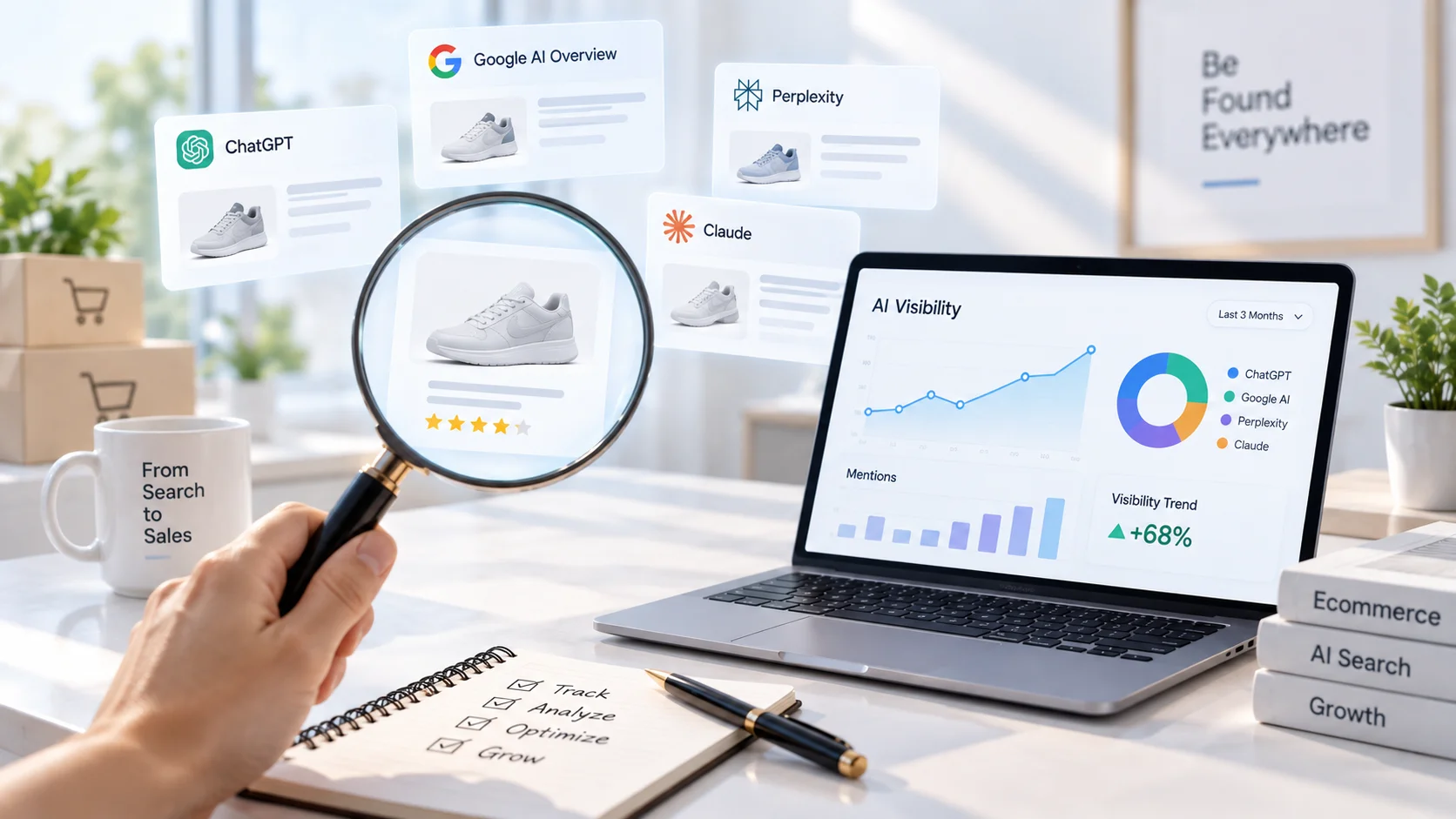
That combination makes AI visibility feel unmeasurable. It is not, but the instruments are immature and each one shows a partial picture.
AI Search Grader by bCloud AI
Grade your ecommerce search in 10 quick questions
31% of ecommerce searches return zero results — and most shoppers who hit a dead end leave for a competitor. How does your store's search stack up?
Answer 10 short questions and get your AI search score, plus a personalized report to fix the gaps. Free, takes about 2 minutes.
No signup needed to take the quiz.
Understanding intent…
Scoring your answers across relevance, AI, experience, and insights.
Your AI search score is ready
Tell us where to send your personalized report. You'll see your score and recommendations right away.
Your score by pillar
Personalized recommendations
Fix the gaps in weeks, not quarters
bCloud AI replaces keyword-only search with hybrid AI retrieval — sub-200ms responses, 99.99% uptime, and conversion lifts of up to 40% across 50+ implementations.
The scale, so you can size the bet
Some verified context for how much this should matter to you.
2.5 billion monthly users.
Google reported AI Overviews reaching more than 2.5 billion monthly active users in 2026, with AI Mode passing 1 billion monthly users within a year and query volume more than doubling every quarter since launch.
52% of US adults.
A national Elon University survey found 52% of US adults using large language models. Gartner separately projected search engine volume dropping 25% by 2026 as answer experiences absorb queries.
4.4x the conversion rate.
Semrush’s analysis found AI search traffic converting at roughly 4.4x the rate of traditional organic, because these visitors arrive with a recommendation rather than a hypothesis.
Modest volumes, high intent. That is the shape of the channel today, and it is why the channel deserves measurement now rather than budget now.
The four instruments available
None is a complete picture. Together they give you a workable one.
Platform-native reporting
Bing Webmaster Tools AI Performance is the most direct instrument currently available, reporting citations and cited pages from Microsoft Copilot and partners. Two caveats matter: the data is sampled, and it lags two to three days, so the final days of any chart are always incomplete. Teams regularly mistake that lag for a collapse.
Google Search Console introduced generative AI performance reporting in June 2026, and Merchant Center added AI performance insights for commerce covering discovery across AI Mode and AI Overviews, with metrics on visibility, product terms, attributes, and completeness.
That Merchant Center addition is worth noting for retailers specifically. Google is now reporting on attribute completeness as an input to AI discovery, which makes catalog data quality a measurable variable rather than an article of faith.
Referral traffic
Filter your analytics for AI assistant domains: chat.openai.com, copilot.microsoft.com, perplexity.ai, and gemini.google.com. Set them up as a named channel group rather than letting them scatter across direct and referral.
This is the most commercially meaningful measurement, because it connects AI visibility to sessions and revenue you can actually attribute. Volumes will look small next to organic. Judge them on conversion rate instead.
Prompt-level monitoring
Track which prompts your customers plausibly ask and whether you appear in the answers. Start manually by querying the assistants yourself, noting which sources get cited, and using that as a baseline.
Manual works for a handful of prompts and breaks down beyond that. Dedicated AI visibility tools now track citation frequency across multiple engines, surface the prompts your audience asks, and connect citations back to specific pages. When evaluating them, prioritize multi-engine coverage and page-level attribution over dashboard polish.
Why multi-engine matters: Ahrefs’ Brand Radar study across 15,000 prompts found only 8% citation overlap between ChatGPT and Google, and 28% between Perplexity and Google. Measuring one engine tells you almost nothing about the others.
Crawler logs
The leading indicator, and the one most teams never check. Filter server logs for GPTBot, OAI-SearchBot, Bingbot, PerplexityBot, ClaudeBot, and Google-Extended. Are they arriving? What status codes do they get?
Access problems precede visibility problems by days or weeks, which makes this your early warning. A pattern of 403s or 503s explains a citation decline before any dashboard will. Our AI crawlers guide covers the full diagnostic.
The volatility problem
Volatility deserves its own section, because it causes more bad AI visibility decisions than anything else. Citation counts swing for reasons outside your control. Grounding indexes get rebuilt. Sampling methodology changes. Sites have experienced near-total citation collapse lasting one to three weeks, with pages still indexed and nothing changed on their end, then recovered spontaneously.
Ignore the last three days of any report.
Reporting lag makes them structurally incomplete, and a chart falling to zero at the right edge is almost always an artifact.
Judge trends over weeks, not days.
A single day at triple your average is usually backfill after a gap, not a breakthrough.
Check access before assuming content failure.
When citations drop, the ordered diagnosis is: crawler access, then server errors, then platform-side events, then content. Most teams reverse that order and start rewriting content that was never the problem.
Record incidents.
Note dates, shape, and resolution. The second time it happens you will recognize the signature in a day instead of two weeks, and you will not stop your content program over a platform artifact.
The expensive version of this mistake is a team that rewrites a working content program in response to a platform-side event, then attributes the eventual recovery to the rewrite.
What to actually track
A workable AI visibility scorecard, reviewed monthly.
Citations by engine.
Bing’s report plus whatever multi-engine tooling you use. Track them separately, never summed. Given 8% overlap, a combined number obscures more than it reveals.
Cited pages count.
More diagnostic than raw citations. If citations rise while cited pages stay flat, you are getting deeper on the same content rather than broader, which means publishing more indexed surface is the lever.
AI referral sessions and conversion rate.
The commercial number. Compare conversion against your site average rather than judging volume.
Prompt coverage.
Of the twenty questions your customers most plausibly ask, how many return you? Crude and genuinely informative.
Crawler health.
Arrival frequency and error rate per crawler, as the leading indicator.
Freshness cadence.
What share of your key pages were updated in the last 30 days. ConvertMate’s analysis of 80 million citations found a 3.2x freshness multiplier for content updated within that window, which makes this a controllable input rather than a vanity metric.
What improves AI visibility
Measurement without levers is just anxiety. Five things move AI visibility, in rough order of effect.
Crawler access.
Nothing else counts if bots cannot reach you, and blocks hide in WAF and CDN rules rather than robots.txt.
Indexed surface area.
More quality pages covering the question tree means more retrievable material. Depth of topical coverage matters more than any single page.
Freshness.
The 3.2x multiplier makes updating existing content a legitimate strategy, often outperforming publishing new.
Structured, complete product data.
Attribute completeness now appears in Google’s own Merchant Center AI reporting. Our product schema markup guide covers implementation.
Answer-first content structure.
Citation analysis found 44.2% of citations coming from the first 30% of content. Lead with the answer. Our answer engine optimization guide covers the full content discipline, and recommended by ChatGPT covers the platform-specific playbook.
Building your baseline this month
Week 1 – instrument.
Verify Bing Webmaster Tools and Search Console are connected. Create an AI-referral channel group in analytics. Pull thirty days of crawler logs and record arrival rates and error codes.
Week 2 – establish prompt coverage.
Write the twenty questions your customers most plausibly ask an assistant. Run each through ChatGPT, Copilot, Perplexity, and Gemini. Record whether you appear and how you are described. This takes an afternoon and is the most revealing exercise on this list.
Week 3 – audit the inputs.
Crawler access across all three layers, server-side rendering on product pages, schema completeness, and how recently your key pages were updated.
Week 4 – set the cadence.
Monthly scorecard review, quarterly prompt re-run, and a documented rule that the last three days of any report are ignored.
Then leave it alone for a quarter. AI visibility data is noisy enough that reacting weekly produces worse decisions than reacting quarterly.
Who owns AI visibility
A practical question that determines whether any of this survives its first quarter.
In most organisations AI visibility falls between teams. SEO owns organic search, ecommerce owns the storefront, and merchandising owns the catalog, while the work that drives AI visibility spans all three. Nobody’s objectives include it, so it gets attention during a scare and neglect otherwise.
SEO-led with catalog support.
The most common arrangement and usually the most effective, since the measurement discipline is closest to existing SEO practice.
Ecommerce-led.
Suits organisations where product data quality is the binding constraint, because that is where the leverage sits.
A named owner with a cross-functional remit.
Best resourced and rarest. Worth arguing for if the channel is already producing revenue you can point at.
Whichever fits, two things are non-negotiable: someone’s objectives must include AI visibility metrics, and that person must have authority to change catalog data. A measurement function without the ability to act on findings produces reports nobody uses.
Report it upward in commercial terms. Leadership funds revenue, not citations. Lead the conversation with AI referral sessions and their conversion rate, then use citation counts as the diagnostic detail underneath. Teams that report citations alone struggle to sustain investment, because the number means nothing to anyone outside the function.
The honest limits
Three things worth accepting rather than fighting.
You will never see the full picture.
No instrument shows every answer your customers receive. You are working from samples and proxies, and that is the state of the art.
Attribution is genuinely hard.
A shopper who asks an assistant, then searches your brand directly, then converts, appears as branded organic traffic. The AI recommendation that started it is invisible in your funnel.
The channel is young.
Tooling, reporting, and even terminology are changing quarterly. Build habits rather than dashboards, because the dashboards will change.
None of that argues against measuring. It argues for measuring proportionately: enough to catch problems and prove direction, not so much that you are optimizing noise. Our semantic search analytics guide covers the same discipline applied to your own site search, where the data is considerably better.
Frequently asked questions
What is AI visibility?
AI visibility is your presence inside AI-generated answers: being cited as a source, recommended as a product, or referenced as an authority when someone asks an assistant a question. Unlike search visibility there is no ranking position, and the same question phrased differently returns different sources.
How do I measure AI visibility?
Four instruments together: platform-native reporting (Bing Webmaster Tools AI Performance, Google Search Console’s generative AI reporting, Merchant Center AI insights), AI referral traffic in analytics, prompt-level monitoring across engines, and crawler logs as the leading indicator.
Why do my AI citations fluctuate so much?
Because grounding indexes get rebuilt and reporting is sampled and lagged by two to three days. Sites have seen citations collapse for one to three weeks with nothing changed on their end, then recover spontaneously. Ignore the last three days of any report and judge trends over weeks.
Is it enough to track one AI engine?
No. Research across 15,000 prompts found only 8% citation overlap between ChatGPT and Google, and 28% between Perplexity and Google. Performance on one engine tells you very little about the others, so track them separately rather than summing.
What improves AI visibility fastest?
Crawler access first, since nothing counts if bots cannot reach you. Then indexed surface area, content freshness measured at a 3.2x citation multiplier within 30 days, complete structured product data, and answer-first content structure.
How much traffic should I expect from AI assistants?
Modest volumes relative to organic search, but unusually high intent. Analysis has found AI search traffic converting at roughly 4.4x the rate of traditional organic, because these visitors arrive with a recommendation rather than a hypothesis. Judge the channel on conversion, not volume.
Can I see which AI answers mention my brand?
Not completely. No instrument shows every answer your customers receive, so you are working from samples and proxies. Prompt-level spot-checking across engines is the closest available view, and it is genuinely informative even though it is incomplete.
You can’t improve what you can’t see, but you can measure enough.
bCloud AI builds the structured catalog that AI engines read, and reports the search quality that drives it.
bcloud.ai