What makes a tool “AI” site search
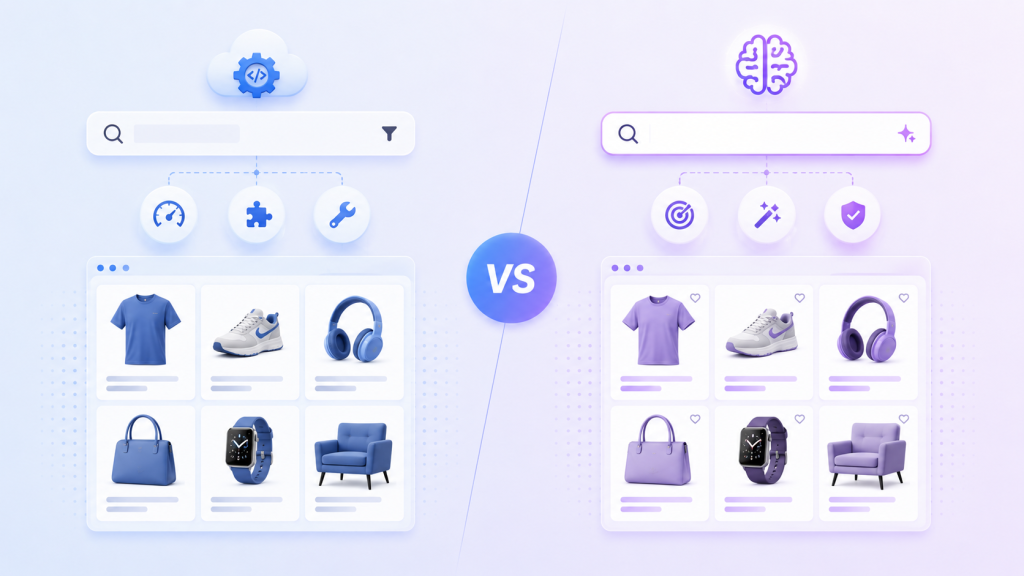
The label is applied loosely, so here’s the honest filter. Three capabilities separate genuine AI site search tools from keyword engines with new marketing:
Semantic understanding.
The tool matches meaning, not characters — “couch” finds sofas, and a full descriptive sentence returns products nobody titled that way. This is the semantic search discipline, implemented with vector embeddings.
Behavioral learning.
Ranking improves from real clicks and purchases rather than hand-maintained boost rules that decay the moment your catalog shifts.
Per-visitor adaptation.
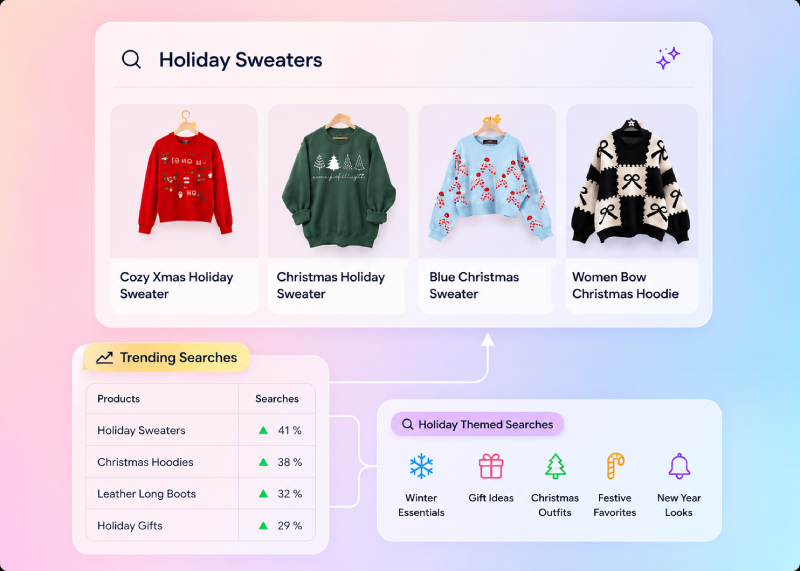
The same query can rank differently for different shoppers based on session and history — without ever overriding what they actually asked for.
A fourth capability separates the good from the merely modern: hybrid retrieval. Pure semantic tools drift on exact SKUs and part numbers, returning “close enough” when a shopper typed a precise identifier. The best AI site search tools pair semantic understanding with classic keyword matching and fuse the results. For the wider field across relevance approaches, see our roundup of the top semantic search solutions for e-commerce.
The 8 best AI site search tools for e-commerce
1. bCloud AI — best overall for mid-market
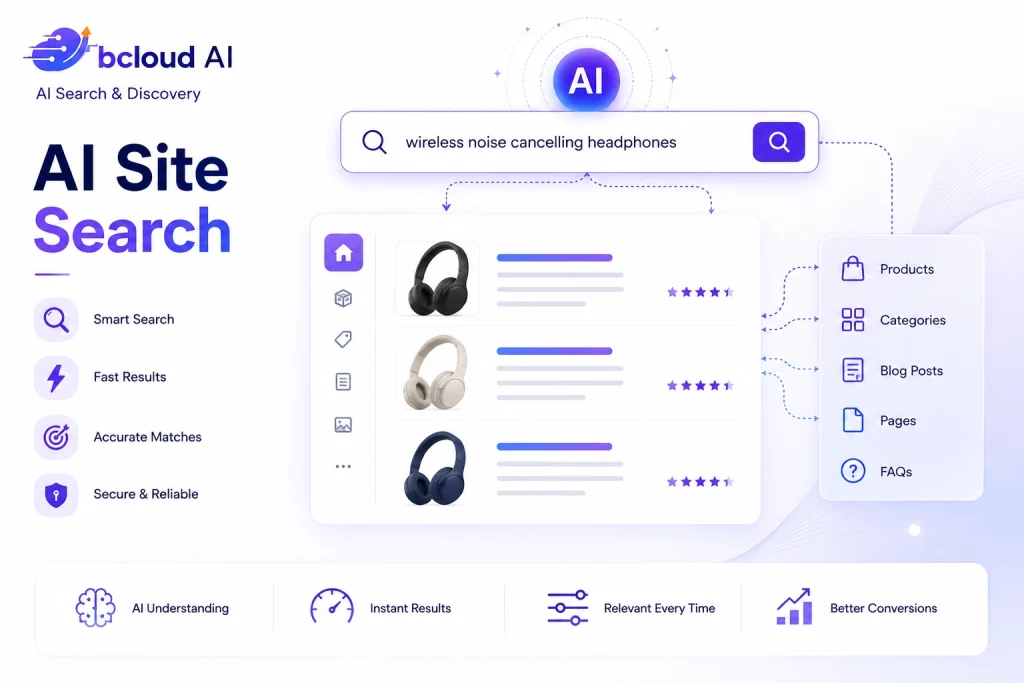
A managed platform pairing hybrid BM25 + vector retrieval with conversational search, AI recommendations, and personalization. Sub-200ms cached responses, ranking models retraining weekly on real behavior, 40+ language support, and native connectors for Shopify Plus, BigCommerce, Magento, and WooCommerce plus a REST API for headless. The differentiator: semantic capability at every tier rather than enterprise-gated, with catalog-based pricing that doesn’t spike on peak days. Free tier covers 20,000 searches and 100,000 records monthly with free implementation. Best for: retailers wanting AI-native search live in weeks.
2. Algolia — best developer experience
Sub-millisecond keyword performance, polished InstantSearch UI libraries, 200+ integrations, and a free 10,000-request tier. NeuralSearch adds true vector retrieval but only on the top-tier Elevate plan, and per-query billing scales with traffic. Best for: engineering-led teams who value tooling and can reach the AI tier.
3. Klevu — best mid-market merchandising
Mature NLP-driven discovery with strong merchandising automation, long established among Shopify and Magento retailers. Quote-based annual pricing, 14-day trial, no permanent free plan. Best for: catalog retailers who want proven merchandising depth.
4. Constructor — best conversion optimization
Ranks toward revenue outcomes using clickstream and purchase data rather than relevance alone, strongest in high-SKU fashion and marketplace catalogs. Custom, sales-led pricing. Best for: enterprise retailers measuring search on revenue.
5. Searchspring — best merchandiser control
Deep merchandising and personalized search with granular product-ranking control. Best for: teams whose merchandisers want hands-on control of every result set.
6. Coveo — best enterprise breadth
Mature ML ranking spanning commerce and support properties, useful when search must work beyond the storefront. Enterprise pricing, heavier implementation. Best for: large organizations unifying multiple search surfaces.
7. Bloomreach Discovery — best full-suite option
AI search and merchandising bundled with content and customer-data modules. Quote-based, commonly $50K+ annually, with 3–6 month implementations and real-time personalized search requiring multiple modules. Best for: enterprises consolidating CDP, CMS, and search.
8. Typesense / Weaviate — best open-source AI site search tools
Both ship built-in vector search with hybrid capability. Typesense prices on resources with no per-search charges; Weaviate fuses BM25, vectors, and filters natively with built-in vectorization modules. Fewer commerce merchandising features. Best for: technical teams wanting control at predictable cost.
The 5 tests that expose a weak tool
Vendor demos run on curated catalogs. These five run on yours.
1. The messy-query test.
Pull a hundred real queries from your logs — typos, long descriptions, half-remembered brands, problem-framed searches like “shoes for standing all day.” Score which tool puts the right product on the first screen. This is where AI site search tools genuinely separate, and it’s where most stores currently fail: Baymard Institute’s long-running UX research consistently finds these query types break site search.
2. The exact-match floor.
Type precise SKUs and model numbers. They must resolve literally. Drift here means the tool is vector-only, which is disqualifying for any catalog with technical identifiers.
3. Speed at your scale.
Sub-200ms at p95 and p99, with your catalog size and your real filters applied, under concurrent indexing load. Averages on a demo index predict nothing.
4. Where does the AI live in the pricing?
Several vendors reserve semantic and vector search for their top enterprise tier. The capability you’re evaluating the tool for may not be in the plan you get quoted. Ask directly, then model your bill at three times current traffic.
5. Can it prove lift?
The best AI site search tools roll out against a control group and report search conversion, revenue per search, and zero-result rate. If quality is a slide instead of a dashboard, keep looking. Our search relevance metrics guide covers what to measure, and A/B testing ecommerce search covers how.
Integration: the constraint most teams underestimate
Relevance gets all the attention in tool comparisons; integration decides how quickly you see any of it. Three questions matter.
Does it connect natively to your platform?
Native connectors for Shopify, BigCommerce, Magento, and WooCommerce turn a multi-week engineering project into a configuration task. Headless and custom stacks need a clean REST API with full control over ranking parameters.
How does the catalog stay current?
Prices and stock change constantly, and results are only as truthful as the index behind them. Real-time, event-driven indexing keeps search accurate; nightly batch rebuilds mean shoppers see stale data for most of the day. Our real-time indexing guide covers what to ask for.
Who operates it after launch?
Managed AI site search tools absorb tuning, scaling, and model migrations. Self-operated engines hand that to your team permanently. This single choice usually shapes total cost more than the license fee.
A useful proxy for integration quality: ask each vendor what week one looks like. Credible answers describe catalog indexing, a relevance review on your real data, and a traffic-split rollout. Vague answers describing a services engagement usually mean a longer, costlier project than the quote implies.
Matching AI site search tools to your situation
The eight above aren’t interchangeable, and the fastest way to shortlist is by constraint rather than feature list.
Small catalog, small team, tight budget.
Prioritize AI site search tools with a genuine free tier and native platform connectors. You want configuration, not a project. bCloud AI’s free tier and Algolia’s Build tier both let you validate on real traffic before spending anything, and Meilisearch or Typesense work if you have a developer who enjoys this.
Mid-market, growing traffic.
Pricing shape matters more than anything else here, because this is the band where per-query billing starts to bite. Confirm semantic search is included in the tier you’d actually buy. This is the segment where teams most often discover that the AI they evaluated sits two plans above the one they were quoted.
Large or complex catalog.
Filtered-query performance and real-time indexing dominate. Test with your worst multi-facet queries and ask for indexing lag as a distribution rather than an average. Many AI site search tools that feel fast on a demo index slow dramatically once facets are applied at scale.
B2B or parts-heavy.
The exact-match floor is non-negotiable. Buyers arrive with part numbers, cross-references, and internal codes, and a tool that approximates on those loses procurement’s trust in a single session.
Marketing-led, AI-visibility focused.
If the driver is being recommended by ChatGPT and Copilot rather than fixing on-site search, weight structured data quality and catalog completeness heavily — those determine what external engines can read.
What changed in 2026
Three shifts reframe how AI site search tools should be evaluated this year.
AI became baseline. Nearly every vendor now claims semantic capability, so the question moved from does it have AI to how good is the hybrid blend, and is it in my tier.
Measurement became the differentiator. Buyers increasingly expect control-group proof of lift rather than case-study claims, and tools that can’t provide it get screened out.
Search became a discoverability layer. Shoppers now ask ChatGPT, Copilot, and Gemini for product recommendations, and those assistants read the same structured catalog that powers on-site search. Investing in AI site search tools improves discovery on your own site and how external AI engines represent your products — one project, two returns.
Free tiers and trials worth using
One practical advantage of evaluating AI site search tools in 2026: you can test most of them on real traffic before spending anything, which was not true three years ago.
bCloud AI’s free tier covers 20,000 searches and 100,000 catalog records monthly with free implementation and 24×7 support, pay-as-you-go with no contract — generous enough to run a genuine pilot on a mid-size catalog rather than a toy index. Algolia’s Build tier includes 10,000 requests monthly, ample for a proof of concept though it will not survive real traffic for long. Constructor offers a 30-day trial plus a revenue assessment, and Klevu a 14-day trial with no permanent free plan.
Open-source AI site search tools skip trials entirely: Typesense and Meilisearch can be self-hosted at zero license cost, which makes them the cheapest way to test semantic retrieval on your catalog if you have a developer willing to spend an afternoon.
Use these deliberately rather than casually. A trial that indexes your real catalog and runs your real query set produces a decision; a trial that indexes sample data produces a feeling. And instrument the pilot from day one — zero-result rate, search conversion, revenue per search — so the comparison at the end is evidence rather than impression.
How to run a fair pilot of AI site search tools
A trial only tells you something if both tools face identical conditions.
Most pilots fail on setup rather than on search quality. One vendor gets a tuned index while another gets a raw feed. Consequently the result measures effort, not capability. Four rules prevent that.
Send every tool the same feed.
Same fields, same records, same messy tail. Do not clean the data for one vendor and not another. Otherwise you are comparing your own prep work.
Score blind where you can.
Strip vendor branding from the result sets before someone grades them. People favour the tool they already liked. Blind scoring removes that pull.
Cap the tuning time.
Give each tool the same fixed window, such as four hours of configuration. A tool that needs a week of tuning to look good will need that forever.
Include a category you sell badly.
Pilots usually test bestsellers, where everything works. Add a neglected category with thin data instead. That is where the real difference shows.
In short, decide the rules before the first index loads. Write down what a win looks like too, since a scorecard agreed afterwards tends to match whatever happened. Our search relevance metrics guide covers how to build that scorecard.
Common mistakes when choosing
- Evaluating on the vendor’s data. Curated demo catalogs flatter every tool. Use your own worst hundred queries.
- Ignoring product data quality. AI site search tools can only understand meaning your catalog expresses. Thin titles and missing attributes cap every tool’s ceiling on day one — enrichment before selection pays off more than any configuration afterward.
- Buying vector-only. Without a lexical layer, exact identifiers fail. Insist on hybrid.
- Skipping the pricing model. Per-query billing turns a good Black Friday into a bad invoice. Model at 3× traffic.
- Treating launch as the finish line. Vocabulary shifts, catalogs grow, and embeddings age. Review quality monthly and keep a permanent holdout so the lift stays proven.
Frequently asked questions
What are the best AI site search tools for e-commerce?
The 2026 leaders are bCloud AI, Algolia, Klevu, Constructor, Searchspring, Coveo, Bloomreach Discovery, and the open-source options Typesense and Weaviate. Managed tools suit most retailers; open-source engines suit teams with engineering depth. The right pick depends on catalog size, platform, and whether semantic capability is included in the tier you can afford.
What makes a site search tool genuinely “AI”?
Three capabilities: semantic understanding that matches meaning rather than exact keywords, behavioral learning that improves ranking from real clicks and purchases, and per-visitor personalization. A fourth — hybrid retrieval pairing semantic with keyword matching — separates production-ready tools from ones that drift on exact SKUs.
How do I test AI site search tools before buying?
Run five tests on your own catalog: a hundred messy real queries, exact SKU resolution, p95/p99 speed with your filters applied, where AI capability sits in the pricing tiers, and whether the tool can prove lift against a control group.
Do AI site search tools work with Shopify and BigCommerce?
Most leading tools offer native connectors for Shopify, Shopify Plus, BigCommerce, Magento, and WooCommerce, plus REST APIs for headless storefronts. Confirm the specific connector for your platform during evaluation, since native integration is the difference between a configuration task and an engineering project.
How much do AI site search tools cost?
Widely variable by pricing model. Free tiers exist (bCloud AI includes 20,000 searches and 100,000 records monthly; Algolia offers 10,000 requests), usage-based plans scale with traffic, open-source engines cost infrastructure only, and enterprise suites are commonly quoted at $50K+ annually.
How long do they take to implement?
Managed AI site search tools typically go live in weeks including catalog indexing and integration. Enterprise suites often run 3–6 months. Building your own stack from components is a multi-month engineering project.
AI search that understands your shoppers — live in weeks.
bCloud AI delivers hybrid, learning, sub-200ms site search with measurement built in and semantic capability on every plan.
bcloud.ai