What Is Voice Commerce?
How Does Voice Commerce Work?
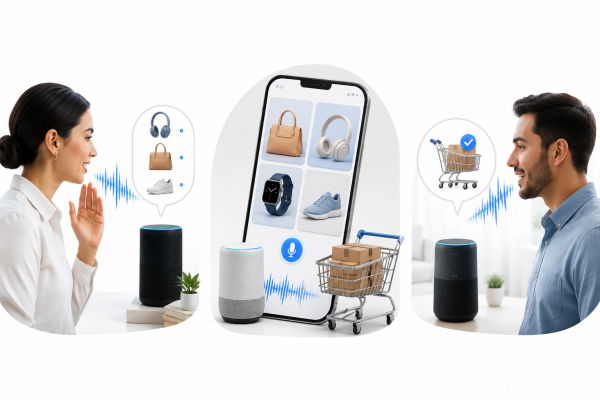
It runs through a quick pipeline. First, automatic speech recognition converts the shopper’s spoken words into text. Next, natural language understanding interprets the intent — what product, what constraints, what action. Then the system searches the catalog for relevant products, applying the same semantic understanding that powers modern text search. Finally, it returns a response: a spoken list of options, a confirmation, or a completed action. The hardest part is the middle — understanding messy, conversational speech — which is exactly where AI and semantic search make voice shopping viable.
Why Voice Commerce Matters
Voice is the most natural interface there is, and shoppers increasingly reach for it. Smart speakers sit in millions of homes, and nearly every phone has a capable voice assistant. Voice shines in hands-free moments — cooking, driving, multitasking — and for quick, known-item tasks like reordering. It also lowers barriers for shoppers who find typing difficult, improving accessibility. Above all, voice shopping matches the shift toward conversational, intent-driven shopping: people speak in full sentences, not keywords, so a store that understands natural language is already most of the way to supporting voice. It is a close sibling of conversational commerce.
Voice Commerce Channels
It happens across several devices and surfaces.
Smart Speakers
Alexa, Google Home, and similar devices let shoppers search, reorder, and buy by voice in the home — the classic voice shopping setting.
Mobile Voice Assistants
Siri and Google Assistant put voice search and shopping in every pocket, ideal for on-the-go and hands-busy moments.
Voice Search on Your Site and App
A microphone in your own search bar lets shoppers speak their query directly, turning natural speech into onsite results.
Voice-Enabled AI Assistants
AI assistants increasingly accept voice, recommending products conversationally and connecting voice to the broader rise of AI-driven shopping.
7 Benefits of Voice Commerce
| # | Benefit | Why it matters |
|---|---|---|
| 1 | Speed and convenience | Speaking is faster than typing, especially on mobile |
| 2 | Hands-free shopping | Works while cooking, driving, or multitasking |
| 3 | Effortless reordering | Repeat purchases happen in a single spoken command |
| 4 | Natural language | Shoppers ask the way they think, not in keywords |
| 5 | Accessibility | Lowers barriers for shoppers who find typing hard |
| 6 | Faster discovery | Conversational follow-ups narrow choices quickly |
| 7 | Loyalty | Frictionless reordering deepens customer habits |
Voice Commerce Use Cases
Voice shopping is strongest for a few high-value patterns. Reordering consumables — coffee, household supplies, pet food — is the killer use case, because the shopper already knows the product and just wants it again. Hands-free situations, from kitchens to cars, turn idle moments into purchases. Quick lookups (“is this in stock,” “find a gift under $50”) suit voice’s conversational nature. And accessibility-driven shopping opens your store to customers for whom typing is a barrier. In each case, voice removes friction at the exact moment intent appears, capturing sales that might otherwise wait or vanish.
How to Optimize for Voice Commerce
Optimizing for voice comes down to understanding natural language and structuring your data well. Make sure your search understands conversational, full-sentence, long-tail queries rather than just keywords. Keep product data clean and complete so an assistant can answer specific questions about price, availability, and attributes — which is where search enrichment pays off. Provide concise, direct answers a device can speak aloud, and keep responses fast. Much of this overlaps with classic SEO and structured data, so a voice-ready store is also a search-engine-friendly one.
Voice Search and AI Visibility
Voice assistants and AI engines draw their answers from the same structured, machine-readable product data that traditional search uses. When a shopper asks an assistant for a recommendation, the brands with clean catalogs, complete attributes, and clear, answer-direct content are the ones that get named and read aloud. That ties voice shopping directly to your AI visibility: the work that makes you discoverable in AI answers also makes you discoverable by voice. As voice and AI assistants converge, a single, well-structured catalog is what keeps you present across both.
Common Voice Commerce Mistakes
A few mistakes hold stores back: relying on keyword-only search that cannot parse conversational requests; thin product data that leaves assistants unable to answer specific questions; verbose, unstructured content that does not translate to a spoken answer; and treating voice as a separate project rather than an extension of conversational, intent-aware search. The fix is to build voice on a real AI search foundation that understands natural language and grounds answers in clean catalog data — so a spoken query gets the same relevant result a typed one would.
Where Voice Fits Among AI Shopping Channels
Voice does not replace other channels — it joins them. Text search remains the workhorse for detailed, comparison-heavy shopping. Visual search wins when appearance drives the decision. And voice excels at speed, hands-free moments, and known-item reordering. What unites them is intent: each is just a different way for a shopper to express what they want, and each depends on the same underlying ability to understand meaning and match it to your catalog. The retailers who treat voice, text, visual, and chat as one multimodal discovery system — rather than four disconnected features — deliver a consistent experience no matter how a shopper chooses to engage.
How to Measure Voice Commerce Success
To know whether voice is working, track adoption (how many shoppers use voice search), the conversion rate of voice sessions, reorder frequency through voice, and the rate of unrecognized or unanswered requests. That last metric is especially telling: frequent failures usually mean your search cannot parse conversational phrasing or your product data lacks the detail an assistant needs to answer. Reviewing these regularly shows where to improve natural-language understanding and catalog quality, turning voice from an experiment into a reliable, measurable channel that contributes real revenue.
The Future of Voice Shopping
Voice is poised to grow as assistants get smarter and more deeply integrated with shopping. Speech recognition keeps improving, AI understands conversational nuance better each year, and shoppers grow more comfortable buying by voice as trust builds. The convergence of voice with AI assistants means a single spoken request may soon move smoothly from discovery to purchase across devices. As with visual and conversational shopping, the advantage will go to retailers who build on a strong, intent-aware search foundation now, so each new capability becomes an extension rather than a rebuild.
Voice and Accessibility
One benefit deserves its own mention: accessibility. For shoppers with visual impairments or motor difficulties, voice can be the most natural — sometimes the only comfortable — way to shop online. Building a capable spoken experience is not just a growth lever; it widens who can use your store, which is both good practice and good business.
Start With Reordering
If you are beginning with voice, start where it already works best: reordering. Letting customers repurchase known items with a single spoken command delivers immediate value, builds the habit, and is the simplest experience to get right. Once shoppers trust voice for reorders, expanding to discovery and richer interactions becomes a natural next step rather than a leap.
How bCloud AI Powers Voice Commerce
bCloud AI makes voice commerce work by powering the understanding behind it. Its intent-aware, conversational search interprets natural, full-sentence requests, and its hybrid semantic engine returns relevant products grounded in your catalog data. That same engine plugs into voice platforms directly: with bCloud AI, Alexa Skills, Google Actions, and other voice assistants can query your store’s search so a shopper can simply say “ask [your store] for wireless headphones under $100” and get an immediate, relevant answer — no custom integration required. Because voice, visual, semantic, and conversational search share one engine, your store stays consistent and relevant across every way a shopper chooses to search. To compare AI-native platforms, see our roundup of the best ecommerce search engines for 2026.
Frequently Asked Questions About Voice Commerce
What is voice commerce?
Voice commerce is the use of voice commands and natural speech to search for products, get recommendations, and complete purchases. A shopper speaks a request to a smart speaker, phone, or voice-enabled app, and the system understands it and responds by reading options, adding to a cart, or placing an order.
How does voice commerce work?
It runs through a pipeline: automatic speech recognition converts speech to text, natural language understanding interprets intent, the system searches the catalog with semantic understanding, and it returns a spoken response or completes an action. Understanding conversational speech is the key challenge AI solves.
Why is voice commerce important?
Voice is the most natural interface, and shoppers increasingly use smart speakers and phone assistants. It excels at hands-free moments and reordering, improves accessibility, and matches the shift to conversational, intent-driven shopping where people speak in full sentences rather than keywords.
What are the channels of voice commerce?
Channels include smart speakers (Alexa, Google Home), mobile voice assistants (Siri, Google Assistant), voice search in your own site and app, and voice-enabled AI assistants that recommend products conversationally.
What is the difference between voice commerce and conversational commerce?
Voice commerce is shopping through spoken voice across devices, while conversational commerce is the broader practice of shopping through natural-language dialogue in any form, including text chat. Voice is a spoken channel of conversational commerce, and both depend on understanding intent.
How do I optimize my store for voice commerce?
Ensure your search understands conversational, long-tail queries, keep product data clean and complete so assistants can answer specific questions, provide concise answers a device can speak, keep responses fast, and use structured data — much of which overlaps with SEO.
What are the best use cases for voice commerce?
The strongest use cases are reordering consumables, hands-free shopping while cooking or driving, quick lookups like stock or gift ideas, and accessibility-driven shopping for customers who find typing difficult.
What is the best platform for voice commerce?
The best platform powers voice with intent-aware, semantic search grounded in clean catalog data and connects to voice assistants like Alexa and Google Actions. Leading AI-native options include bCloud AI, whose engine lets voice platforms query your store’s search directly.
Let Shoppers Search and Buy by Voice
Voice shopping runs on AI that understands natural speech and your catalog. Start for free or book a demo to see voice, visual, and conversational search working as one.
Related resources: Conversational Commerce · Visual Search · AI Visibility for Ecommerce · Best Ecommerce Search Engine: Top 10 for 2026