

bCloud AI vs WPSOLR
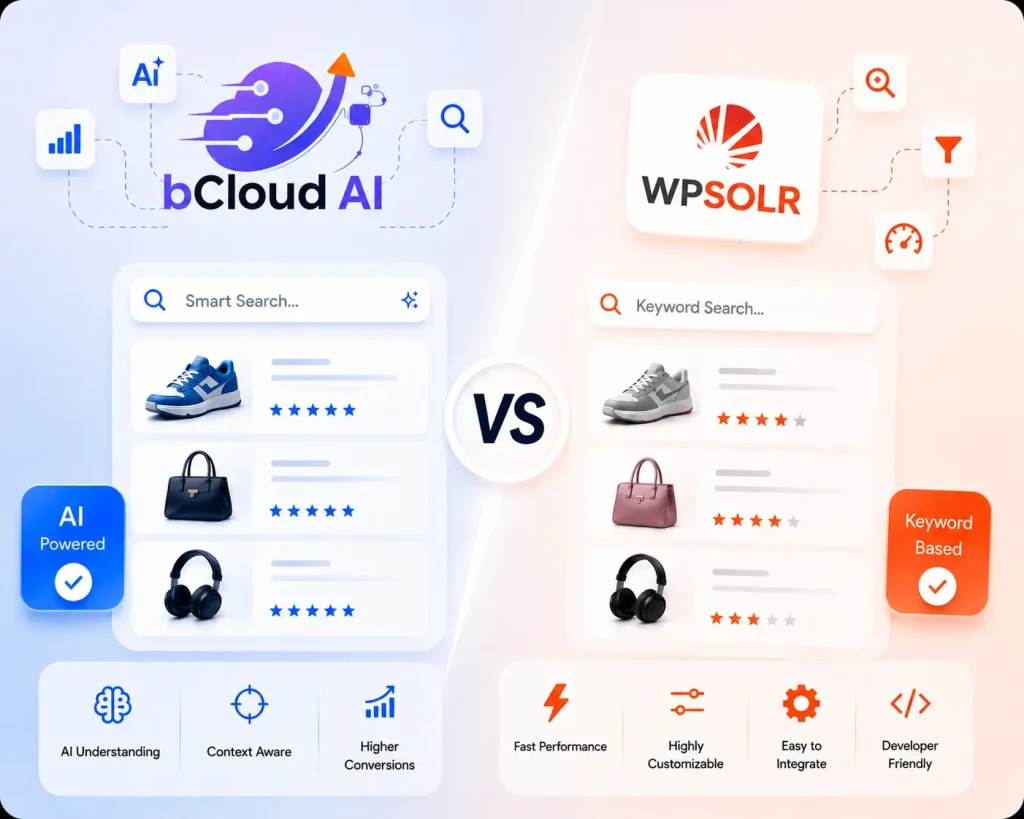
bCloud AI vs WPSOLR : side-by-side comparison
Capability
WPSOLR
bCloud AI
Where WPSOLR falls short for modern e-commerce search
Complex Infrastructure
Running vector indexes, failover clusters, and hybrid retrieval systems requires constant engineering oversight.
01
02
AI Features Need Manual Work
Behavioral reranking, semantic search, embeddings, and merchandising tools must be stitched together manually.
Slower Conversion Optimization
Engineering time spent maintaining search systems is time not spent improving shopper experience and revenue performance.
03
Where bCloud AI wins on capability and economics
Sub-200ms Search Performance
Edge-cached AI retrieval delivers lightning-fast product discovery globally.
AI Features Included by Default
Semantic search, embeddings, reranking, and typo handling work automatically.
Clear Visual Dashboard
Growth teams can pin, boost, and optimize products without engineering help.
Lower Total Cost of Ownership
Reduce infrastructure, operational overhead, and engineering maintenance costs.
Specific advantages teams flag during migration
Deployment in under a week
Catalog sync via native connectors; frontend integration via a single async script.
Hybrid AI retrieval by default
Vector search, BM25 keyword scoring, and behavioral reranking all work together — not gated behind premium tiers.
Self-serve visual merchandising
Pin bestsellers, boost margin items, bury out-of-stock SKUs without engineering tickets.
Sub-200ms cached latency
Edge-cached across global CDN regions, with sub-400ms cold response times.
Native multilingual embeddings
One index handles all supported languages without per-language deployment overhead.
Predictable flat-tier pricing
No per-request surprises; no AI-feature surcharge.
Pricing and total cost of ownership
WPSOLR Costs
Infrastructure & Hosting
AI Feature Upgrades
Engineering Maintenance
Traffic-Based Overages
bCloud AI Advantage
Flat-Tier Pricing
AI Included by Default
Built-In Analytics & A/B Testing
Lower Year-One TCO
Migration playbook: switching from WPSOLR to bCloud AI
Performance benchmarks: latency, scale, and reliability
⚡
Sub-200ms Cached Search
Ultrafast AI retrieval optimized for high-conversion shopping experience.
🌐
Global CDN Edge Caching
Distributed edge infrastructure with regional failover support for caching.
📈
Massive Catalog Scalability
Supports 10M+ SKUs without requiring re-architecture or migration.
Reliability at Scale
<200ms
Cached Query Latency
<400ms
Cold Query Response
99.99%
SLA Uptime Guarantee
10M+
SKU Scale Support
When WPSOLR is still the right choice
Already Invested
Typically when your team has already invested heavily in the platform's broader ecosystem.
Capability Gap
When WPSOLR ships a capability you need that bCloud doesn't yet match.
Contract Cycles
Or when a contract renewal cycle locks in current-year decisions.
An AI-native WPSOLR alternative usually delivers faster ROI and lower total cost.
How to evaluate any platform for your store
01
Run a Real Pilot
Test on actual catalog data for 30 days to measure real-world business impact.
02
Track Key Metrics
Monitor conversion lift, zero-results rate, abandonment, and productivity improvements.
03
Compare Operations
Evaluate deployment, catalog syncing, analytics quality, and day-to-day usability.
04
Talk to Real Teams
Speak with merchandisers and growth teams actively using the platform daily.
What teams typically report after switching to bCloud AI
30–50%
Conversion Lift
Search-to-purchase conversion commonly improves by 30–50% following deployment.
<2%
Zero Results Rate
Teams often reduce zero-result searches from 8–15% down to under 2%.
40–60%
Less Abandonment
Search abandonment frequently declines by 40–60% as shoppers discover relevant products faster.
10–18%
Higher AOV
Average order value typically increases through semantic cross-selling and better product discovery.
Mobile Search Improvements
Mobile engagement typically improves by 20–30% because natural-language and voice-style queries finally resolve correctly.
Operational Impact
Merchandising velocity increases substantially. Pin, boost, and bury actions that previously required engineering tickets become same-hour decisions for growth teams. Search-related support requests also decrease because users find products immediately instead of escalating "I can't find X on your site" complaints.
Frequently asked questions
Why are teams looking to switch from WPSOLR?
Is bCloud AI a viable replacement for WPSOLR?
How long does migration from WPSOLR to bCloud AI take?
What conversion lift should we expect after switching?