Why A/B testing ecommerce search matters
7 high-impact things to test
1. The whole engine.
New AI search vs your current system — the biggest test of all, usually rolled out to a small traffic slice first (e.g., 5%) and ramped as confidence grows.
2. Ranking algorithm.
How results are ordered — relevance-first vs conversion/revenue-weighted ranking.
3. Hybrid weighting.
The balance between semantic and keyword matching (a 60/40 blend, for example), which materially changes results across query types.
4. Autocomplete and suggestions.
Whether predictive suggestions and their design lift search usage and conversion.
5. Facets and filters.
Filter order, dynamic vs static facets, and how filtering affects add-to-cart.
6. Zero-result handling.
Fallbacks, “did you mean,” and recommendations shown when a query returns nothing — often a fast revenue win.
7. Merchandising rules and UI.
Boosting high-margin or in-stock products, plus result-page layout and the search bar itself.
Many of these ride on the same foundation — see our guides to hybrid search systems and ecommerce conversion rate optimization.
AI Search Grader by bCloud AI
Grade your ecommerce search in 10 quick questions
31% of ecommerce searches return zero results — and most shoppers who hit a dead end leave for a competitor. How does your store's search stack up?
Answer 10 short questions and get your AI search score, plus a personalized report to fix the gaps. Free, takes about 2 minutes.
No signup needed to take the quiz.
Understanding intent…
Scoring your answers across relevance, AI, experience, and insights.
Your AI search score is ready
Tell us where to send your personalized report. You'll see your score and recommendations right away.
Your score by pillar
Personalized recommendations
Fix the gaps in weeks, not quarters
bCloud AI replaces keyword-only search with hybrid AI retrieval — sub-200ms responses, 99.99% uptime, and conversion lifts of up to 40% across 50+ implementations.
Deciding what to test first
Seven candidates is more than most teams can run in a quarter. Order matters.
Every test costs traffic and calendar time, so the sequence decides how much you learn per month. Four questions rank the queue quickly.
How much traffic does it touch?
A change affecting every search reaches significance far sooner than one affecting a narrow query type. Therefore broad changes belong early in the queue.
Is it cheap to reverse?
A ranking weight can be undone in minutes. A new engine cannot. Start with the reversible changes while your team builds confidence in the process.
Does your data already point at it?
A high zero-result rate makes fallback handling the obvious first test. Consequently your analytics should set the agenda rather than the roadmap.
Will the result change a decision?
If you would ship the change regardless of outcome, skip the test. Spend that traffic on a question you are genuinely unsure about.
In short, run one test at a time on overlapping traffic, since parallel tests on the same shoppers muddy both results. Our ecommerce search analytics guide covers which numbers should shape the queue.
How to run a valid search A/B test
The methodology is what separates a real result from a misleading one:
Pick one primary metric. Usually search-driven conversion rate or revenue per search — the outcome you actually care about. Decide it before you start.
Set guardrail metrics. Watch zero-result rate, latency (p95/p99), and bounce so a “win” on conversion doesn’t quietly break something else.
Randomize properly and choose the right unit. Split by user (or session, consistently), so the same shopper always sees the same variant. A/B testing is, at its core, a controlled experiment comparing two variants — the Wikipedia overview of A/B testing is a solid primer on the fundamentals.
Size the test and run it long enough. Calculate the sample size and run for full business cycles (at least one to two weeks) so weekday/weekend and payday patterns wash out. Underpowered tests produce noise dressed as insight.
Don’t peek. Checking results repeatedly and stopping the moment they look good inflates false positives. Set the duration up front and hold to it.
Segment your analysis. Break results out by new vs returning shoppers, device, and query type (head, long-tail, typo) — a change can help one group and hurt another.
Validate offline first. Screen candidate changes with search relevance metrics like nDCG before spending live traffic, then use the A/B test to confirm business impact.
A managed platform simplifies this loop: bCloud AI’s AI search engine supports traffic-level rollouts against a control group and measures conversion, revenue per search, and satisfaction automatically, so experimentation is built in rather than bolted on.
Faster alternatives: interleaving and bandits
Classic A/B tests can be slow to reach significance on ranking changes. Two techniques help. Interleaving mixes results from two rankers into one list and measures which side earns more clicks — it can detect a winner with far less traffic, ideal for comparing relevance models. Multi-armed bandits dynamically shift more traffic toward the better-performing variant as evidence accumulates, reducing the revenue “cost” of testing. Use A/B tests for clean, defensible business-impact numbers; use interleaving and bandits when speed or traffic constraints matter.
Common A/B testing mistakes to avoid
- Too small a sample. Search subsegments (by query type) need real volume to reach significance.
- Stopping early. Peeking and early stopping are the most common ways to fool yourself.
- Ignoring guardrails. A conversion win that triples latency isn’t a win.
- Testing during anomalies. Black Friday and major promos distort results; test in normal periods.
- Novelty effect. New experiences can spike temporarily — run long enough for behavior to settle.
- Wrong unit of analysis. Splitting by request instead of user contaminates the test.
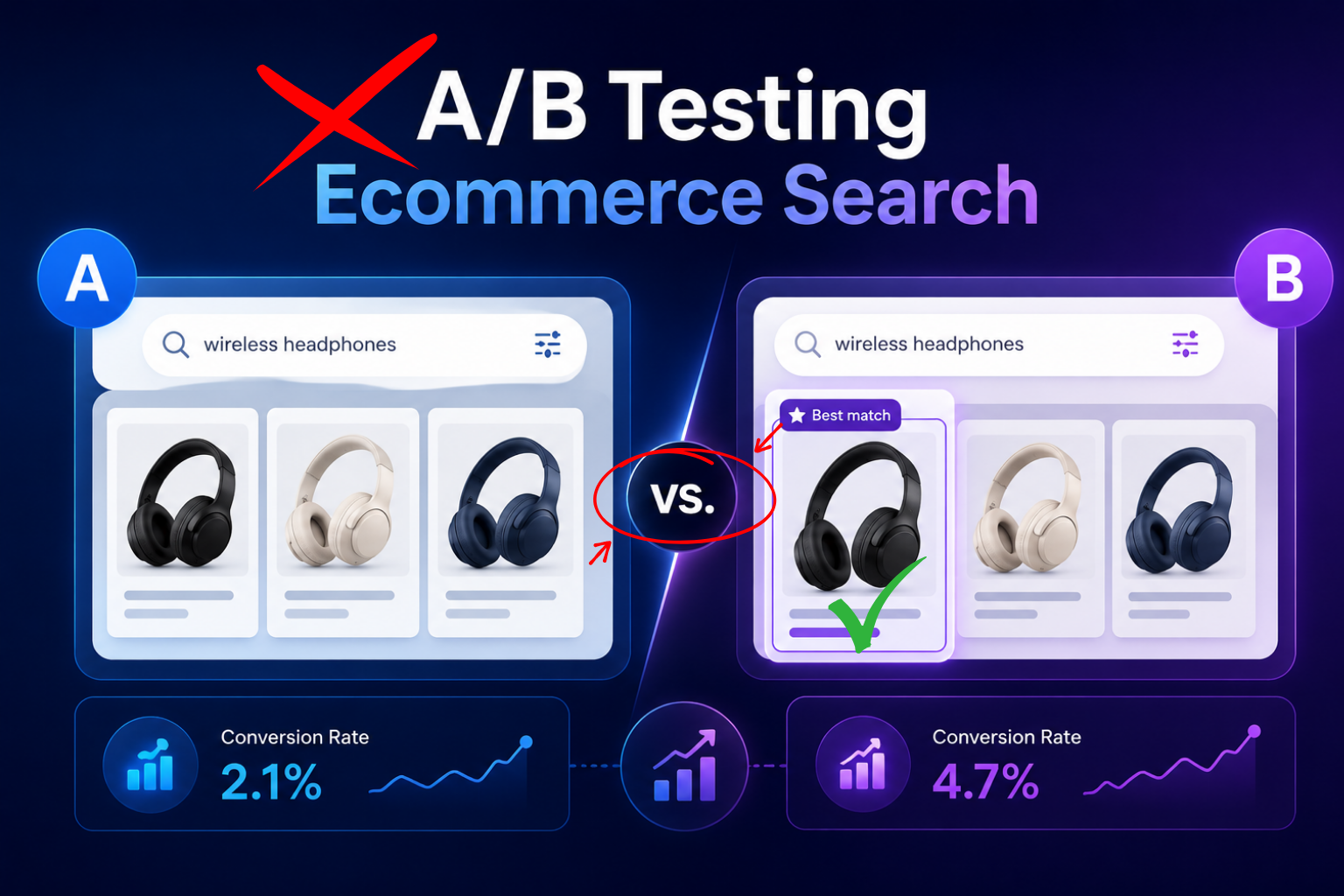
A/B Testing Ecommerce Search is one of the most effective ways for online retailers to optimize the shopping experience and improve conversion rates. By comparing two versions of an ecommerce search experience—such as different ranking algorithms, autocomplete suggestions, search filters, or AI-powered recommendations—businesses can identify which version delivers better user engagement and sales. Instead of relying on assumptions, A/B testing provides data-driven insights that help retailers make informed decisions about their search strategy.
Modern AI-powered ecommerce search platforms use A/B Testing Ecommerce Search to evaluate how machine learning models influence customer behavior. Retailers can test semantic search, personalized search results, synonym handling, typo tolerance, and product ranking strategies against existing search experiences. Key performance indicators (KPIs) such as click-through rate (CTR), search exit rate, add-to-cart rate, average order value (AOV), and overall conversion rate are measured to determine which search configuration produces the best business outcomes.
Implementing A/B Testing Ecommerce Search also helps businesses continuously refine the customer journey. Seasonal campaigns, new product launches, pricing changes, and merchandising rules can all impact search performance. Regular testing enables ecommerce teams to optimize search relevance, reduce zero-result searches, and ensure customers find the most relevant products quickly. This iterative approach enhances customer satisfaction while increasing revenue and reducing cart abandonment.
As AI continues to transform online shopping, A/B Testing Ecommerce Search has become a critical component of ecommerce optimization strategies. Combining AI-driven search with continuous experimentation allows retailers to personalize search experiences, improve product discovery, and maximize return on investment. Businesses that regularly conduct A/B testing can adapt faster to changing customer preferences, outperform competitors, and create a seamless shopping experience that drives long-term growth.
What Happens After an A/B Test Ends?
Completing an A/B test is not the finish line—it’s the beginning of the next optimization cycle. The value of experimentation comes from applying the insights gained and using them to improve future search experiences.
Step 1: Validate the Results
Confirm that the winning variation achieved statistical significance and improved your primary KPI without negatively affecting guardrail metrics like latency or zero-result rate.
Step 2: Roll Out Gradually
Instead of switching all traffic immediately, increase exposure in stages while monitoring search performance and customer behavior.
Step 3: Document What You Learned
Record the hypothesis, metrics, outcome, and business impact. A testing history prevents repeating unsuccessful experiments and accelerates future improvements.
Step 4: Plan the Next Experiment
Every completed experiment reveals new opportunities. Use customer behavior, search analytics, and feedback to define the next hypothesis and continue improving search relevance.
Continuous optimization wins: Successful ecommerce teams don’t treat A/B testing as a one-time project. They build an ongoing experimentation process where each completed test contributes to better search relevance, higher conversion rates, and a more consistent shopping experience.
Frequently asked questions
What is A/B testing for ecommerce search?
A/B testing ecommerce search is a controlled experiment where a portion of shoppers sees a changed search experience (a new engine, ranking, or UI) while the rest stay on the current one, so you can measure the change’s real impact on conversion and revenue before rolling it out to everyone.
What should I measure in a search A/B test?
Choose one primary metric — usually search conversion rate or revenue per search — and set guardrail metrics like zero-result rate, latency, and bounce. Segment results by new vs returning shoppers, device, and query type.
How long should a search A/B test run?
Long enough to reach statistical significance at your calculated sample size, typically at least one to two full weeks so weekday/weekend and pay-cycle patterns average out. Avoid stopping early or testing during anomalies like major sales events.
What can I A/B test in site search?
Common tests include a new search engine vs the old one, ranking algorithms, the semantic-vs-keyword hybrid balance, autocomplete, facets and filters, zero-result handling, merchandising rules, and the search UI itself.
Is interleaving better than A/B testing for search?
Interleaving can identify a better ranker with far less traffic, making it useful for comparing relevance models quickly. A/B testing gives cleaner, more defensible business-impact numbers. Many teams use interleaving to screen and A/B testing to confirm.
Prove every search change before you ship it.
bCloud AI rolls out new search against a live control and measures conversion and revenue per search automatically — experimentation, built in. Start free or book a demo.
bcloud.ai