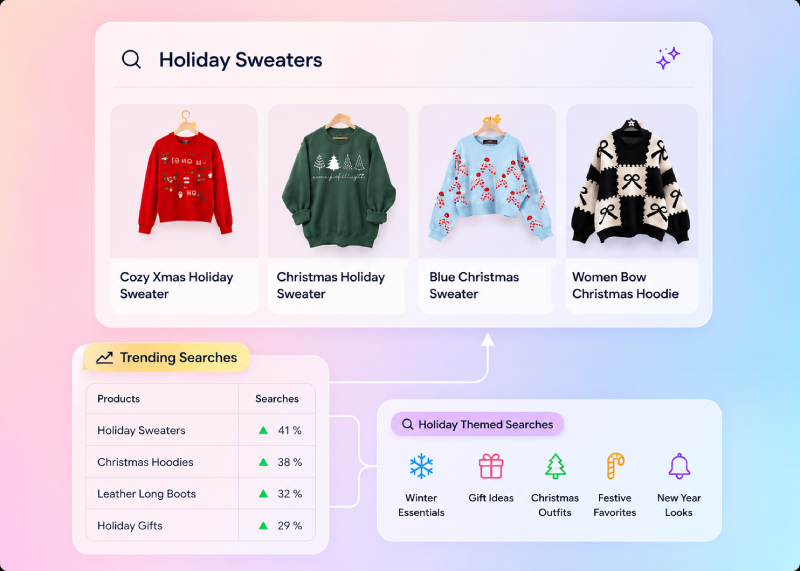

This guide breaks down what each one actually is, what “AI search” means in each context, where they overlap, where they don’t, and how to decide. If you run an online store, the practical takeaway is simple: these tools sit at opposite ends of the search journey, so comparing them feature-for-feature is the wrong mental model.
What is Searchbloom?
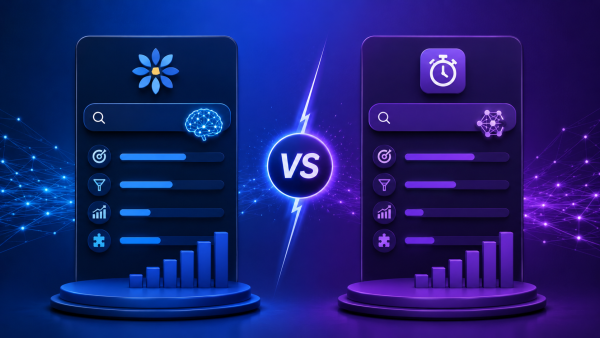
In plain terms, Searchbloom is a team you pay to improve where and how often your store shows up — in Google’s organic results, in AI Overviews, and in generative answers. When Searchbloom talks about “AI search,” it means AI Search Optimisation (sometimes called GEO, Generative Engine Optimisation, or AEO, Answer Engine Optimisation): the practice of structuring content, authority and data so large language models cite your pages when shoppers ask them questions. You can read more about that discipline in our explainer on vector search for product discovery, which covers the technology side of how those engines retrieve sources. Searchbloom’s own site is the canonical reference for its services: searchbloom.com.
What is Algolia?
Algolia is a hosted search-and-discovery product — an API-first platform that developers integrate into a website or app to power the on-site search box, autocomplete, filtering, merchandising and recommendations. Shoppers type a query into your store, and Algolia returns ranked results in milliseconds. Algolia’s AI capability, NeuralSearch, blends traditional keyword matching with vector (semantic) relevance so the engine understands meaning, not just exact words.
When Algolia talks about “AI search,” it means on-site AI relevance: making the search results inside your store smarter, faster and more conversion-friendly. It is software you deploy and pay for by usage or contract, not a team you hire. Algolia’s documentation and product pages at algolia.com are the authoritative source for its current features and pricing.
AI Search Grader by bCloud AI
Grade your ecommerce search in 10 quick questions
31% of ecommerce searches return zero results — and most shoppers who hit a dead end leave for a competitor. How does your store's search stack up?
Answer 10 short questions and get your AI search score, plus a personalized report to fix the gaps. Free, takes about 2 minutes.
No signup needed to take the quiz.
Understanding intent…
Scoring your answers across relevance, AI, experience, and insights.
Your AI search score is ready
Tell us where to send your personalized report. You'll see your score and recommendations right away.
Your score by pillar
Personalized recommendations
Fix the gaps in weeks, not quarters
bCloud AI replaces keyword-only search with hybrid AI retrieval — sub-200ms responses, 99.99% uptime, and conversion lifts of up to 40% across 50+ implementations.
Searchbloom vs Algolia AI search comparison: the core difference
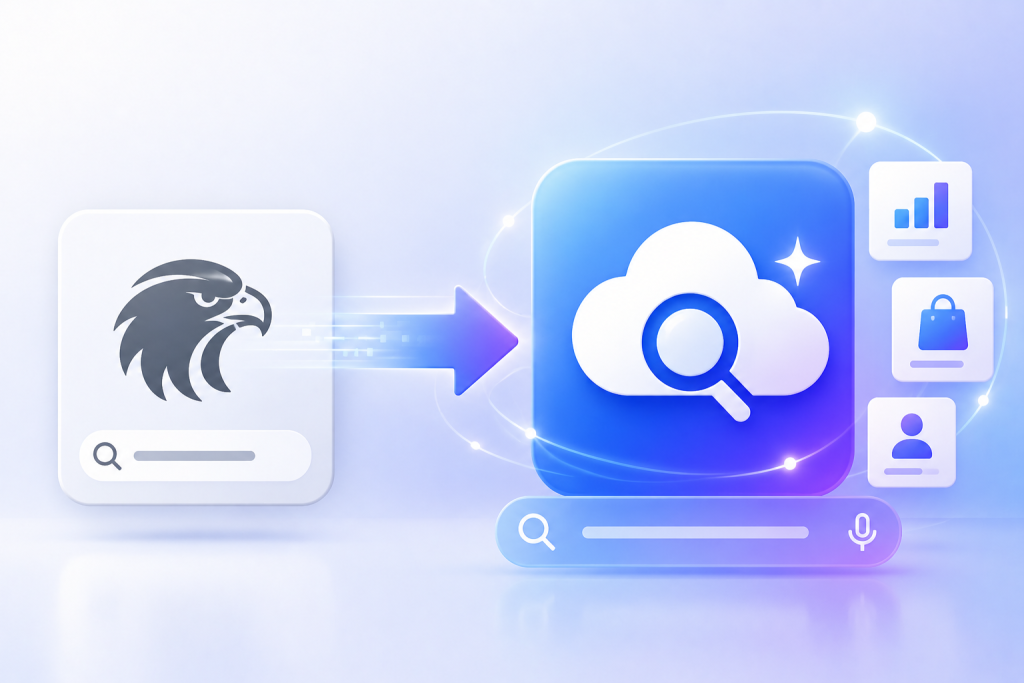
Here is the distinction that the whole comparison hinges on. Searchbloom works on the outside of your store — earning visibility in external search engines and AI answer engines so shoppers discover you in the first place. Algolia works on the inside of your store — powering the search experience once a shopper is already on your site. They are complementary, not competitive.
Another reason a Searchbloom vs Algolia AI search comparison trips people up is that both brands have leaned into the word “AI” at the same moment the market did. As answer engines reshaped how shoppers discover products, every vendor — agency or software — started describing itself as “AI-powered,” which blurs categories that were once easy to tell apart. Reading past the marketing language is the real skill here: ask whether a provider does work for you (a service) or runs inside your store (a product), and the apparent overlap dissolves almost immediately.
| Searchbloom | Algolia | |
|---|---|---|
| Category | SEO / AI-search-optimisation agency | Site-search software (API/product) |
| You buy | A service / retainer | A platform / subscription |
| Where it works | External: Google, AI Overviews, ChatGPT, Perplexity | Internal: your store’s search box |
| “AI search” means | Earning citations in answer engines (GEO/AEO) | On-site semantic/vector relevance |
| Primary goal | Get found & cited | Help on-site shoppers find products |
| Who operates it | Their team | Your developers |
| Typical buyer | Marketing / SEO lead | Engineering / product lead |
| Pricing | Agency retainer | Usage- or contract-based |
What “AI search” means in each context
The phrase “AI search” causes most of the confusion in any Searchbloom vs Algolia AI search comparison, because the two companies use it to mean opposite ends of the funnel.
For Searchbloom, AI search is about distribution. As answer engines increasingly resolve shopper questions directly — “what’s the best running shoe for flat feet?” — being the cited source in that answer is the new front page. Searchbloom’s MERIT framework is explicitly built to win those citations. This is the same shift we analyse in our guide to the top semantic search solutions for e-commerce: meaning-based retrieval now decides who gets surfaced.
For Algolia, AI search is about experience. NeuralSearch uses embeddings so that a shopper searching “warm jacket for winter hiking” sees insulated technical coats even if those exact words aren’t in the product title. The goal is fewer zero-result searches and higher on-site conversion. The underlying technique — hybrid keyword-plus-vector retrieval — is the same one we compare across vendors in our API site search comparison.
So when you see “AI search” attached to each brand, mentally translate: Searchbloom = be the answer; Algolia = power the search box.
Searchbloom vs Algolia AI search comparison by use case
Choosing comes down to the problem in front of you.
Choose Searchbloom (or an AI-search-optimisation agency) when your products are excellent but invisible — you rank poorly in Google, you’re not cited in AI answers, and shoppers find competitors first. This is a marketing-and-content problem, solved by authority building, structured data, original research and the kind of content that answer engines quote. It’s done-for-you work, ideal when you lack in-house SEO/GEO capacity.
Choose Algolia (or a site-search product) when shoppers already reach your store but can’t find what they want once they’re there — high search-exit rates, frequent zero-result queries, weak relevance on descriptive searches. This is an engineering-and-UX problem, solved by deploying better on-site search technology.
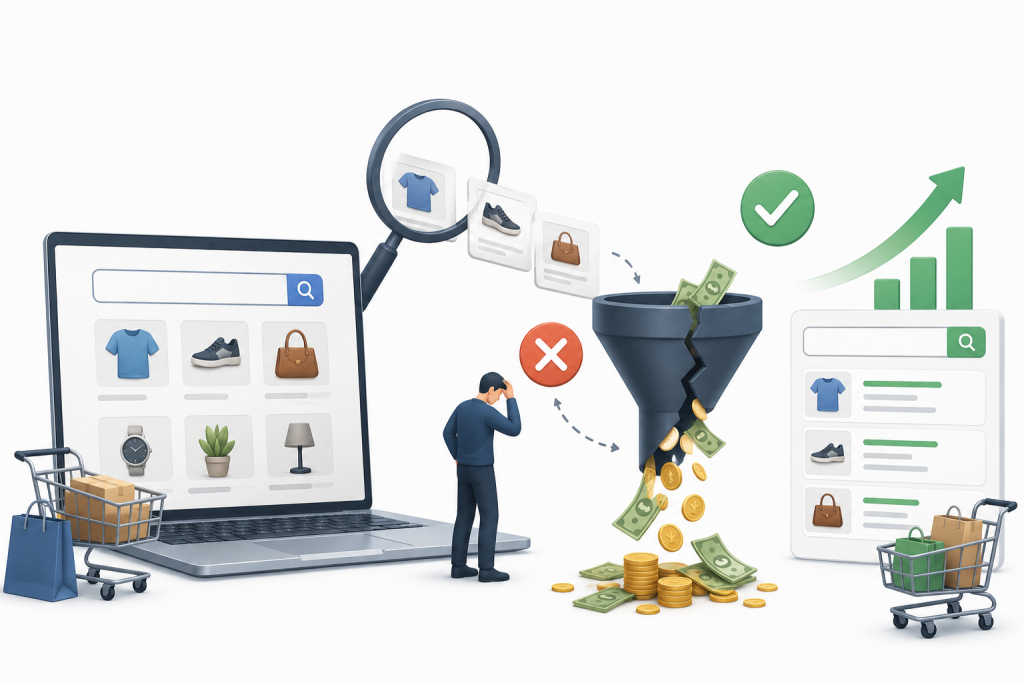
You need both when you’re scaling: the agency drives qualified discovery from outside, and the product converts that traffic with a great on-site experience. Spending on one while neglecting the other leaks revenue — traffic with bad on-site search bounces, and great on-site search with no traffic starves.
Budgeting is where a Searchbloom vs Algolia AI search comparison becomes genuinely practical rather than theoretical. An agency engagement is an operating expense tied to people and outcomes, billed as a monthly retainer, while a search product is a platform cost that scales with your catalog size and query volume. Treating them as competing line items is a mistake; they belong in different budgets — marketing versus engineering — and starving one to fund the other usually shows up later as either invisible products or a frustrating on-site experience.
Where a product like bCloud AI fits
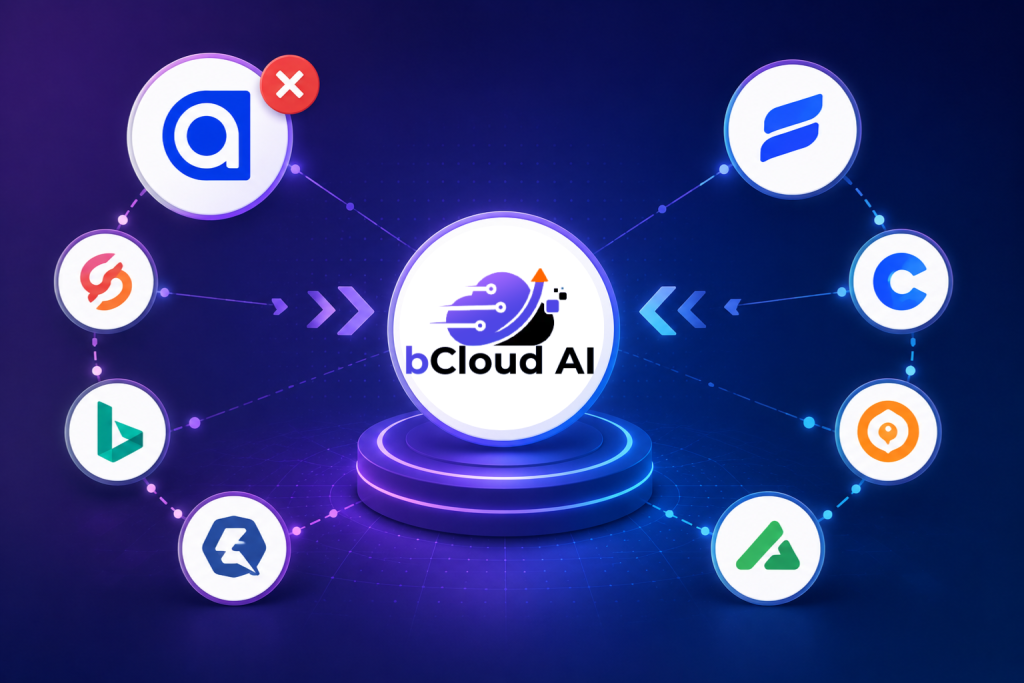
If your problem is the on-site side — the Algolia category — then bcloud.ai is a direct alternative worth evaluating alongside Algolia. It delivers [hybrid semantic + keyword] relevance with [real-time indexing] and built-in merchandising, aimed at retailers who want strong AI search inside their store without managing machine-learning infrastructure. Standout: [1536-dimension vector search with an XGBoost re-ranker (trained on millions of searches across ~47 signals like CTR, margin and stock), retrains weekly on real behaviour, and returns results in sub-200ms cached / under 400ms cold.]. Pricing: [A free tier lets you index a subset and measure lift first; published usage rates are around $0.40 per additional 1K records and $0.40–$1.10 per additional 1K search requests depending on plan (10K searches + 100K records included to start).]. For a fuller field, see our roundup of the top e-commerce search solutions for large catalogs.
Note that bcloud.ai does not replace an agency like Searchbloom — it sits in Algolia’s lane (on-site software), while Searchbloom sits in the visibility lane. If anything, the two pair naturally: an agency earns the traffic, a product like bcloud.ai converts it.
How AI Search Supports the Ecommerce Customer Journey
AI search can influence multiple stages of the ecommerce customer journey, from helping shoppers discover a brand to helping them find the right product after they arrive. External AI-search optimisation can improve how a business appears when shoppers ask product-related questions, while on-site AI search can interpret natural-language queries and connect shoppers with relevant products within the store. When these two experiences work together, businesses can create a smoother path from discovery to product selection, reducing friction at both stages. The result is a more connected search experience where visibility brings qualified shoppers to the store and intelligent on-site search helps turn that interest into meaningful product engagement and conversions.
How to choose: a simple decision path
Diagnose the bottleneck. Are you losing shoppers before they reach your site (visibility) or after they arrive (on-site search)? That single question routes you to an agency or a product.
Quantify it. Check your organic and AI-referral traffic on one side, and your on-site search exit rate and zero-result rate on the other. The bigger gap wins your first budget.
Match the buyer. Visibility work lives with marketing; on-site search lives with engineering. Make sure the right team owns the decision.
Plan for both at scale. Most growing stores eventually run an AI-search-optimisation program and a modern on-site search product in parallel.
Measure citations and conversions separately. Track AI citations (the agency’s job) and on-site search conversion (the product’s job) as distinct KPIs so each investment is accountable.
The discipline of earning citations in answer engines is still new; the Wikipedia overview of Generative Engine Optimisation is a useful primer on why it’s become a category of its own.
The bottom line
The honest result of any Searchbloom vs Algolia AI search comparison is that there is no head-to-head winner, because they aren’t running the same race. Searchbloom helps shoppers discover you through search and AI answers; Algolia helps shoppers find products once they’re on your site. Pick the one that matches your bottleneck today, and expect to run both as you grow — with a product like [bcloud.ai] a credible alternative to Algolia on the on-site side.
If there’s one thing to remember from this Searchbloom vs Algolia AI search comparison, it’s that the smartest growing stores stop framing it as “either/or” the moment they can afford not to. The agency side earns the qualified visibility that brings shoppers to your door, and the product side — Algolia, or an alternative like [bcloud.ai] — converts that hard-won traffic with relevant, fast on-site results. Sequenced well, the two compound: better discovery feeds better on-site search, and better on-site search makes every visit the agency drives worth more.
Common Mistakes When Comparing Searchbloom and Algolia
Many businesses compare Searchbloom and Algolia as if they solve the same problem. In reality, they address different stages of the customer journey. Avoid these common mistakes before making your investment.
Comparing Services to Software
Searchbloom provides ongoing SEO and AI visibility services, while Algolia is a search platform that developers integrate into an ecommerce store. They shouldn’t be evaluated using the same criteria.
Ignoring Your Biggest Bottleneck
If your store has very little traffic, improving on-site search alone won’t generate more visitors. Likewise, increasing traffic won’t help if shoppers can’t find products after they arrive.
Overlooking Long-Term Costs
Agency retainers and SaaS subscriptions have different pricing models. Consider implementation, maintenance, and scaling costs instead of focusing only on monthly fees.
Choosing Without Measuring Results
Define KPIs before investing. Track organic traffic and AI citations for SEO services, while measuring search conversion, zero-result searches, and revenue per search for on-site search platforms.
Takeaway: The best decision isn’t choosing between Searchbloom and Algolia—it’s identifying whether your business needs better online visibility, a stronger on-site search experience, or both. Solving the right problem first delivers the greatest return on investment.
FAQ
Is Searchbloom a competitor to Algolia?
Not really. Searchbloom is an SEO and AI-search-optimisation agency you hire; Algolia is a site-search product you deploy. They address different stages of the shopper journey and are often used together.
What does “AI search” mean for Searchbloom vs Algolia?
For Searchbloom it means earning citations in answer engines like ChatGPT and Google AI Overviews. For Algolia it means AI-powered on-site relevance (semantic/vector search) inside your own store.
Do I need both an agency and a search product?
Often yes, as you scale. The agency drives external discovery; the search product converts that traffic with a strong on-site experience. Neglecting either side leaks revenue.
What’s a good Algolia alternative for on-site search?
Products such as [bcloud.ai], Constructor, Coveo, Bloomreach, Klevu and Elastic compete in Algolia’s category. Compare them on relevance, speed, merchandising and pricing for your catalog.
Can an agency like Searchbloom set up Algolia for me?
Some agencies will advise on or coordinate on-site search, but configuring a product like Algolia is typically engineering work. Confirm scope before assuming an SEO retainer includes on-site search implementation.
Which should I invest in first?
Whichever fixes your bigger bottleneck: visibility (agency) if shoppers can’t find you, or on-site search (product) if they can’t find products once on your site.
Choose the AI Search Solution That Grows With Your Store
Whether you’re replacing Algolia or evaluating modern alternatives, bCloud AI delivers smarter relevance, faster results, and transparent pricing designed for growing ecommerce brands.