
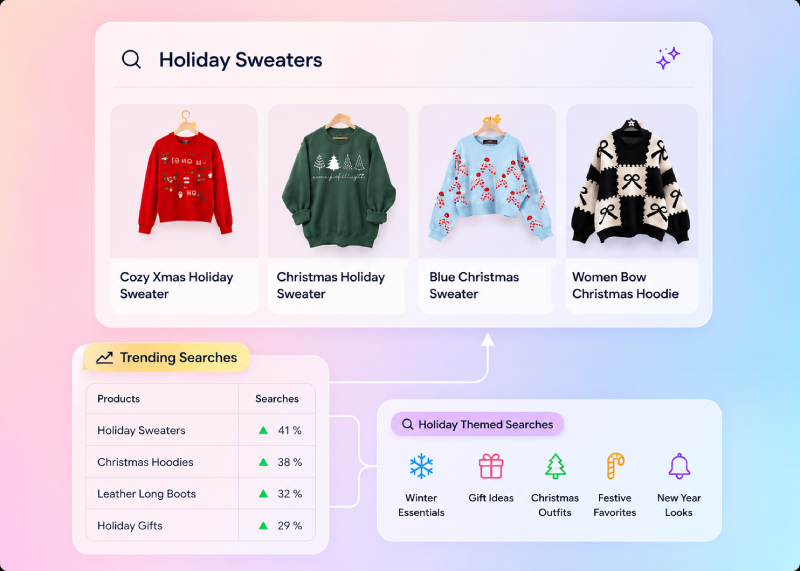
What are embedding models?
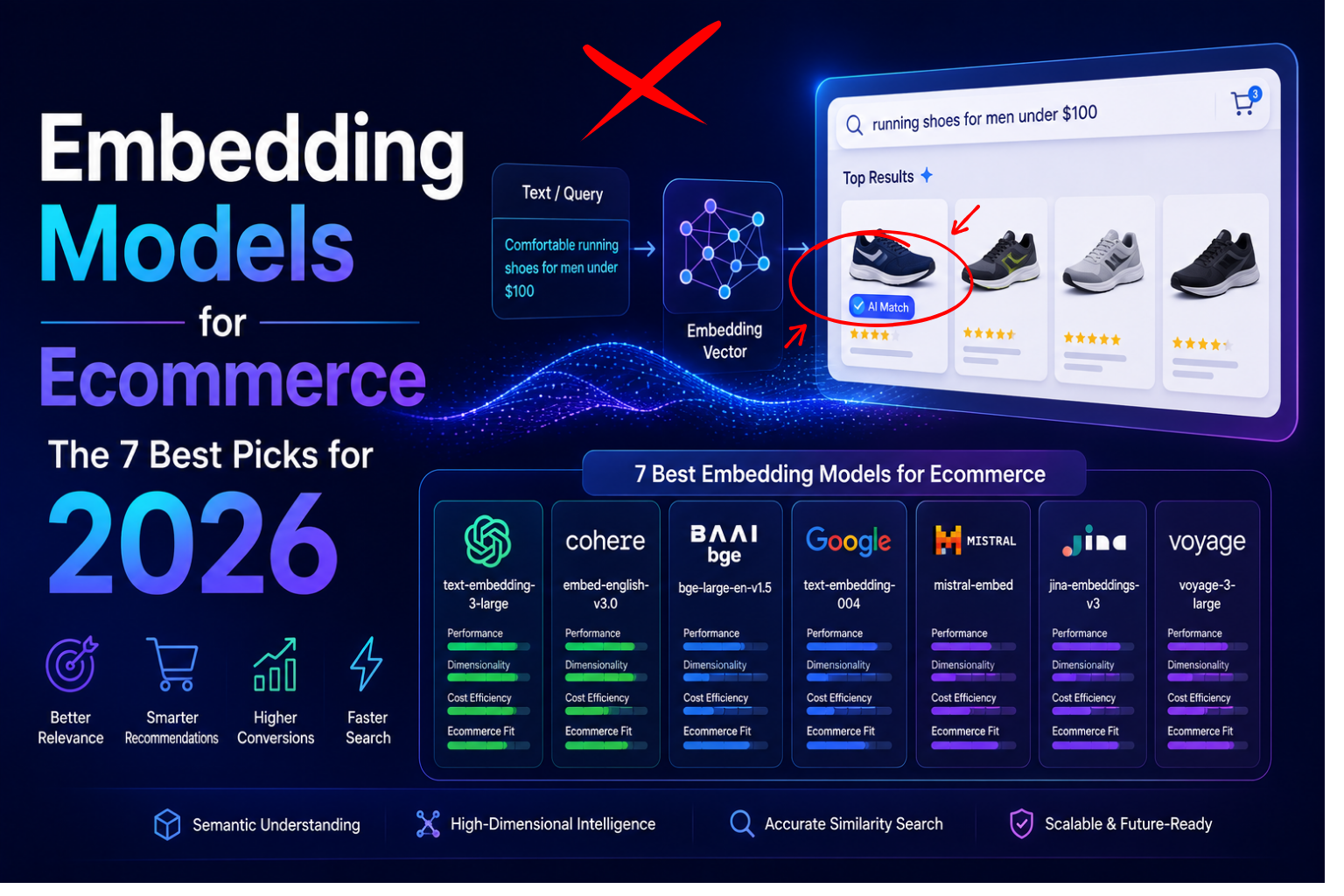
This is why embedding models sit at the heart of semantic search, retrieval-augmented generation (RAG), and recommendation systems. In an ecommerce context, embedding models are what make “couch” match “sofa,” “sapphire sneaker” match “blue running shoes,” and a vague, descriptive query return a sensible set of products instead of an empty results page. Our AI ecommerce search guide walks through where embeddings fit in the wider pipeline.
Why embedding models matter for ecommerce search
The quality of your embedding models directly shapes revenue, because search is where your highest-intent shoppers tell you exactly what they want. Weak embeddings return near-misses and dead ends; strong embeddings surface the right product on the first screen. A few reasons embedding models matter so much for online stores:
- They handle language the way shoppers actually use it — synonyms, misspellings, and descriptive phrases that break keyword search.
- They power the retrieval half of hybrid search, which combines keyword precision with the semantic recall that embedding models provide (see our guide to hybrid search systems).
- They set your storage and latency budget. A model’s vector size (dimensions) determines how much memory your index needs and how fast search runs.
- They’re expensive to change. Switching embedding models means re-embedding and re-indexing your entire catalog, so the choice compounds over time.
In short, embedding models are foundational infrastructure, not a detail — which is exactly why it’s worth comparing them carefully.
How embedding models work
The mechanics are consistent across every provider. First, each product in your catalog — its title, description, and attributes — is passed through an embedding model and converted into a vector, often 768 to 3,072 dimensions. Those product vectors are stored in a vector index. When a shopper searches, their query is passed through the same embedding model to produce a query vector, and the system retrieves the products whose vectors are closest to it, usually measured by cosine similarity.
Because embedding models encode meaning rather than characters, “blue running shoes under $150” lands near footwear that’s blue and built for running — even products whose titles never use those exact words. That semantic matching is the core capability, and it’s why the specific embedding models you choose (and how well they were trained) make such a visible difference in result quality. For the retrieval layer that stores these vectors, see our vector database comparison.
The 7 best embedding models for 2026
The landscape shifted dramatically in early 2026, with major releases from Google, Voyage AI, Cohere, and the open-source community. Here are the seven embedding models worth shortlisting, with their trade-offs.
1. OpenAI text-embedding-3 (small and large)
The safe industry default. text-embedding-3-small produces 1,536-dimensional vectors at roughly $0.02 per million tokens; text-embedding-3-large produces 3,072 dimensions at around $0.13 per million with a stronger MTEB score (~64.6). Both support Matryoshka embeddings, letting you truncate dimensions to save storage. Watch-out: these embedding models haven’t been updated since early 2024, and newer options now beat them on most benchmarks. Best for: teams already in the OpenAI ecosystem who want a reliable, well-integrated default.
2. Cohere embed-v4
A top performer on accuracy (MTEB ~65.2) and a major upgrade over v3: the context window jumped from 512 tokens to 128K, so you can embed a full product page in one call instead of chunking aggressively. Strong multilingual support and a free trial tier make it easy to evaluate. Best for: multilingual catalogs and teams that want high accuracy with long-context embedding models.
3. Voyage AI voyage-4 family
Launched January 2026 with a mixture-of-experts (MoE) architecture and a shared embedding space across the family. Pricing spans voyage-4-large ($0.12/M, top retrieval quality), voyage-4 ($0.06/M), voyage-4-lite ($0.02/M with a 32K context window), and voyage-4-nano (free, open-weight). Voyage consistently leads retrieval-specific benchmarks. Best for: high-accuracy retrieval and specialized domains where a few points of recall map directly to revenue.
4. Google Gemini Embedding
Google’s embedding models top the public MTEB leaderboard (~68.32) and, with Gemini Embedding 2 (March 2026), added multimodal embeddings across text, images, video, and audio in one shared space — powerful for visual product discovery. Pricing is competitive, and text-embedding-005 is unusually cheap for its quality. Best for: Google Cloud users and stores that need multimodal (image + text) embedding models.
5. Jina embeddings (v3 / v5)
Open-weight embedding models with excellent price-performance ($0.02/M or self-hosted), long context (32K), broad multilingual coverage (89 languages in v5), binary quantization, and multimodal variants. Apache-licensed. Best for: budget-conscious multilingual deployments and teams that want open-source flexibility.
6. BGE-M3 and open-source leaders
BGE-M3 (MTEB ~63.0) and newer open-source embedding models like Qwen3-Embedding (0.6B/4B/8B) and Microsoft’s Harrier offer strong quality with zero API cost — you pay only in infrastructure and ops. Best for: teams with engineering capacity who want to self-host their embedding models and avoid per-token fees.
7. Qwen3-Embedding
A strong open-source family (up to ~70.58 MTEB) available in 0.6B, 4B, and 8B sizes, with a matching reranker line — useful if you want embedding and reranking from one model family. Best for: self-hosting teams optimizing the quality-to-size ratio.
How to choose the right embedding models
The “best” model depends entirely on your catalog and constraints. When you evaluate embedding models, weigh these factors:
- Retrieval accuracy (MTEB). Use the MTEB “Retrieval Average” as a starting signal — the MTEB leaderboard is the field’s reference — but remember it’s a starting point, not the answer.
- Dimensions and storage. A 1,024-dimension float32 vector takes ~4KB; at 10 million products that’s ~40GB of vector storage, and doubling dimensions doubles the cost. Matryoshka-capable embedding models let you trade a little accuracy for a lot of savings.
- Context window. Long-context embedding models (Cohere v4’s 128K, Voyage’s 32K) let you embed full product descriptions in a single call instead of chunking.
- Price per million tokens. Embeddings are far cheaper than generative calls — ranging from about $0.006 to $0.18 per million — but at catalog scale it still adds up.
- Latency and language support. Sub-100ms inference and coverage for your markets both matter in production.
- Multimodal needs. New in 2026: if visual search matters, choose embedding models that handle images and text in one space.
The single most important rule: benchmark on your own data. Generic MTEB scores don’t always translate to your specific catalog, so test candidate embedding models against a labeled query set from your real search logs (our guide to search relevance metrics explains how). And plan for the switching cost — changing embedding models means re-indexing everything.
The build-vs-buy reality
Choosing embedding models is step one of a much larger project. A production ecommerce search stack pairs your embedding models with a vector database, a hybrid-blending layer, re-ranking, merchandising, and a storefront UI — and you’ll own re-indexing every time you upgrade the model. If that’s not where you want your engineers, a managed AI search platform handles model selection and the entire pipeline for you. bCloud AI’s AI search engine ships vector embeddings, hybrid blending, and re-ranking as one managed capability, so you get the benefit of strong embedding models without maintaining them yourself — see the best AI ecommerce search platforms for the managed field.
Common mistakes when choosing embedding models
- Chasing the leaderboard. The top MTEB model isn’t automatically best for your catalog — test on your data.
- Ignoring dimensions. High-dimension embedding models quietly multiply your storage and memory bill.
- Forgetting the re-indexing cost. Switching models later is expensive; choose deliberately.
- Skipping hybrid. Even great embedding models miss exact matches (SKUs, model numbers) — pair them with keyword search.
- Never re-evaluating. Stale embedding models fall behind fast; the 2026 field moved a lot in months.
Frequently asked questions
What are embedding models in ecommerce search?
Embedding models are AI models that turn product text and shopper queries into numerical vectors capturing meaning, so a store can match products by intent rather than exact keywords. They power semantic search, letting “sofa” match “couch” and descriptive queries return the right products.
What are the best embedding models for 2026?
Strong 2026 options include OpenAI text-embedding-3-large (safe default), Cohere embed-v4 (long context, multilingual), the Voyage-4 family (top retrieval accuracy), Google Gemini Embedding (multimodal leader on MTEB), and open-source embedding models like Jina, BGE-M3, and Qwen3. The best choice depends on your accuracy, cost, language, and multimodal needs.
How do I choose an embedding model for my store?
Weigh retrieval accuracy (MTEB), vector dimensions (storage cost), context window, price per token, latency, and language and multimodal support — then benchmark the top candidates on a labeled query set from your own search logs, since generic scores don’t always transfer to your catalog.
Do more dimensions mean better embedding models?
Not necessarily. Higher-dimension vectors can capture more nuance but cost more to store and search, and many modern embedding models match or beat older high-dimension ones at fewer dimensions. Matryoshka-capable models let you shorten vectors with graceful quality loss.
Can I switch embedding models later?
Yes, but it’s costly: switching embedding models requires re-embedding and re-indexing your entire catalog, which can mean significant engineering time. That’s why the initial choice matters — or why many stores use a managed platform that handles model changes for them.
Get world-class embeddings without managing the model.
bCloud AI ships vector embeddings, hybrid ranking, and re-ranking as one managed platform — no model to pick, tune, or re-index. Start free or book a demo.
bcloud.ai