What Is Enterprise Search?
Customer-Facing vs. Internal Enterprise Search
Business search shows up in two distinct settings, and both matter.
| Aspect | Customer-facing | Internal / business |
|---|---|---|
| Users | Shoppers and visitors | Employees, partners, support teams |
| Indexes | Products, content, support articles | Documents, wikis, tools, data |
| Success metric | Conversion and AOV | Productivity and time-to-answer |
| Key need | Relevance and personalization | Permissions, coverage, accuracy |
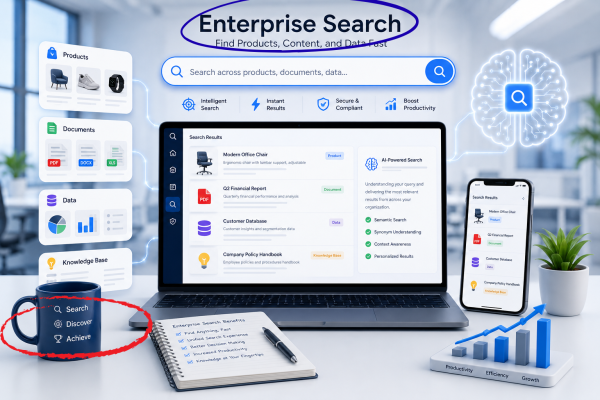
Both share the same underlying engine — semantic understanding, ranking, personalization — applied to different content and audiences. A well-architected platform handles both.
Why Enterprise Search Matters
The cost of bad search is enormous. On the customer side, every search that returns zero results or the wrong product is a lost sale, and at scale the lost revenue compounds quickly. Internally, employees spend hours every week hunting for information that should be one query away — a productivity tax that grows with company size. Strong enterprise search turns both into opportunities: more sales from customers who find products fast, and more productive teams because the answer to “where is that document” is one question, not thirty minutes. As AI-style answering becomes the norm, this capability is increasingly how businesses deliver speed at scale.
How AI-Powered Enterprise Search Works
Modern systems run on a stack of AI capabilities working together.
Connectors and Indexing
The platform pulls data from product catalogs, content systems, document stores, and databases, then indexes it for fast retrieval — without forcing a costly migration.
Semantic and Vector Search
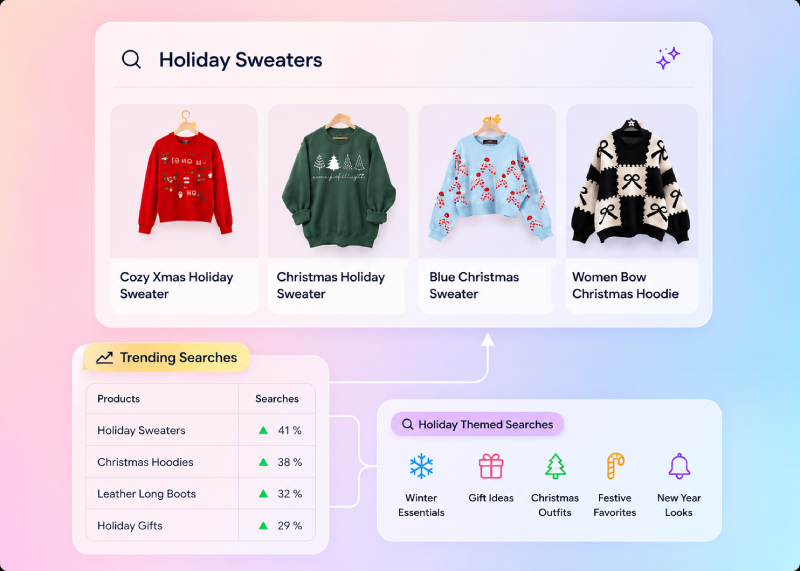
Large language models and vector embeddings let the system match by meaning, so “remote work expense policy” finds the right document even if it’s titled differently.
Personalization and Behavioral Ranking
Results adapt to the user’s role, history, and context, so what each person needs surfaces first.
Conversational and Generative Interfaces
Users can ask full-sentence questions and get direct, grounded answers, not just a list of links — the new default expectation set by AI assistants.
Security and Permissions
Permission-aware retrieval ensures users see only what they’re authorized to access, a non-negotiable in enterprise environments.
Use Cases for Enterprise Search
It powers a wide range of business workflows. On the customer-facing side, it drives product discovery on ecommerce sites and supports customers through self-service help and knowledge bases. Inside the business, it powers employee search across documents and wikis, gives support agents fast access to product information and case history, helps sales teams find collateral and contracts, and turns the knowledge base into a queryable resource. For mid-market and growth-stage retailers, the highest-leverage use case is still customer-facing product discovery — covered in our ecommerce search overview — but the same platform can extend internally as the business grows.
9 Powerful Wins From Modern Business Search
| # | Win | Why it matters |
|---|---|---|
| 1 | Higher conversion | Shoppers find products faster on commercial sites |
| 2 | Productivity gains | Employees spend less time hunting for information |
| 3 | Faster support | Agents and customers reach answers in seconds |
| 4 | Better decisions | Knowledge becomes findable, not buried |
| 5 | Lower zero-results | Semantic matching recovers searches that used to fail |
| 6 | Personalized results | Each user sees what’s most relevant to them |
| 7 | Scalable AI experiences | One platform powers chat, voice, and visual interfaces |
| 8 | Security at scale | Permission-aware retrieval keeps data safe |
| 9 | Future-ready | Built for AI assistants and conversational interfaces |
Choosing the Right Platform
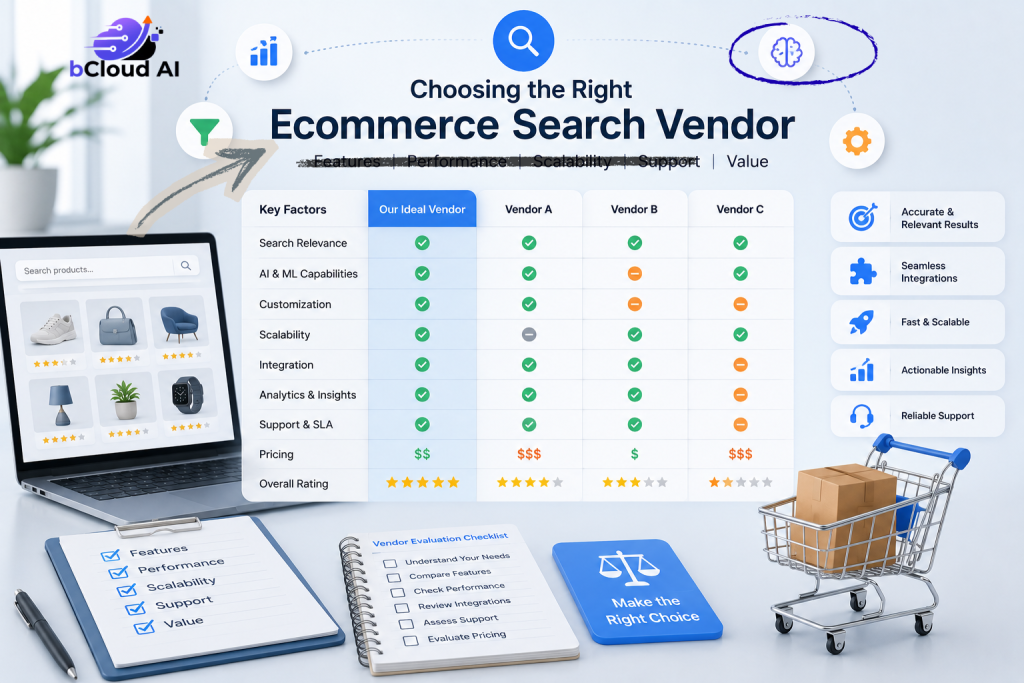
The right platform combines several non-negotiables: AI-native semantic search, the connectors and indexing depth to cover your data sources, permission-aware retrieval, performance at your scale, multilingual support if you operate internationally, and a clear roadmap for conversational and generative AI. Pricing predictability matters too — per-search models can spike on busy days, while flat catalog-based pricing scales more smoothly. For ecommerce-focused buyers, see our roundup of the best ecommerce search engines for 2026 and the ecommerce search vendor evaluation guide for the full criteria.
Common Business Search Mistakes
A few mistakes recur across deployments. Treating enterprise search as a one-time setup instead of a continuously tuned system. Indexing too much, too messy, so even good engines return noise. Skipping permissions and security thinking until late in the project. Choosing a vendor on a feature checklist instead of a hands-on test with real data. And neglecting the conversational and generative AI layer, even though users now expect it. The fix is an AI-native foundation, clean data and connectors, security baked in, and a hands-on evaluation on your actual content.
How to Measure Enterprise Search Success
Strong measurement is what turns business search from a one-time deployment into a continuously improving capability. On customer-facing surfaces, track search conversion, zero-result rate, search-led revenue share, and top failing queries. On internal deployments, track adoption (what share of employees actively use it), time-to-answer for common questions, deflection rate from human support, and user satisfaction scores. The queries users actually type are some of the richest organizational data you have — they reveal gaps in catalogs, content, knowledge bases, and product information. Treating those signals as a monthly improvement cycle compounds the value of the investment over time.
Security and Compliance Considerations
Business deployments live or die on permissions and compliance. The platform must respect existing access controls so users only see what they’re allowed to, support audit logs for regulated industries, handle data residency where required, and integrate with your identity provider. AI capabilities add a new layer of consideration: generative answers must be grounded in your verified data rather than hallucinated, and the platform should give you visibility into how an answer was constructed. Vendors with mature trust centers and clear documentation make these conversations easier with security teams.
Implementation Timeline at the Business Tier
Implementation for a mid-sized business typically runs four to eight weeks: connectors and indexing in the first two weeks, security and permissions wiring next, search-UI integration and tuning in week four, and gradual rollout. Large enterprises with many data sources can take longer, while ecommerce-only deployments on a single catalog are faster. The biggest variable is data quality and source variety — platforms with built-in enrichment and broad connectors compress the timeline significantly. Either way, modern AI-native vendors deliver business-grade search in weeks, not quarters.
The Future of Business Search
Business search is moving toward conversational, generative, and grounded answers — users will increasingly ask full questions and expect a direct, accurate response that cites sources. That shift rewards platforms that already combine semantic search, retrieval-augmented generation, and clean data, and it widens the gap between AI-native vendors and legacy keyword systems. The businesses building on a modern foundation today will adopt each new AI capability as an upgrade rather than a rebuild, which is exactly the architecture leading vendors are pushing toward.
How bCloud AI Powers Enterprise Search
bCloud AI delivers a platform built for AI-driven commerce and business. Its NeuralSearch combines vector and keyword retrieval with sub-second performance at scale, while real-time personalization, generative experiences, and conversational, visual, and voice interfaces all share one platform. AI data enrichment cleans and structures messy catalogs and content during onboarding, and the trust center covers security and compliance. Native integrations with Shopify Plus, BigCommerce, Magento, WooCommerce, and headless stacks make enterprise deployments fast, and predictable catalog-based pricing keeps cost in check as you scale.
Frequently Asked Questions About Enterprise Search
What is enterprise search?
Enterprise search is a search technology built for the scale, variety, and security needs of a business. It indexes large catalogs, content libraries, knowledge bases, and internal documents, then returns relevant results to customers or employees — handling permissions, multiple sources, and high uptime that basic site search cannot.
How does enterprise search work?
It connects to data sources, indexes content for fast retrieval, uses semantic and vector AI to match by meaning, ranks results with personalization and behavioral signals, and increasingly answers full-sentence questions through conversational and generative interfaces — all while respecting permissions.
What’s the difference between enterprise search and ecommerce search?
Ecommerce search is one application of enterprise search, focused on customer-facing product discovery. Enterprise search is broader: it also covers internal use cases like employee search, support agents, and knowledge bases. Both share the same underlying AI engine, applied to different content and audiences.
What are the use cases for enterprise search?
Use cases include ecommerce product discovery, self-service support and knowledge bases, employee search across documents and wikis, support-agent tools, sales collateral retrieval, and querying internal data. Customer-facing ecommerce typically delivers the biggest revenue impact.
How does AI improve enterprise search?
AI adds semantic understanding so queries match by meaning, personalization so results adapt to the user, conversational and generative answers, and the ability to handle natural full-sentence questions — turning a list-of-links search into a guided answer experience.
Why does business search matter?
Bad business search is a daily revenue and productivity tax: customers can’t find products and leave, while employees waste hours hunting for information. Strong enterprise search lifts conversion on customer-facing sites and accelerates work internally, with both effects compounding at scale.
How do I choose an enterprise search platform?
Evaluate on AI-native semantic search, connector and indexing depth, permission-aware retrieval, scale and performance, multilingual support, conversational and generative roadmap, and pricing predictability. Run a hands-on test with real data and queries rather than a generic demo.
What is the best enterprise search platform?
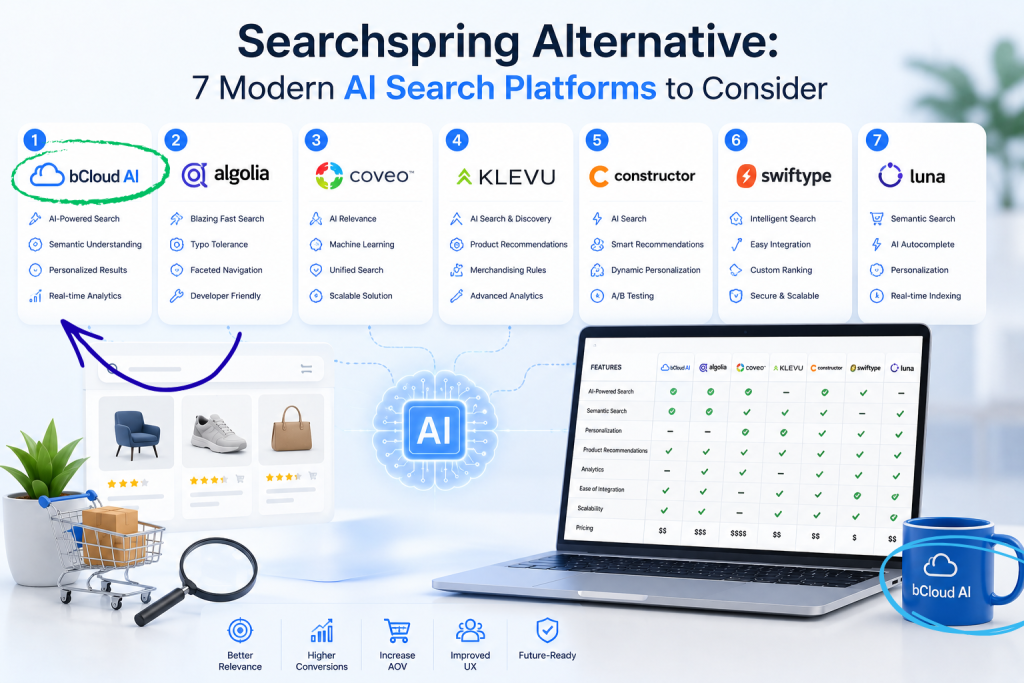
The best platform combines AI-native semantic search, real-time personalization, conversational and generative interfaces, strong connectors, security, and predictable pricing. Leading AI-native options include bCloud AI, whose NeuralSearch and generative-experience stack are built for AI-driven commerce and business.
Give Your Business Search Worth Searching
Modern business search lifts conversion, speeds support, and unlocks knowledge across your company. Start for free or book a demo to see AI-native enterprise search on your data.
Related resources: Ecommerce Search Overview · Ecommerce Search Vendor Guide · B2B Ecommerce Search · Best Ecommerce Search Engines for 2026