What Is Headless Commerce Search?
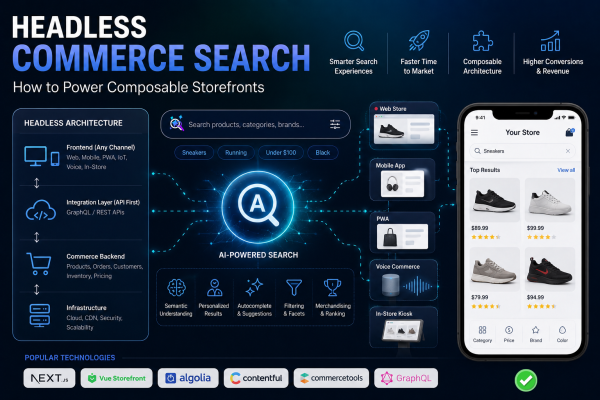
How Headless Commerce Search Works
The architecture is deliberately simple in shape and powerful in what it enables.
Indexing Layer
Your catalog and content stream into the platform through connectors or feed APIs. The platform enriches, structures, and indexes everything for fast retrieval — decoupled from wherever the data originally lives.
Search API
Front-ends call a search API (typically REST or GraphQL) passing a query and context. The engine handles semantic understanding, vector retrieval, ranking, personalization, and merchandising rules server-side.
Response Contract
Results come back as structured JSON: products, facets, sort options, banners, recommendations, and analytics events. The front-end decides how to render — a Next.js page, a React Native screen, or an AI assistant response.
Extensible Endpoints
Beyond core search, headless platforms expose autocomplete, recommendations, browse, and analytics endpoints so a single service powers every discovery surface without duplication.
Headless vs. Traditional Search
| Aspect | Traditional (coupled) | Headless |
|---|---|---|
| Architecture | Search tied to a specific storefront | API-first, storefront-agnostic |
| Front-ends supported | One at a time, per plugin | Any — web, mobile, POS, voice, AI |
| Innovation speed | Constrained by platform releases | Ship UI whenever your team wants |
| Best fit | Simple stores, single channel | Composable / MACH stacks, multi-channel brands |
| Team profile | Merchandiser-led | Engineering-led with merchandiser tooling |
Coupled search is fine for small, single-channel stores; headless becomes essential once you have a modern storefront or you’re selling across web, apps, and emerging AI surfaces from one catalog.
Why Headless Commerce Search Matters
Composable and MACH architectures are becoming the default for growth-stage and enterprise ecommerce, and search has to move with them. Traditional coupled search forces you to choose your storefront based on what its plugin can do — the tail wagging the dog. A headless approach flips that: your team ships whatever front-end best serves shoppers, and the search platform adapts. It also future-proofs discovery for surfaces that don’t exist yet in mature form — AI shopping assistants, voice, kiosks, in-store apps — because all of them can consume the same APIs. The result is fewer platform decisions that lock you in, and more optionality as commerce continues to fragment across channels.
7 Powerful Wins From Headless Commerce Search
| # | Win | Why it matters |
|---|---|---|
| 1 | Storefront freedom | Ship any UI without changing the search backend |
| 2 | Multi-channel from one catalog | Web, mobile, POS, voice, AI — all consistent |
| 3 | Faster iteration | Front-end changes don’t require backend releases |
| 4 | Best-of-breed stack | Pick the strongest tool for each layer |
| 5 | Better performance | Edge caching and CDN for lightning-fast results |
| 6 | Future-ready | New surfaces (AI, voice) plug in via API |
| 7 | Cleaner data | One index feeds every channel; no duplication |
Key Features to Look For
Not every “headless” claim is equal. Look for real API-first design (not a monolith with an API bolted on), well-documented REST and GraphQL endpoints, SDKs for the frameworks your team uses (Next.js, React Native, Vue, iOS, Android), semantic and vector search, personalization signals accessible through the API, merchandising and rule controls exposed to non-technical users, robust analytics events, autocomplete and recommendations as separate endpoints, and clear rate limits and performance guarantees. The ecommerce search API guide breaks down what a modern search API should deliver, and the ecommerce search platform guide covers wider platform criteria.
Headless Search in Composable / MACH Stacks
Headless search fits naturally into composable, MACH-style stacks — microservices, API-first, cloud-native, headless — where each capability is chosen independently. In a typical composable setup, the search platform sits alongside a headless commerce engine (like Shopify Hydrogen, BigCommerce, commercetools, or Elastic Path), a CMS, a payments provider, and a front-end framework. Search calls happen from the front-end (or via a backend-for-frontend layer) directly to the search API, with the results shaped by shared context like user session and locale. Because everything runs on APIs, adding a new channel — a native app or an AI assistant integration — means calling the same endpoints from a new place, not replatforming.
Implementing Headless Commerce Search
Implementation follows a predictable path. First, connect your catalog and content sources so the search platform has clean data to index. Second, define your search API contracts — query parameters, response shape, personalization context — with your front-end team. Third, build the front-end integration in the storefront framework your team uses; SDKs speed this up dramatically. Fourth, set up merchandising and analytics so non-technical teams retain control despite the architectural change. Fifth, roll out to production behind feature flags, monitor performance and relevance, and iterate. Native SDKs plus AI-driven data enrichment cut mid-market implementations to roughly four weeks, versus multi-month builds when both platform and integration are custom.
Common Headless Search Mistakes
A few mistakes trip teams up. Choosing a “headless” vendor that’s actually monolithic behind the API, so flexibility is a marketing claim not a reality. Forgetting merchandising: engineering-led rollouts can leave merchandisers without tooling to control the experience. Neglecting performance testing: headless architectures shift more work to the front-end, and slow API responses feel slower than slow monoliths. Skipping analytics wiring: without event data, you can’t optimize. And treating search as separate from recommendations and personalization: shared intelligence is the whole point of a modern platform, and splitting them wastes it.
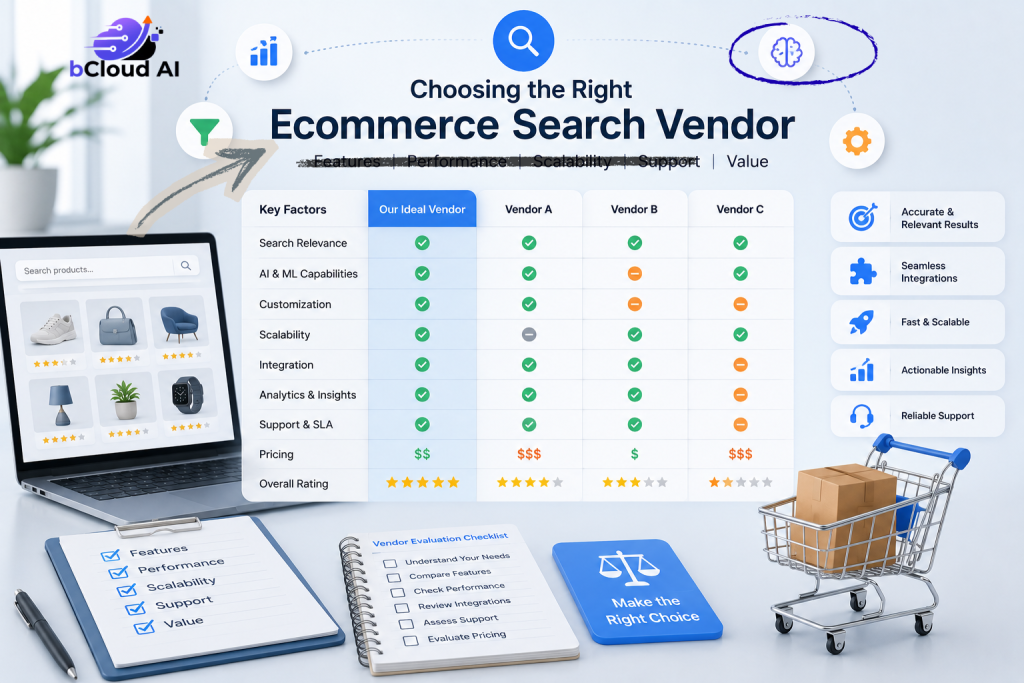
Choosing a Headless Commerce Search Vendor
Evaluating a headless commerce search vendor takes a slightly different lens than a coupled one. Beyond feature checklists, run a hands-on API test: how easy is it to hit the search endpoint from your framework of choice, how well-documented is the response contract, and how does the SDK feel to work with? Test rate limits and performance under load, because headless commerce search shifts more responsibility to how quickly APIs respond. Check whether merchandising and personalization controls are genuinely exposed through the API, not just the console. And verify multi-channel support with a real second front-end — a mobile app or a POS demo — because that’s where headless commerce search proves (or fails to prove) its value.
Headless Commerce Search and AI Discovery
The rise of AI-powered discovery makes headless commerce search more strategic, not less. AI shopping assistants, voice agents, and generative shopping experiences all consume product data through APIs — exactly what headless commerce search is built to provide. Retailers who’ve already invested in an API-first search platform can add these new surfaces by calling the same endpoints with slightly different context, rather than integrating a new tool per channel. That’s a compounding advantage: the effort invested in headless commerce search today pays off with every new discovery surface tomorrow.
Migrating From Coupled to Headless
Retailers moving from a coupled platform to headless commerce search typically follow a phased approach: run both in parallel for the initial rollout, migrate a single storefront section first (often category pages or search results), validate performance and merchandising continuity, then expand. Well-designed headless commerce search platforms make this manageable by shipping SDKs and reference implementations that mirror common front-end patterns, and by exposing merchandising rules through APIs so business teams don’t lose control during the migration.
How bCloud AI Powers Headless Commerce Search
bCloud AI is API-first by design. Its NeuralSearch exposes semantic, vector, and hybrid retrieval through REST and GraphQL APIs, with SDKs for the frameworks composable teams actually use. Recommendations, autocomplete, browse, and analytics run as separate endpoints from the same engine and catalog, so a headless front-end has full parity with a coupled implementation without giving up personalization or merchandising controls. Integrations connect natively to Shopify Plus, BigCommerce, Magento, WooCommerce, and headless engines like commercetools, and AI data enrichment keeps the underlying catalog clean regardless of how many channels consume it. To compare AI-native platforms, see the best ecommerce search engines for 2026.
Frequently Asked Questions About Headless Commerce Search
What is headless commerce search?
Headless commerce search is an architecture where the search engine — indexing, semantic understanding, ranking, personalization — runs as an API-first service separate from the storefront. Any front-end (web, mobile, POS, voice, AI) can call the same APIs and render results however suits that channel.
How does headless commerce search work?
The platform indexes your catalog server-side, exposes search, autocomplete, and recommendations through REST or GraphQL APIs, and returns structured JSON that the front-end renders. Semantic understanding, ranking, personalization, and merchandising rules all run server-side; the UI is up to you.
What’s the difference between headless and traditional search?
Traditional search is coupled to a specific storefront through a plugin; headless is API-first and works with any front-end. Headless suits composable stacks and multi-channel brands; coupled search is fine for simple single-channel stores.
Do I need headless search for a composable / MACH stack?
Yes. Composable and MACH architectures are built on decoupled, API-first services, and a monolithic search plugin defeats the point. A headless search platform slots into the stack alongside a headless commerce engine, CMS, and payments provider.
What features should a headless search platform have?
Real API-first design, well-documented REST/GraphQL endpoints, SDKs for common frameworks, semantic and vector search, personalization signals in the API, merchandising controls for non-technical users, analytics events, autocomplete and recommendations as separate endpoints, and performance guarantees.
How long does headless search take to implement?
With native SDKs and AI-driven data enrichment, mid-market implementations typically run about four weeks: catalog ingest, API contract definition with the front-end team, storefront integration, merchandising and analytics setup, and phased rollout. Fully custom builds take longer.
Can headless search work with mobile apps and voice assistants?
Yes — that’s a core benefit. Because everything runs through APIs, a native iOS or Android app, a POS terminal, a chatbot, or a voice assistant can call the same endpoints as the web storefront and get consistent results shaped by shared context.
What is the best headless commerce search platform?
The best platform is truly API-first (not a monolith with an API bolted on), unifies search, recommendations, and personalization behind shared endpoints, provides SDKs for modern frameworks, and delivers strong performance. Leading AI-native options include bCloud AI.
Power Every Front-End From One Search API
Start for free or book a demo to see a headless commerce search platform built for composable stacks.
Related resources: Ecommerce Search API · Ecommerce Search Platform · Integrations · Best Ecommerce Search Engines for 2026