Natural Language Product Search:
The Complete UX & Technology Guide
What "natural language" actually means in product search
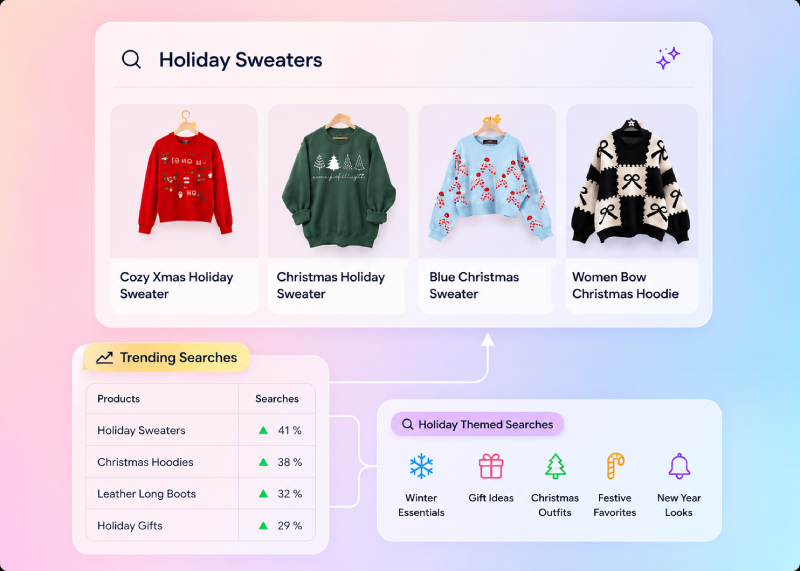
Descriptive queries
"Comfortable walking shoes for travel" — describes use case, not product name.
Recipient-based queries
"Gift for my dad who likes camping" — implies an entire shopping persona.
Occasion queries
"Dress for a beach wedding in summer" — combines occasion, setting, and season.
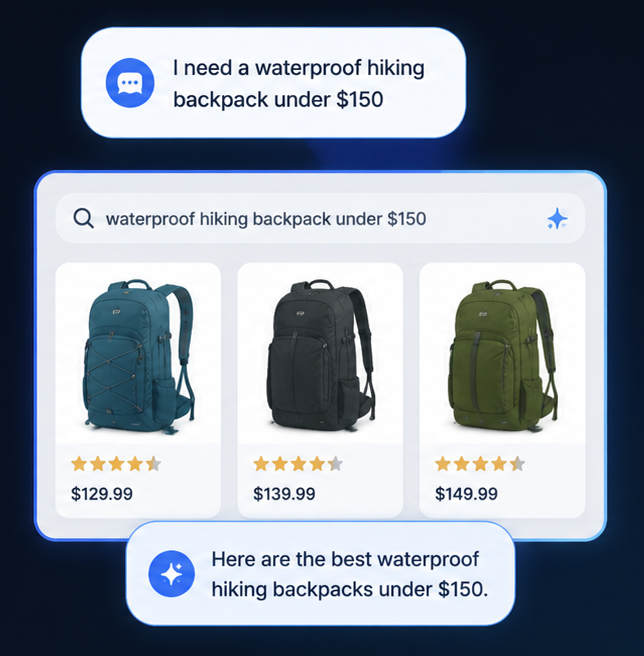
Constraint queries
"Running shoes under $100 for flat feet that ship by Friday" — stacks four orthogonal constraints.
The UX layer: how natural language search should look and feel
The search bar invites natural language
Placeholder copy is the cheapest, highest-impact UX lever. "Search products" is a missed opportunity. Try instead:
- "Try 'comfortable shoes for travel'"
- "Describe what you're looking for…"
- "Ask anything: 'gift for mom who loves cooking'"
This nudge alone increases descriptive query volume by 30–50% in measured deployments. Shoppers who didn’t know the engine could handle natural language now use it.
Suggested queries during typing
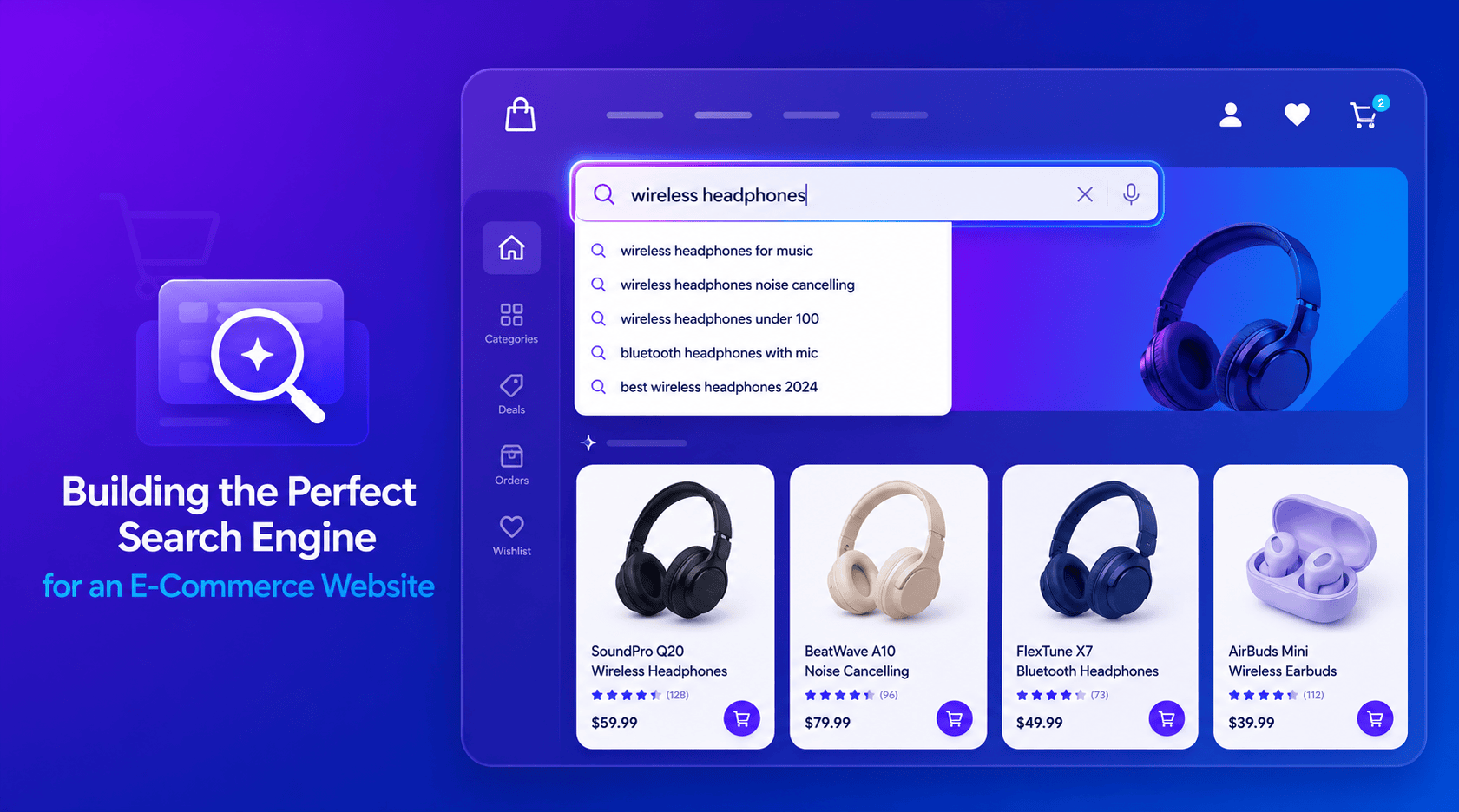
As the shopper types, surface natural-language autocomplete suggestions that go beyond keyword expansion. Instead of "blue → blue dress, blue jeans, blue shirt," surface "blue → blue dress for a cocktail party, blue jacket for hiking, blue running shoes." This teaches users what kinds of queries actually work.

Intent confirmation chips
When the engine parses a complex query into structured intent, surface those parsed components as removable chips above the results: [summer] [beach wedding] [under $200]. This shows the shopper their query was understood, makes refinement frictionless, and recovers control if intent was misinterpreted.
Smart fallbacks instead of zero results
When the engine genuinely can't satisfy every constraint, never return an empty page. Surface the closest matches with an honest message: "No exact matches under $100 — here are similar options between $100–$150." Recovery beats abandonment every time.
Conversational refinement, not modal filters
Modern shoppers refine through conversation, not faceted modals. After initial results, surface refinement prompts inline: "Want to see only the waterproof ones? Cheaper options? Different colors?" Each chip becomes a one-tap refinement that maintains the original intent.
The technology stack underneath
Layer
Technology
Purpose
Voice and conversational interfaces
🎙️
Voice-first Product Discovery
💬
Conversational Query Understanding
Multilingual natural language search
One semantic space for every language
FR
French Queries
veste légère randonnée
US
English Results
lightweight hiking jacket
⚡
Unified Retrieval
Single multilingual pipeline
The conversion data: what natural language search actually delivers
Metric
Typical lift
Why
Common UX mistakes to avoid
Hiding the search bar on mobile
Every percentage point of mobile traffic that uses search converts at 2–3× browse. Don't bury it behind an icon.
Showing too many results per page
24 products is the modern sweet spot. More than 48 induces decision paralysis; fewer than 12 looks sparse.
Removing facets
Conversational refinement supplements facets but doesn't replace them. Power shoppers still want filter controls.
Skipping result explanations
"We found these because you searched for X" — even minimal context lifts trust and CTR.
Tactical tip
Run a search-bar copy A/B test as your first experiment. Changing placeholder text from "Search" to "Try: 'comfortable shoes for travel'" routinely lifts descriptive query volume 30–50%, which is pure incremental conversion lift on top of any backend improvement.
Industry-specific patterns
How to deploy natural language search on your storefront
Step 1: Audit your current search analytics
Pull the last 30 days of search query data. Segment into: head queries (top 100), mid-tail (101–1,000), and long-tail (everything else). Calculate the zero-results rate per segment. Long-tail rates above 15% indicate massive recoverable revenue.
Step 2: Pick your platform path
Build path: 4–9 months, 2–4 engineers, full control. Buy path: under two weeks with AI-native platforms like bCloud, predictable pricing, no engineering team required.
Step 3: A/B test in parallel
Run new natural language search at 50% traffic split alongside existing search. Measure conversion, AOV, search abandonment, zero-results rate. Promote when the lift is statistically significant.
Step 4: Iterate the UX layer
Test placeholder copy, autocomplete behavior, intent chips, refinement prompts. The UX layer often delivers as much lift as the underlying engine upgrade.