
Search Relevance
Tuning Guide
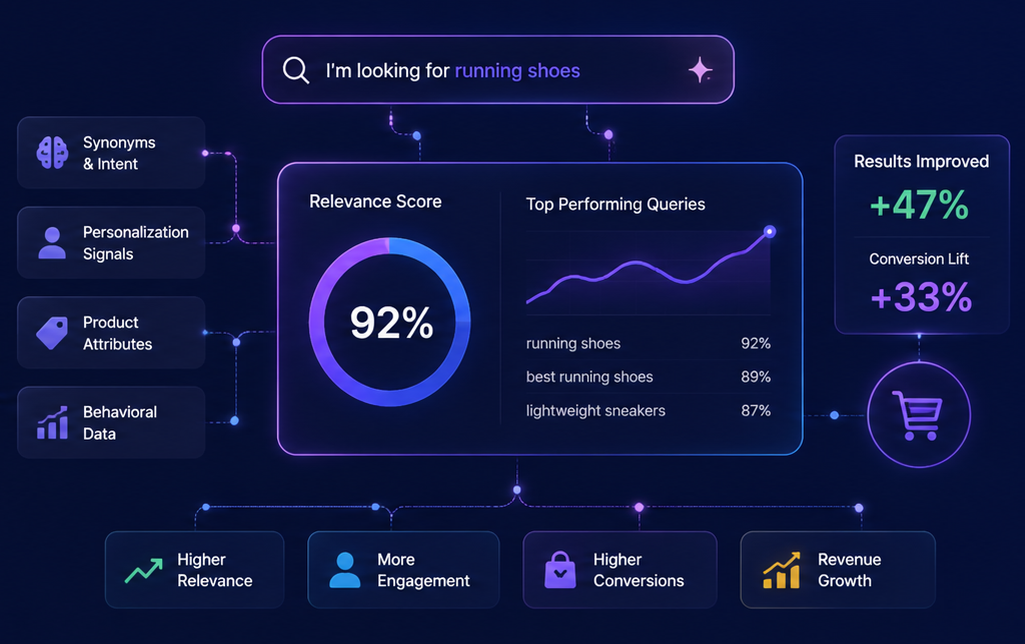
How AI Product Search Works
Ranking Signals
Every relevance engine combines multiple signals into a final score: textual match (TF-IDF or BM25), recency, popularity, inventory status, margin, conversion rate, and increasingly, vector similarity. Effective search relevance tuning starts by deciding which of these signals matter most for your business and how heavily to weight each one.
Synonyms & Expansion
Shoppers don't speak your catalog's language. "Couch" should find sofas, "trainers" should find sneakers, "yoga pants" should find leggings. Synonym dictionaries are the unsexy backbone of search relevance tuning — and the first place legacy platforms fail because the dictionary requires constant manual upkeep.
Boosts, burys, and business rules
Search relevance tuning isn't only about relevance — it's about commercial outcomes. Pin bestsellers to the top, boost high-margin items, push promotional brands during a campaign, and automatically bury out-of-stock products so shoppers don't get frustrated.
Behavioral Signals
Click-through rate, add-to-cart rate, and purchase rate per query are the most important inputs for modern search relevance tuning. A product that gets searched 1,000 times but converts 0.1% should rank lower than one that converts at 4% — even if the textual match is weaker.
The Most Common Relevance Tuning Mistakes
Tuning By Anecdote
One executive typing a single query should never drive ranking decisions. Optimize using aggregate cohort behavior instead of isolated examples.
Ignoring Long-tail Queries
20–40% of ecommerce searches are unique. Focusing only on head queries leaves major revenue opportunities untouched.
Manual Synonym Work
Maintaining synonym dictionaries manually becomes impossible at scale. AI-native systems automate this continuously.
No Measurement Loop
Without CTR, conversion, and zero-results dashboards, relevance tuning becomes guesswork instead of optimization.