

Search Relevance Tuning Guide
How Search Relevance Tuning Works
Ranking Signals
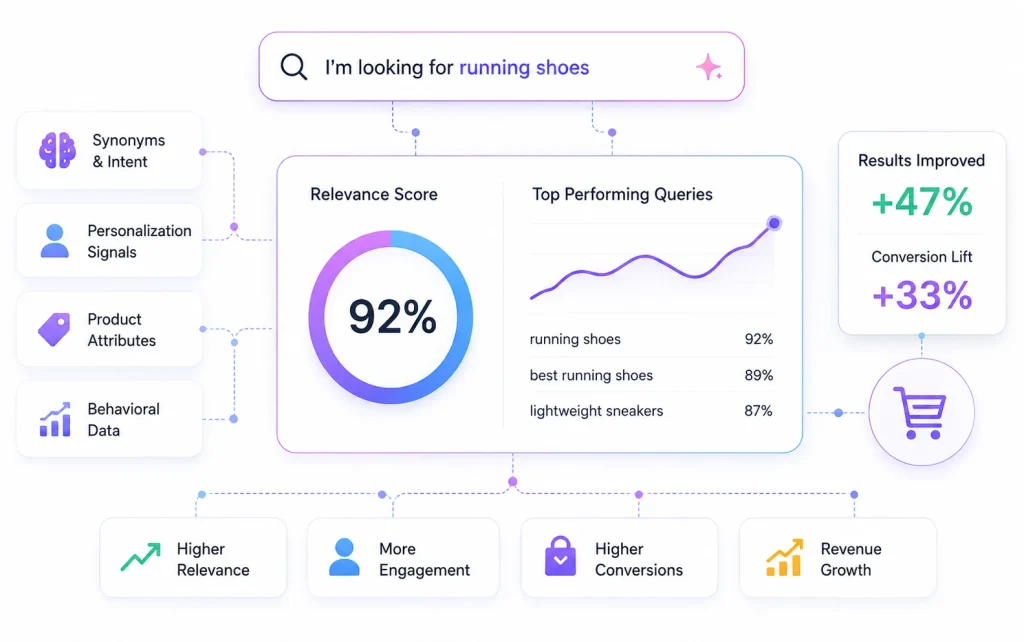
Every relevance engine combines multiple signals into a final score: textual match (TF-IDF or BM25), recency, popularity, inventory status, margin, conversion rate, and increasingly, vector similarity. Effective search relevance tuning starts by deciding which of these signals matter most for your business and how heavily to weight each one.
Synonyms & Expansion
Shoppers don't speak your catalog's language. "Couch" should find sofas, "trainers" should find sneakers, "yoga pants" should find leggings. Synonym dictionaries are the unsexy backbone of search relevance tuning — and the first place legacy platforms fail because the dictionary requires constant manual upkeep.
Behavioral Signals
Click-through rate, add-to-cart rate, and purchase rate per query are the most important inputs for modern search relevance tuning. A product that gets searched 1,000 times but converts 0.1% should rank lower than one that converts at 4% — even if the textual match is weaker.
Boosts, burys, and business rules
Search relevance tuning isn't only about relevance — it's about commercial outcomes. Pin bestsellers to the top, boost high-margin items, push promotional brands during a campaign, and automatically bury out-of-stock products so shoppers don't get frustrated.

How AI Changes Search Relevance Tuning
The Most Common Relevance Tuning Mistakes
Ignoring Long-tail Queries
20–40% of ecommerce searches are unique. Focusing only on head queries leaves major revenue opportunities untouched.
Tuning By Anecdote
One executive typing a single query should never drive ranking decisions. Optimize using aggregate cohort behavior instead of isolated examples.
Manual Synonym Work
Maintaining synonym dictionaries manually becomes impossible at scale. AI-native systems automate this continuously.
No Measurement Loop
Without CTR, conversion, and zero-results dashboards, relevance tuning becomes guesswork instead of optimization.
How bCloud AI Automates Search Relevance Tuning
Catalog Intelligence at Ingestion
When you connect your catalog, bCloud AI doesn't just index it — it enriches it. Product titles, descriptions, attributes, and categories are parsed through a retail-trained language model that builds semantic representations for every SKU. This means relevance starts strong on day one, not after months of manual synonym work.
Real-Time Behavioural Signals
Every shopper interaction is a signal — clicks, add-to-cart events, purchases, scroll depth, and zero-result exits all feed into the ranking model continuously. bCloud AI weights these signals by recency and business outcome, so trending products surface faster and low-performers drop without anyone touching a dashboard.
Automated Zero-Result Recovery
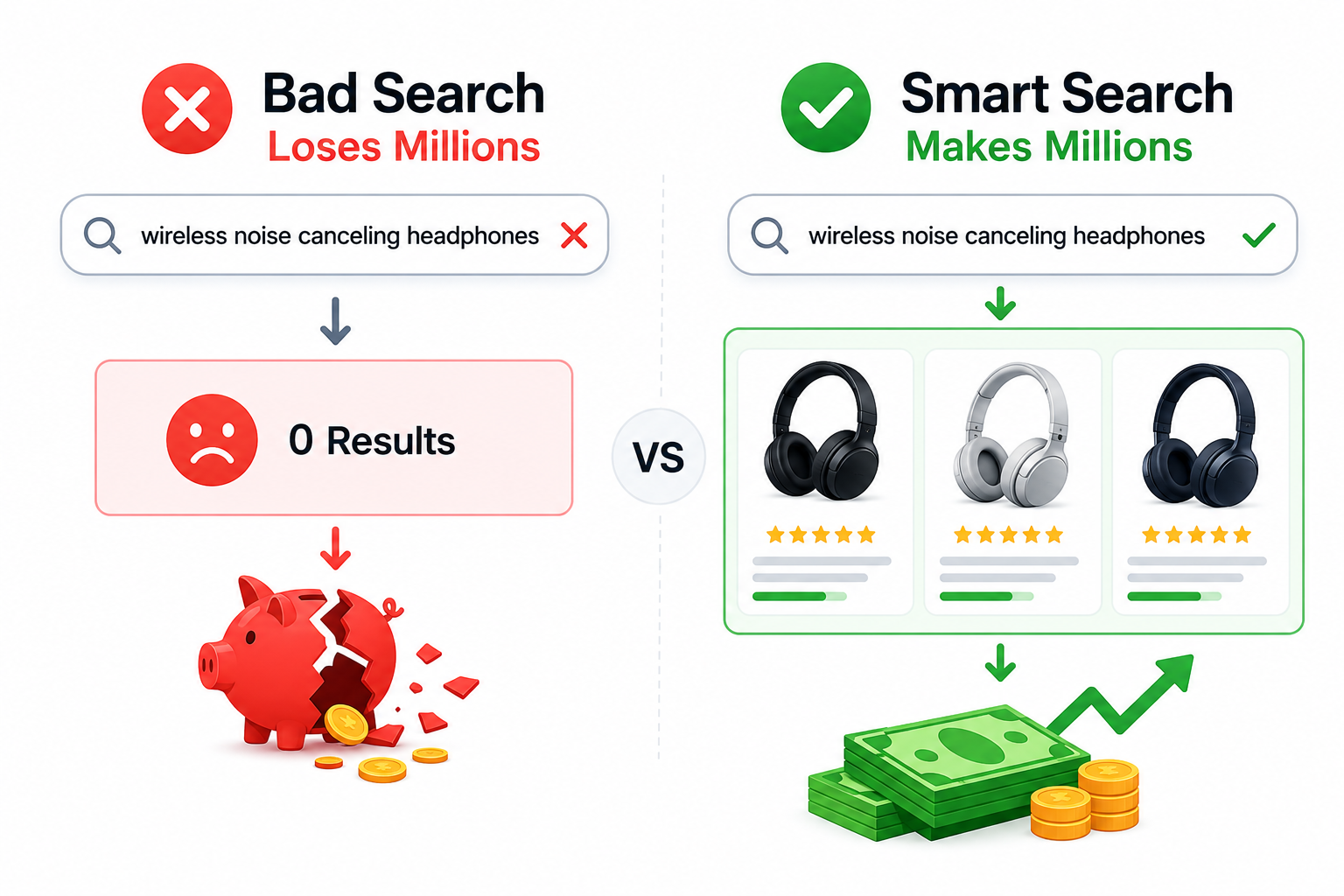
Zero-result queries are the single most damaging relevance failure in ecommerce search. bCloud AI detects them instantly, applies semantic fallback retrieval, and logs them for your team in the analytics dashboard. The result: up to 80% fewer dead-end searches, and a clear list of catalog gaps your buyers are already looking for.
Merchandiser Override Layer
AI sets the baseline — your team sets the strategy. A no-code dashboard lets merchandisers pin products, create synonym rules, boost high-margin SKUs, and bury clearance stock for any query. Changes go live instantly and stack on top of AI relevance, not against it.
⚠ Manual Relevance Tuning
- Synonym lists built by hand — never complete
- Tuning by anecdote, not data
- Zero-result queries undetected for weeks
- No feedback loop — mistakes repeat
- Long-tail queries ignored entirely
✓ bCloud AI
- Synonyms inferred automatically from catalog + queries
- Relevance tuned by real conversion data
- Zero-result queries detected and recovered instantly
- Continuous learning loop — improves week over week
- Long-tail and rare queries handled automatically
80%
−62%
3×
5 days

Related posts

bCloud AI vs Coveo
Coveo sits firmly in the enterprise tier of search and digital experience platforms.
Semantic Search Product Catalog
Semantic search applied to a product catalog.

E-Commerce Search Engine
E-commerce search engine makes all the difference.
Product Search Engine
Intelligent AI search helps customers find products instantly using semantic search.
Ecommerce Site Search Software
If you’ve been searching for an Algolia alternative, you’re not alone.
Vector Search Ecommerce
Vector Search Ecommerce is a retrieval method that converts shopper queries.

Best e-commerce search
The best e-commerce search platform is the one that turns more visitors into buyers.
bCloud AI vs Meilisearch
Compare deployment speed, AI-native capability, infrastructure costs, and search performance.
Zero Results Ecommerce
A zero-results page is the most expensive page on your store. .
E-Commerce Search Advanced
Transform product discovery with AI-powered search experiences designed.
Frequently asked questions
What is search relevance tuning and why does it matter for ecommerce?
What are the most important ranking signals in ecommerce search?
What is a zero-result query and how should I handle it?
How does AI improve search relevance tuning compared to manual rules?
How does bCloud AI handle synonym and spelling variation automatically?
Can I still apply manual merchandising rules on top of AI relevance?
How do I measure whether my relevance tuning is working?
What are the most common search relevance tuning mistakes?