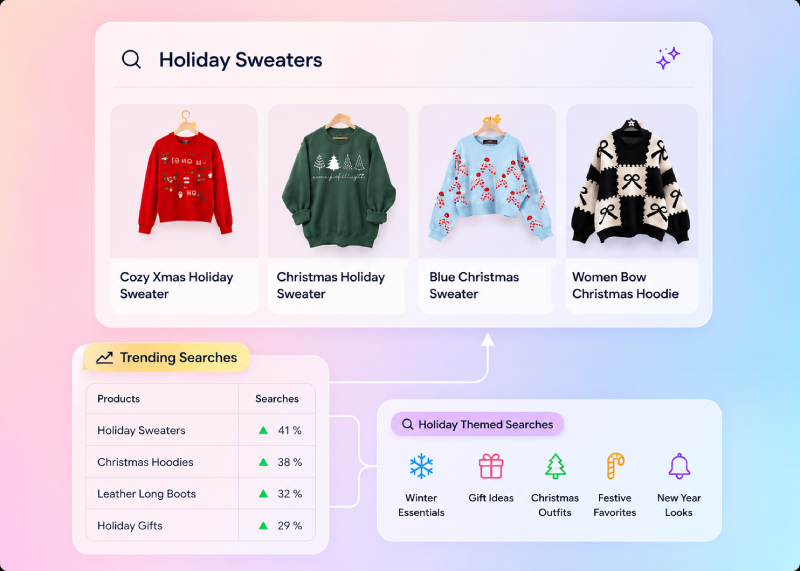
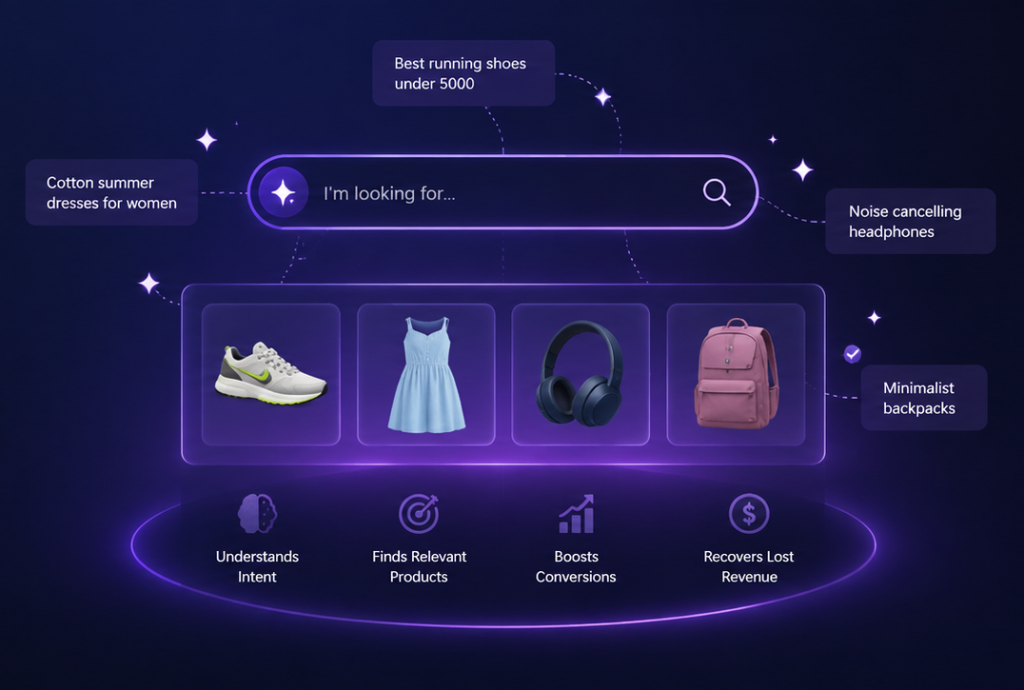
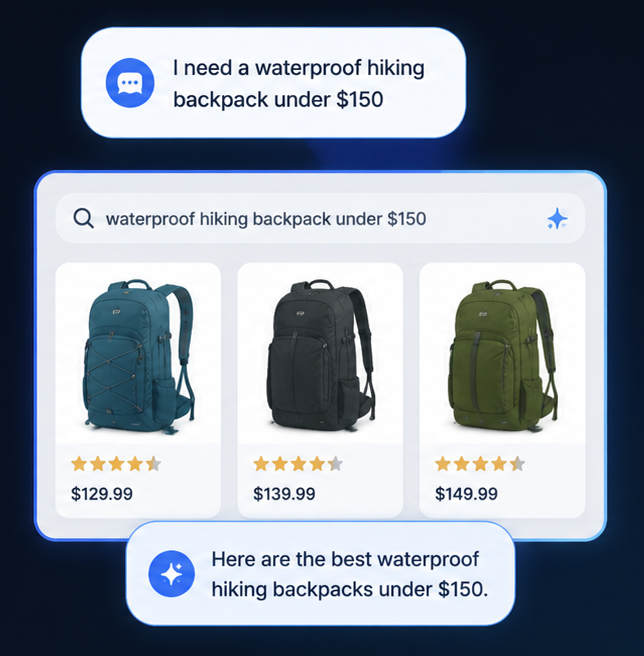
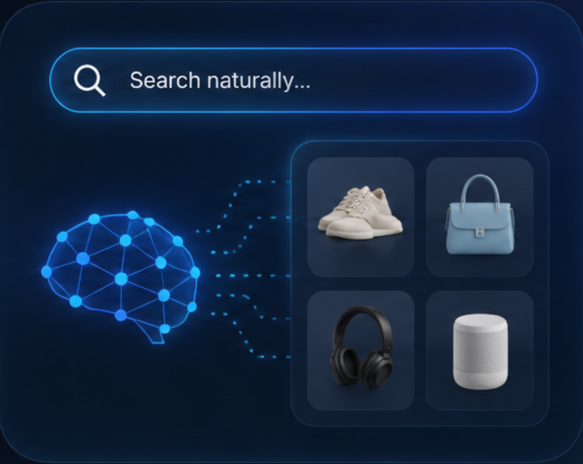
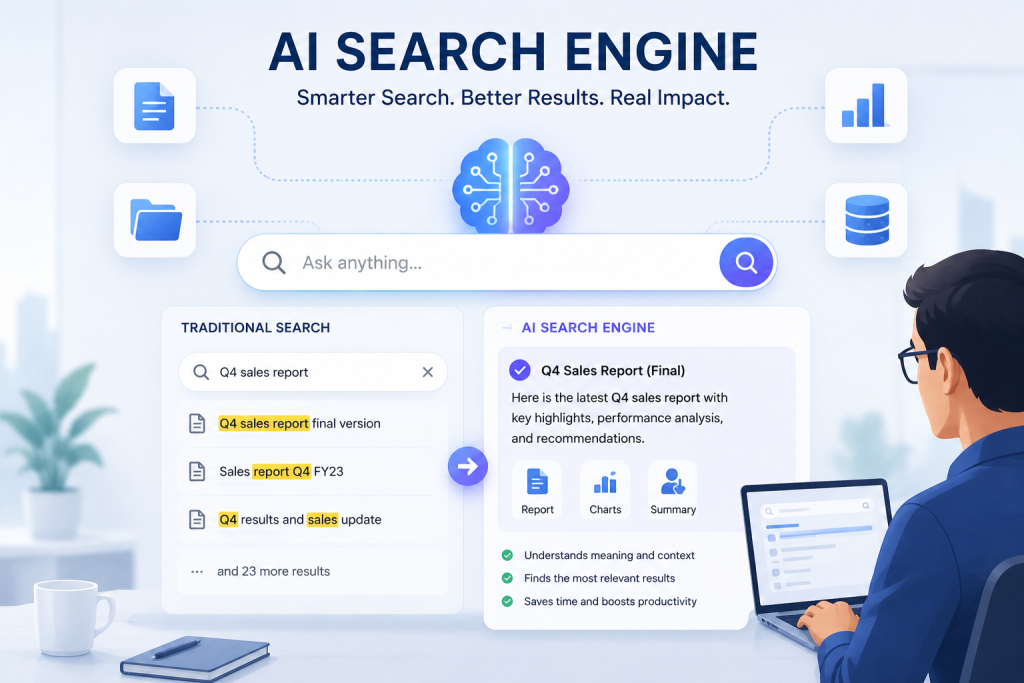
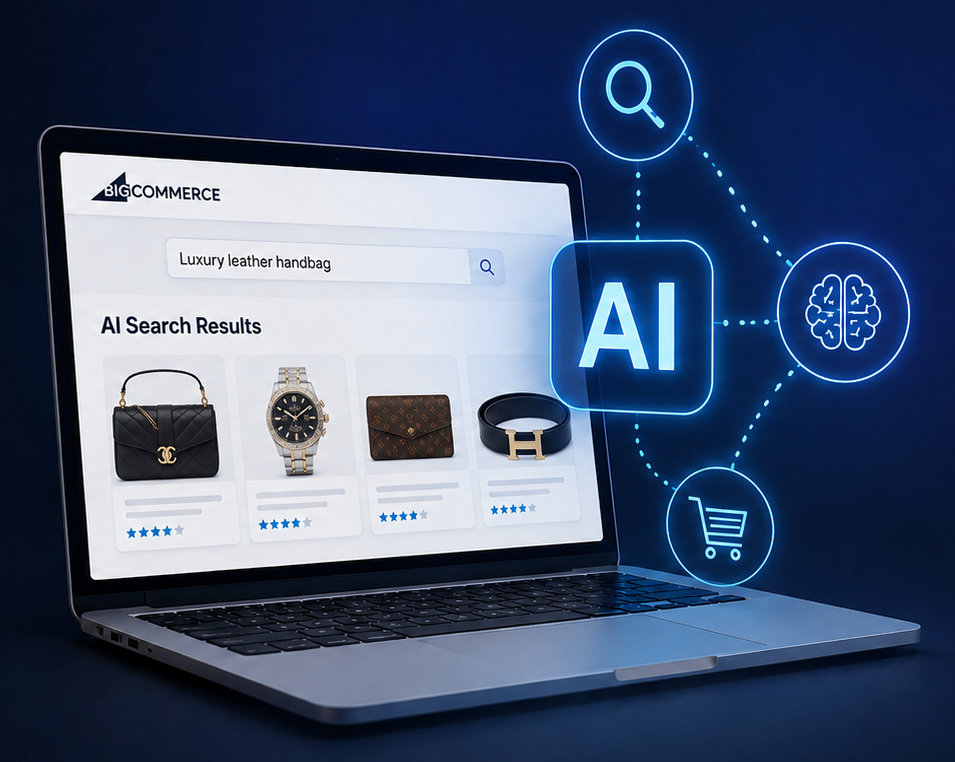
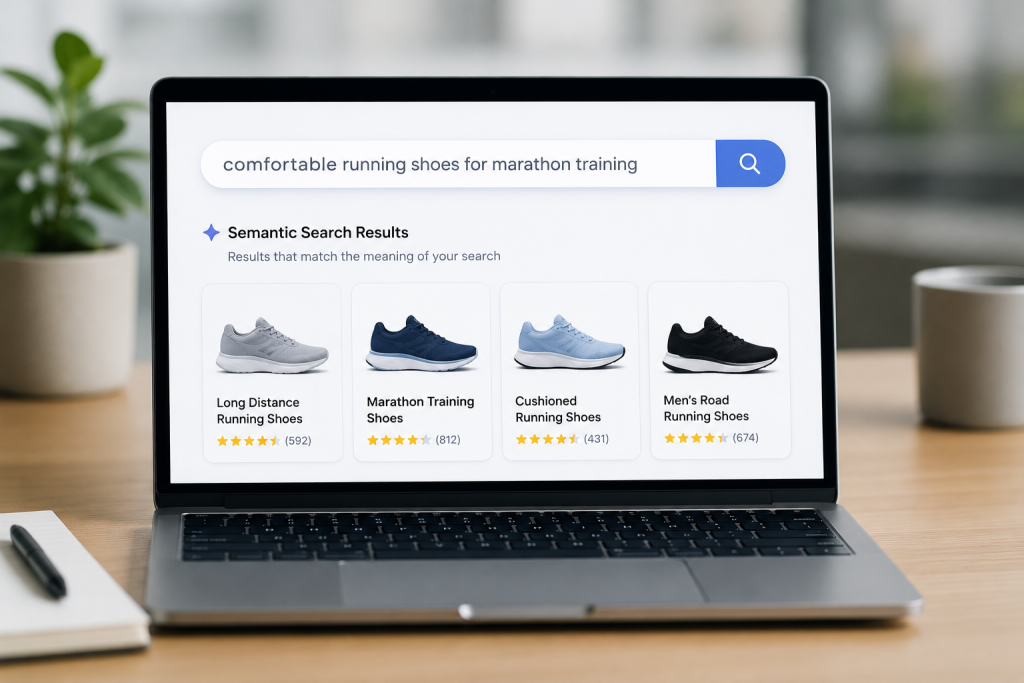
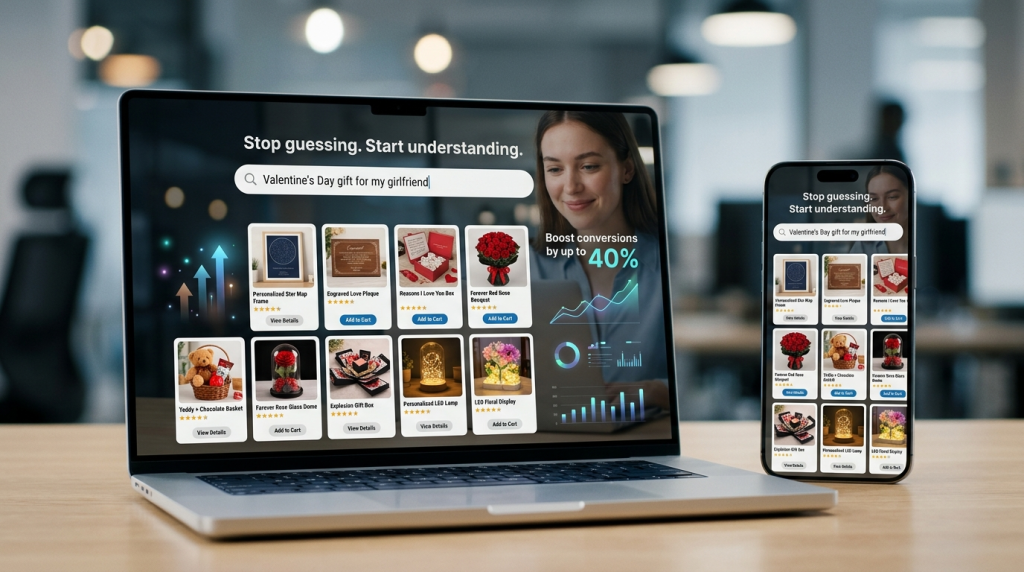
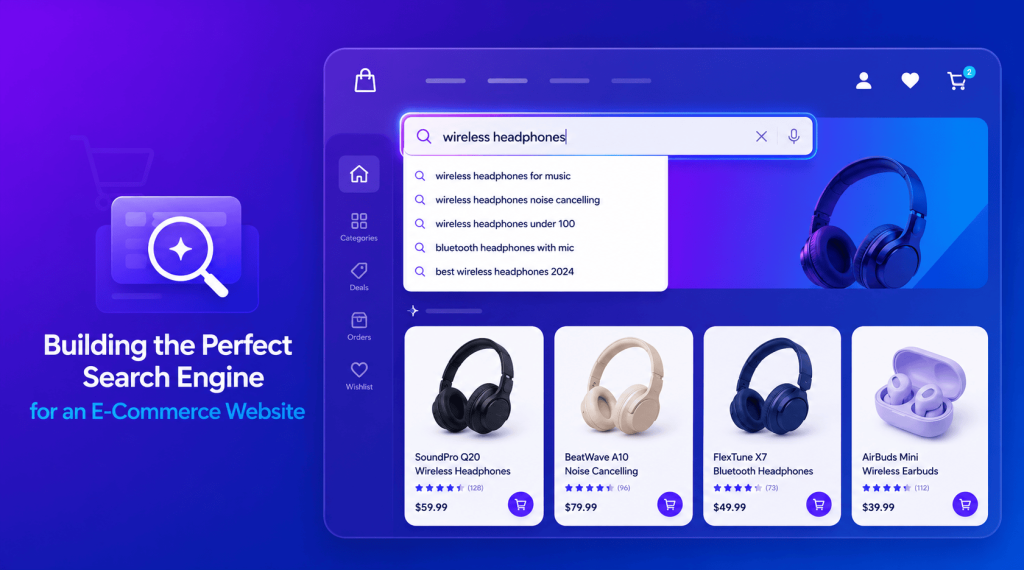
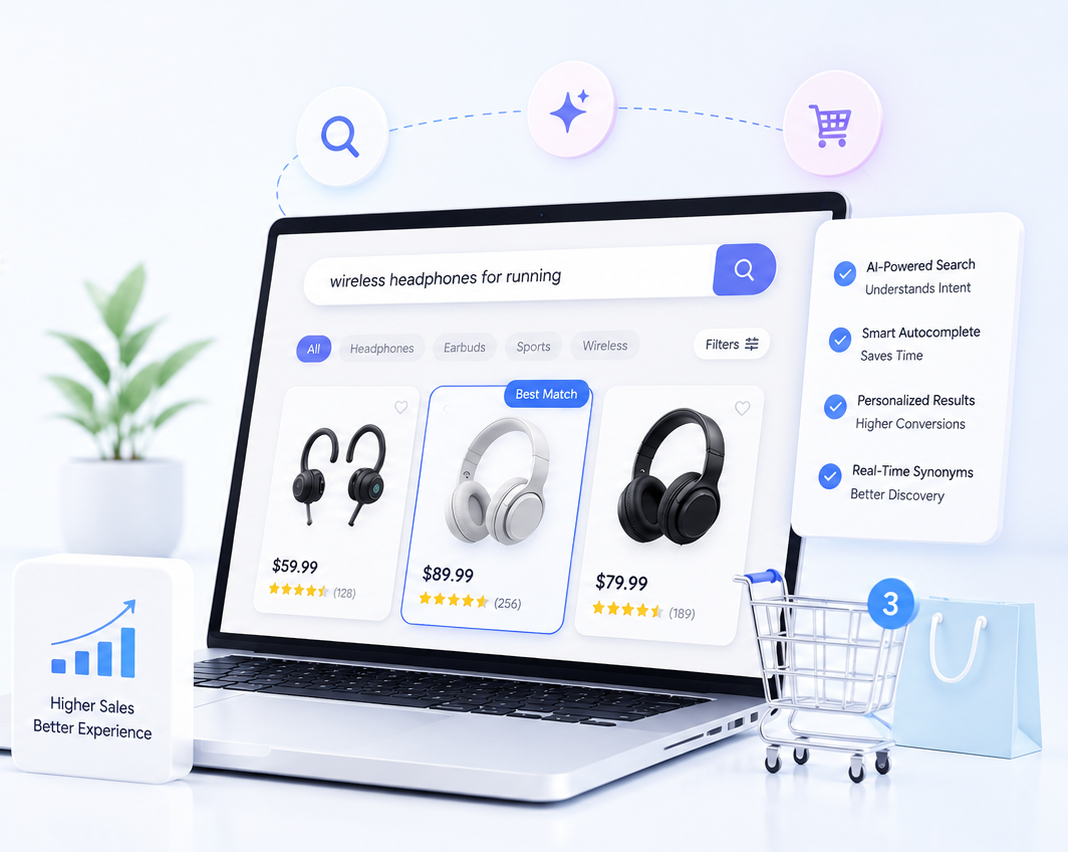
AI Product Search understands shopper intent instead of relying on exact keywords — helping ecommerce brands recover lost traffic, improve relevance, and increase conversion rates by 30–50%.
Clickstream and purchase behavior continuously retrain the ranking engine so every interaction improves future search performance.
Hybrid Retrieval
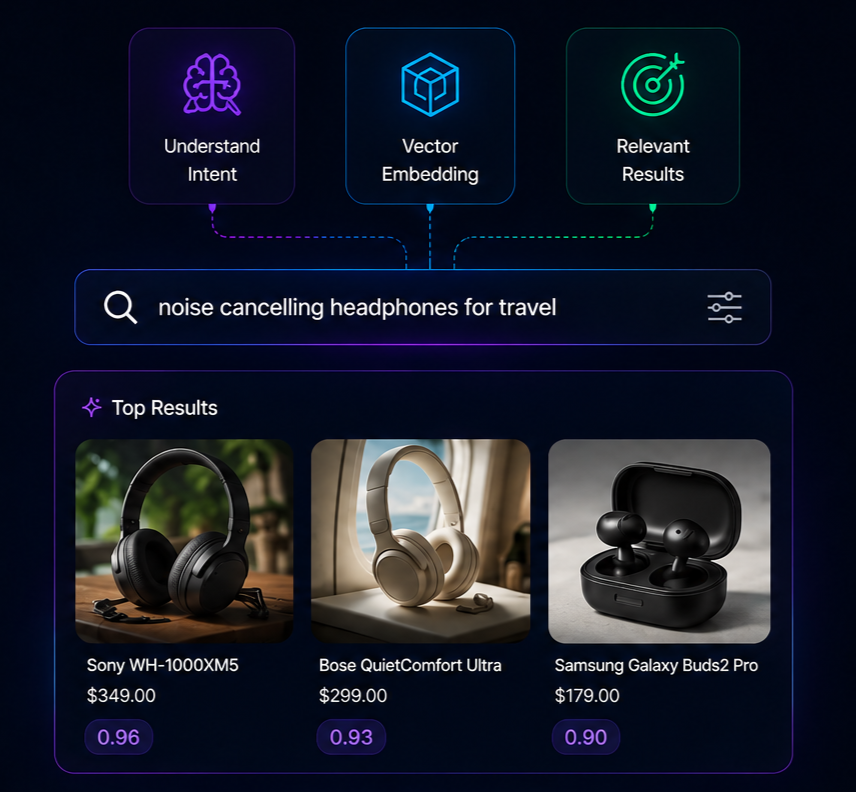
AI combines keyword precision with vector similarity scoring. This hybrid approach dramatically improves relevance while preserving exact-match accuracy.
What AI Search
Looks Like In Practice
Result
Cosine similarity
Why it matched
Linen Maxi Dress
0.94
Vacation apparel cluster, warm-weather, casual
Leather Sandals
0.91
Beach footwear vector neighborhood
Cotton Beach Coverup
0.88
“Beach” exact + cover-up category
Straw Sun Hat
0.85
Vacation accessory cluster
Why AI Product
Search Converts Better
Recovers Long-Tail Queries
20–40% of ecommerce searches are unique. AI search understands intent-driven queries that traditional keyword engines completely miss.
Fixes Typos & Synonyms
“Watter bottle” still returns water bottles. “Trainers” maps to sneakers. AI search automatically resolves linguistic variations.
Understands Shopper Context
Queries like “gift for my sister” trigger intent-aware recommendations rather than literal keyword matching.
Improves Over Time
Behavioral ranking continuously optimizes relevance using clicks, purchases, and engagement data.
How to pick the right
ecommerce site search software
Hybrid Retrieval
Ensure the platform supports both keyword and semantic vector retrieval simultaneously.
Fast Latency
Cached queries should consistently stay below 200ms to maintain strong UX and conversion.
Commerce Integration
Look for plug-and-play support for Shopify, Magento, WooCommerce, and custom storefronts.
Merchandising Tools
Non-technical teams should be able to manage synonyms, boosts, and ranking rules visually.
Avoid platforms that aggressively charge per request or per indexed record at scale.
Scalable Infrastructure
Your AI search stack should scale seamlessly with increasing catalog size and traffic growth.
Why bCloud AI Powers
Smarter Product Search
bCloud AI is built from the ground up for retail and grocery — combining deep catalog intelligence with real-time shopper signals to surface exactly what buyers want, every time.
Intent-Aware Search Engine
Goes beyond keyword matching — bCloud AI reads shopper intent, detects context, and ranks results the way a knowledgeable store associate would.
01
02
Grocery & Retail Native
Designed specifically for grocery and retail catalogs — understands pack sizes, dietary tags, brand variants, and category hierarchies out of the box.
Sub-100ms Response Time
Lightning-fast results even at high catalog volumes. bCloud AI is optimised for speed so shoppers never wait — reducing bounce and boosting add-to-cart rates.
03
04
Learns From Every Session
Continuously improves ranking models based on real shopper behaviour — clicks, purchases, and zero-result queries all feed back into the engine automatically.
Platform-Agnostic Integration
Works with Shopify, WooCommerce, Magento, BigCommerce, and custom stacks. Plug in via REST API or pre-built widgets — live in days, not months.
05
06
Search Analytics Dashboard
Real-time visibility into zero-result queries, top search terms, and conversion by keyword — so merchandisers can act on data, not guesswork.
What AI Search
Looks Like In Practice
Capability
Traditional Search
bCloud AI
Understands intent & synonyms
✗ No
✓ Yes
Handles typos & misspellings
⚠ Limited
✓ Yes
Learns from shopper behaviour
✗ No
✓ Yes
Personalised results per shopper
✗ No
✓ Yes
Zero-result query reduction
⚠ High failure rate
✓ Up to 80% fewer
Conversion rate uplift
Baseline
✓ +15–30%
+27%
Average conversion uplift
80%
Fewer zero-result searches
<100ms
Median search response time
3 days
Typical time to go live
Ready to ship AI product search? Start with our practical guide to search relevance tuning for the day-one playbook on synonyms, boosts, and behavioral signals. Teams currently bleeding traffic on zero results e-commerce pages typically see the fastest payoff. To pick the right vendor, see our roundup of ecommerce site search software and editorial pick of the best e-commerce search tools. Comparing hosted vs self-managed approaches? The Algolia vs Elasticsearch deep-dive covers the trade-offs.
E-commerce search engine makes all the difference between a sale and an abandoned cart.
Frequently asked
questions
Everything you need to know about AI product search and bCloud AI.
Traditional site search matches exact keywords — so “low fat yoghurt” and “yogurt low-fat” might return completely different results. AI product search uses natural language processing and semantic understanding to grasp what the shopper actually means, matching intent rather than just words. This eliminates missed results from typos, synonyms, or varied phrasing.
How does bCloud AI handle large grocery catalogs with thousands of SKUs?
bCloud AI is optimised for high-SKU retail environments. It indexes your full catalog using vector embeddings — a mathematical representation of each product’s meaning — enabling instant semantic retrieval even across 100,000+ products. Catalog updates sync in real time, so new arrivals, price changes, and out-of-stock items are always reflected immediately.
How long does it take to integrate bCloud AI into my existing store?
Most stores go live within 3–7 business days. bCloud AI provides pre-built plugins for Shopify, WooCommerce, Magento, and BigCommerce, plus a REST API for custom platforms. Our onboarding team handles catalog ingestion and initial configuration — your developers typically need less than a day of effort.
Does bCloud AI support multilingual search?
Yes. bCloud AI supports multilingual and cross-lingual search out of the box. Shoppers can search in their preferred language and still surface relevant results, even when product descriptions are in a different language. We currently support 30+ languages commonly used in grocery and retail markets.
Can I control which products rank higher in search results?
Absolutely. bCloud AI gives merchandisers full control through a no-code dashboard. You can pin specific products to the top for certain queries, boost high-margin items, bury out-of-season products, and create custom ranking rules — all without touching any code. AI handles the baseline relevance; you handle the business logic.
How does bCloud AI improve conversion rates?
Conversion improves because shoppers find what they want faster. bCloud AI reduces zero-result searches by up to 80%, ensures relevant results for vague or long-tail queries, and surfaces personalised suggestions based on browsing history. Collectively, customers report an average 15–30% uplift in search-driven conversions after switching.
Is bCloud AI suitable for small retailers, or only enterprise?
bCloud AI is designed to scale in both directions. We offer plans that work for independent grocery stores with a few hundred products, all the way through to multi-banner retail chains managing millions of SKUs across dozens of sites. Pricing is usage-based, so smaller retailers pay only for what they use.
What kind of support and SLA does bCloud AI offer?
All plans include email and chat support. Growth and Enterprise plans include a dedicated success manager, 99.9% uptime SLA, and priority response times. We also provide a comprehensive developer documentation portal, onboarding guides, and a community Slack channel for technical teams.
AI Product Search That Understands Shopper Intent
Deliver highly relevant product results with AI-powered search that understands natural language, context, synonyms, and buying intent across your entire catalog.